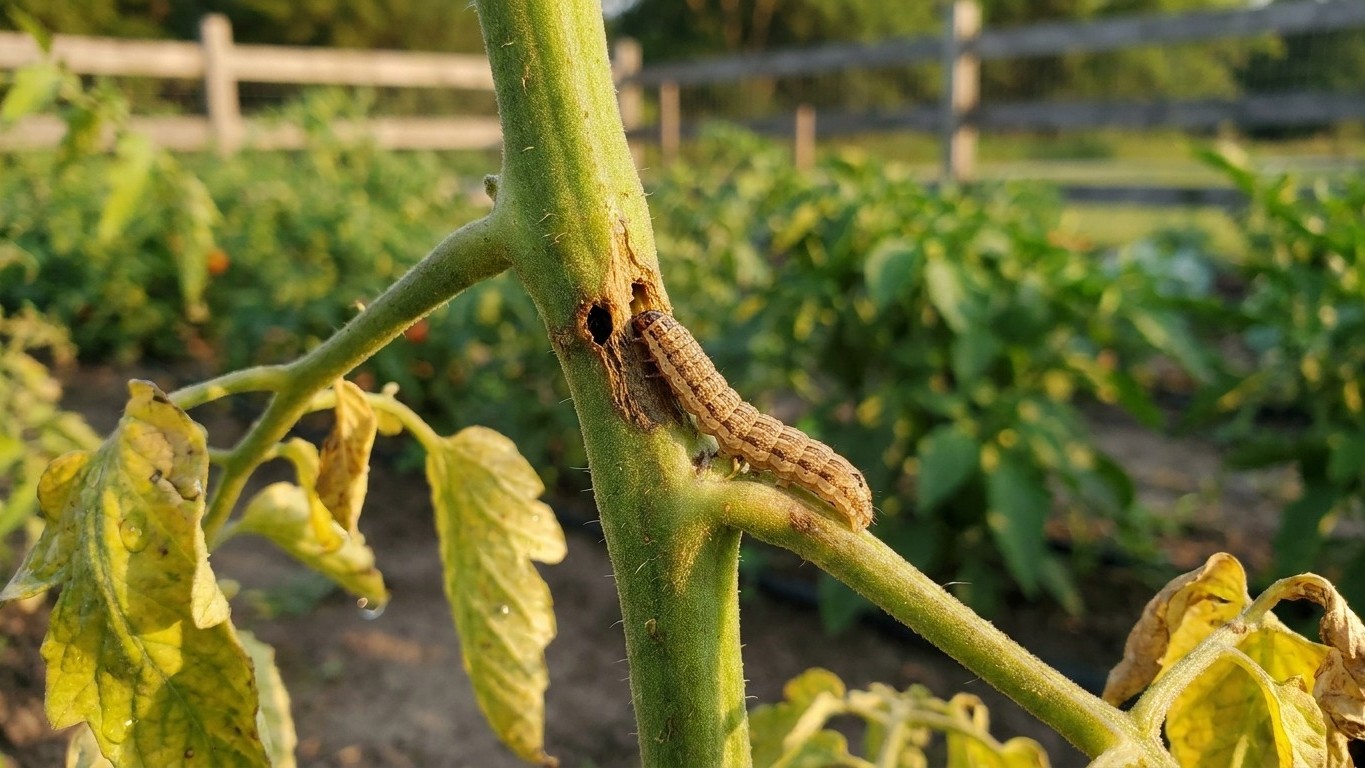

Common stalk borer shows up in Iowa gardens in two waves within a single generation: young larvae crawl out of roadside grasses and weedy fence rows in May, then bore into corn, tomato, and pepper stems as those stems thicken from mid to late June. Nothing stops an established larva once it’s inside a stem, so timing, not spraying, is what actually works.
The weeks to watch

Larvae move into larger garden stems mid to late June, according to Iowa State University Extension’s own seasonal notes for this pest. That’s the window worth marking on a calendar, because it’s the point where a plant that looked fine last week suddenly wilts from the top down.
Before the move: small larvae in grass and weeds
Common stalk borer eggs overwinter on grass stems near the soil line in ditches, fence rows, and weedy field edges. When they hatch in spring, the young larvae feed inside grass stems first, not garden plants. This early stage doesn’t show up on a home gardener’s radar because it’s happening in the weeds along the property line, not in the vegetable bed.
Mid to late June: the move into garden stems
As grass stems get crowded or dry up, the larvae leave and crawl toward whatever green stem is nearby, corn, tomato, pepper, potato. This is the window Iowa State University Extension names directly, and it’s the point where a garden that had no visible pest activity in early June can show wilted plants two weeks later. Iowa’s broader garden pest season runs May through September with the heaviest activity mid-June through August, but for this particular insect, the mid-to-late-June migration is the specific event to watch, not the general summer stretch.
Reading the calendar from your last frost

Common stalk borer answers to soil and stem conditions, not a fixed date on the wall, so a warm spring speeds up the whole sequence and a cold one delays it. NOAA’s 1991-2020 climate normals put Iowa’s last spring frost between April 12 and April 24, and that’s the anchor point most gardeners already use for transplanting tomatoes and peppers.
- Start from your own last frost date, somewhere in the April 12 to April 24 window (a normal, not a guarantee, since Iowa State Extension’s longer county records run about four days later in spring than this airport-based figure).
- Add roughly eight to nine weeks. That lands in mid-to-late June, matching the window Iowa State University Extension gives for larvae moving into larger stems.
That arithmetic matters for row covers. A cover put on right after transplanting protects young stems during the May migration period, when larvae are still small and crawling in search of a stem to enter. But a cover left on into late June does nothing once a larva has already tunneled in, since it’s now feeding inside tissue the cover was never meant to reach.
What it attacks, and what the damage looks like

Most gardeners notice a single wilted leaf or a whole shoot flopping over before they ever see the insect responsible. Look closer and there’s often a small entry hole low on the stem with a bit of sawdust-like frass pushed out around it, sometimes accompanied by a stem that snaps or leans at the damaged point. In corn, this shows up as a wilted, dying center whorl known as dead heart. The larva does all of the damage, boring through the stem’s interior as it feeds and grows, which is exactly why anything applied to the outside of the plant after that point has nothing to work against.
- Corn
- Tomatoes
- Peppers
- Potatoes
- Beans
- Squash and other cucurbits
- Grasses and broadleaf weeds such as giant ragweed and foxtail, where the insect starts out before moving to garden crops
How Iowa sits in this pest’s range

This site currently documents common stalk borer in one territory, Iowa, so there’s no neighboring state’s guidance published here yet to compare timing against. That makes Iowa the reference point for now rather than one data point among several. The mid-to-late-June migration window described above comes directly from Iowa State University Extension, and it’s specific to conditions here, soil warming pace, grass and weed growth along field edges, and the general spring pattern tied to that April 12-24 frost range.
As more territories get added to this site, the differences between them are likely to show up as shifted timing tied to each region’s own spring warm-up, rather than the insect simply being present in one place and absent in another, since its life cycle depends on grasses and weeds that grow across a wide swath of the temperate Midwest. For now, though, Iowa stands alone in what this site has published, and any comparison beyond that would be guessing.
What actually works against it

- Mow or clear grassy weeds along fence rows and field edges in fall. Eggs overwinter on grass stems near the soil line, so removing that grass before winter cuts down on where next spring’s larvae will hatch. This is close to free and it’s the single most effective long-term step available to a home gardener.
- Delay or manage spring mowing near the garden with the migration window in mind. Cutting weedy borders too early can push larvae toward garden plants faster than they’d otherwise move; leaving grass intact until after the May migration period, then clearing it, keeps larvae from having anywhere new to go.
- Rotate susceptible crops away from grassy borders where past infestations were found, since larvae travel a limited distance from where they hatch.
- Use row covers on young transplants through May and into early June, when larvae are still small and crawling in search of a stem. Remove them once plants need pollination or once the mid-to-late-June window arrives, since a cover left on past that point isn’t protecting against anything a larva already inside a stem can be stopped by.
- Check wilting stems early and slit them lengthwise near the entry hole to find and remove the larva by hand, while it’s still close to where it entered. This works only in the first days after a plant shows wilting; once the larva has fed its way deeper into the stem, cutting the plant back to remove the damaged section and destroying it is the only step left, since nothing reaches an insect that far inside plant tissue.
Common questions
Does common stalk borer only affect corn?
No. Iowa State University Extension’s notes cover it moving into a range of garden stems, including tomatoes, peppers, and potatoes, in addition to corn, along with the grasses and weeds where it starts out each spring.
Can row covers stop it once the season starts?
Only during the May migration window, while larvae are still small and moving between plants on the ground. Once a larva has bored into a stem, typically mid to late June, a cover on top of the plant no longer has any effect on it.
What does the damage look like if I don’t see the larva itself?
Look for a single wilted leaf or shoot, a small hole near the base of the stem with sawdust-like frass around it, and in corn, a wilted, dying center whorl. The insect is almost always hidden inside the stem by the time symptoms show.