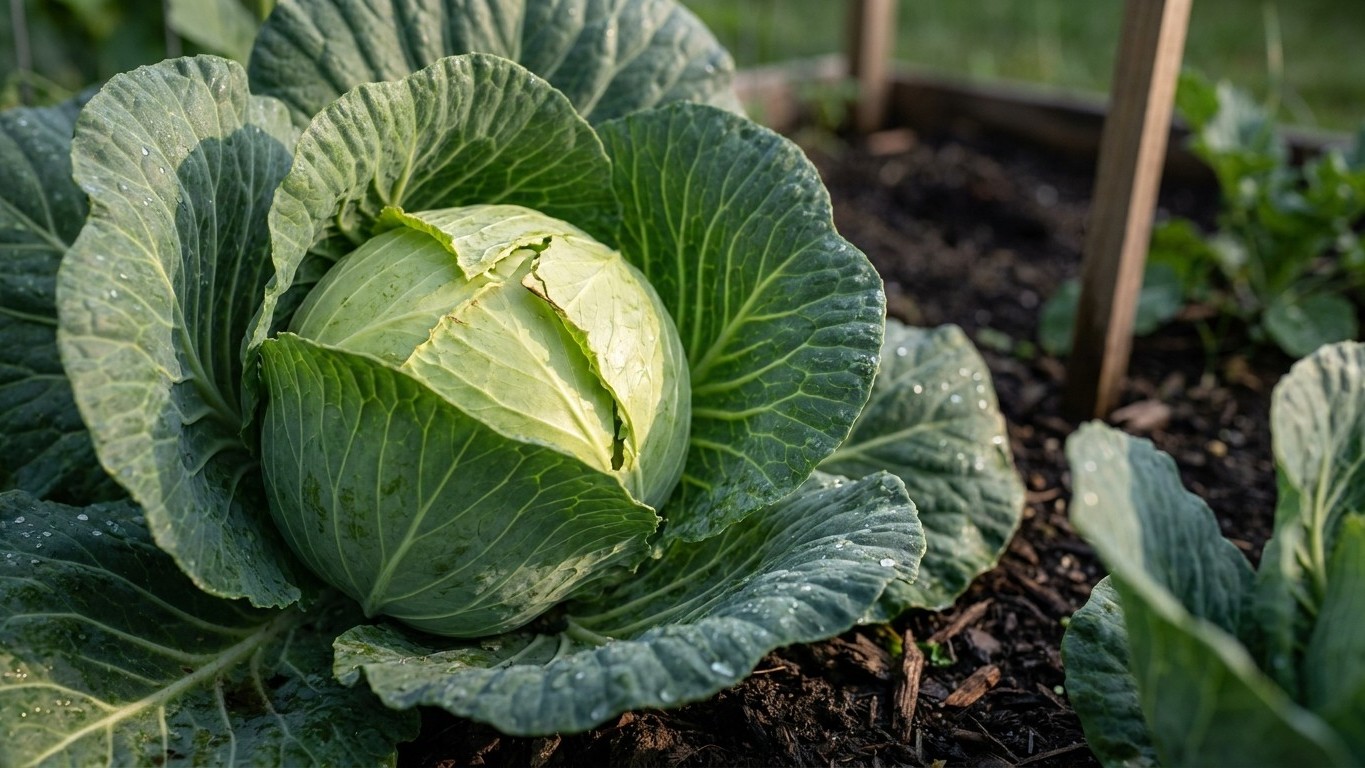

The head holds when water moves into it at a steady pace, not in a rush after a dry spell. Utah State University Extension, in its guide Cabbage in the Garden, points to moisture fluctuation during heading as the direct cause of splitting. The plant isn’t short on water most of the time. It’s the sudden surge, after the soil dries out and then gets soaked, that the head can’t absorb fast enough.
The short answer
Yes, water timing decides whether a cabbage head stays intact or cracks open, and Utah State University Extension states it without hedging: “Moisture fluctuations during heading will cause maturing heads to split open.” That single sentence explains more crop failures in home gardens than any pest or disease on this list. A head that looked perfect on Tuesday can split by the weekend if a heavy rain follows two weeks of drought stress, because the roots suddenly have abundant water to push upward into tissue that’s already packed tight.
Nitrogen timing plays a supporting role. The Extension guide is specific here too: “Avoid applying additional nitrogen after heads begin to form. High nitrogen levels at this time cause loose heads and splitting to occur.” So the two levers a gardener actually controls, once the head starts forming, are watering rhythm and fertilizer restraint. Neither is complicated, but both require attention at the exact stage when it’s tempting to feed the plant harder to push size.
Harvest timing is the other half of this answer. The guide recommends harvesting cabbage “when the heads reach full size and are firm and compact,” which means before splitting starts, not after. A head sitting in the garden past that point isn’t gaining anything; it’s just accumulating risk with every rain event. Once cut, expect a working range for storage: cabbage keeps for 2 to 6 months at 32 degrees Fahrenheit and 95 percent relative humidity, a spread wide enough that variety, curing, and handling all matter.
Yield expectations round out the short answer. A well-grown row produces 10 to 15 pounds per 10 feet of row, and the Extension guide suggests planting 3 to 4 cabbages per person for fresh eating, plus another 5 to 10 plants per person if storage is the goal. Water management isn’t a footnote to that yield number. It’s the difference between heads that make it to the kitchen intact and heads that split in the row and get tossed.
What actually decides it
Three separate mechanisms drive the outcomes gardeners actually see: splitting, tipburn, and heat damage. Each one traces back to something moving, or failing to move, inside the plant, not to a simple shortage in the soil.
Splitting: a transport surge, not a moisture problem
A cabbage head is a tightly wrapped bundle of leaf tissue with very little room to expand. When soil moisture swings from dry to wet, roots that were barely pulling water suddenly pull a lot of it, and that water gets pushed into the head faster than the outer leaves can stretch to contain it. The head splits from the inside pressure, not from rot or disease. This is why the Extension guide’s fix for a head that’s about to split isn’t a chemical or a fertilizer adjustment. It’s physical: “Pull the cabbage head up out of the soil in order to break some of the side roots. This will stop excess water from being transported into the head, which causes splitting.” Fewer functioning roots means less water reaching a head that’s already full. It’s a blunt intervention, but it targets the actual mechanism instead of a symptom.
Tipburn: not a calcium shortage
Tipburn looks like a nutrient deficiency, brown scorched edges on the inner leaves, and the instinct is to add calcium. Utah State University Extension corrects that assumption directly: “Most soils in Utah are very high in calcium so plants have access to plenty of this nutrient. However, when plants go through irregular growth periods, calcium is not adequately transported to these younger, inner leaves and this causes the leaf edges to ‘burn’ or turn brown.” The calcium is sitting in the soil the whole time. The problem is delivery, not supply, and it happens specifically during irregular growth spurts, the same stop-start pattern that causes splitting. The outer leaves look flawless right up until the head is cut open and the damage inside is visible. Adding more calcium to soil that already has plenty does nothing for a transport failure.
Heat: the real enemy, not cold
Cabbage tolerance runs lopsided. The guide states plainly: “Cabbage grows best when temperatures do not exceed 80 F and is not seriously damaged by temperatures down to 25 F.” That’s a 55-degree cushion on the cold side and essentially none above 80. Heat “reduce[s] growth, decrease[s] quality, and may cause internal tipburn to form,” linking directly back to the transport problem above. A hot stretch stresses the plant into the same irregular growth that starves inner leaves of calcium delivery.
How to do it
- Sow seed indoors, timed backward from your last frost date. Transplants need 6 to 7 weeks to reach 4 to 6 mature leaves with a well-developed root system, and they go into the ground 2 to 3 weeks before your area’s last frost date. Add those two spans together, 6 to 7 weeks plus 2 to 3 weeks, and the seed tray needs to start roughly nine weeks before your last frost date. Count back nine weeks on your own calendar from that date to find your sowing day.
- Plant seed 1/4 to 1/2 inch deep, whether starting indoors or direct-seeding outdoors at the same window as transplants.
- Thin seedlings once they reach 3 to 4 true leaves, giving remaining plants room to develop full root systems before the heat of the season arrives.
- Transplant 2 to 3 weeks before the last frost free date for your growing area. Cabbage goes out ahead of frost, the same pattern as broccoli, not after it like a tomato.
- For a fall crop, count forward from your first fall frost instead. The target maturity date should land about 1 to 2 weeks after that first fall frost, then count back 50 to 75 days from that maturity target to find your planting date.
- Choose a variety that matches the days-to-maturity window you calculated. The table below lists four cultivars the Extension guide names alongside their maturity timelines.
- Apply organic mulch once soil temperatures push above 80 F, cooling the root zone during the stretch when heat does the most damage to quality.
- Keep irrigation uniform once heads begin forming, avoiding the dry-then-soak pattern that drives splitting and tipburn alike.
- Stop nitrogen applications once heads begin to form. Continued feeding at this stage produces loose heads and splitting.
- Pull the head upward to break side roots if a head looks ready to split before you can harvest it, cutting off the excess water supply feeding the pressure.
- Harvest once heads are firm and compact, cutting the stem below the head and leaving 2 to 3 wrapper leaves for protection during handling and storage.
| Cultivar | Days to maturity |
|---|---|
| Ruby Ball | 55 |
| Golden Acre | 65 |
| Savoy Ace | 80 |
| Danish Ball Head | 100 |
What goes wrong
- Heads split in the row. Caused by a dry-then-wet moisture swing during heading. If a head is nearly ready and rain is coming, pull it upward to break some side roots and cut the water supply feeding the pressure.
- Inner leaves show brown, burned edges after cutting. This is tipburn from a calcium transport failure during irregular growth, not a soil shortage, since Utah soils typically run high in calcium already. Uniform irrigation, moderate fertilizer additions, and mulch reduce the irregular growth spurts that cause it.
- Heads stay loose instead of tightening up. Usually traced to nitrogen applied after heading began. Stop feeding once heads start to form; additional nitrogen at that stage produces looseness and splitting together.
- Quality drops during a hot stretch. Temperatures above 80 F reduce growth and decrease quality, and can trigger internal tipburn. Organic mulch applied when temperatures climb above 80 F cools the soil and eases the stress.
- Leaves show sooty black spots arranged in concentric circles. This is Alternaria leaf spot. Overhead irrigation spreads it; switching to soil-level watering and rotating cabbage out of the same bed the following season are the listed responses.
- Something is hiding inside the head itself. Cabbage worms and loopers tuck into the folded leaves of the head, often unnoticed until harvest.
- Seedlings disappear or thin out early. Flea beetles can reduce plant stands or kill seedlings outright, making early-season monitoring worthwhile before plants establish.
- Leaves look crinkled and distorted. Aphids cause this crinkling, typically visible on the undersides and new growth.
Common questions
How long does cabbage keep in storage?
Cabbage stores for 2 to 6 months at 32 degrees Fahrenheit and 95 percent relative humidity, according to Utah State University Extension. The range depends heavily on the variety and how carefully the head was handled before storage.
Can cabbage be stored near apples or pears?
No. The Extension guide specifically warns against storing cabbage with apples, pears, or other ethylene-producing fruits, since bitter flavors develop as a result. Many home root cellars and even refrigerator drawers put these items closer together than that rule allows.
How cold can cabbage tolerate before it’s damaged?
Cabbage isn’t seriously damaged by temperatures down to 25 degrees Fahrenheit, but growth suffers once temperatures exceed 80 degrees Fahrenheit. That 55-degree gap toward the cold side, with essentially no cushion on the hot side, is the defining feature of this crop’s temperature tolerance.
How many cabbage plants should I grow per person?
Utah State University Extension recommends 3 to 4 plants per person for fresh eating, plus an additional 5 to 10 plants per person if some of the harvest is meant for storage through the following months.