
Cabbage looper caterpillars show up in Texas gardens as soon as spring temperatures climb into the 70s, and thanks to the state’s mild winters, they can linger from late winter through the first hard freeze. There’s no single arrival date. Instead, timing shifts by region, by how warm the season runs, and by which part of Texas a garden sits in.
The weeks to watch

Texas doesn’t have a single published cabbage looper calendar the way it does for frost dates, and no local extension bulletin in the sourced material names an exact flight window for this species. What’s documented instead is the general biology of a pest that’s active across nearly the entire growing season in warm climates like Texas, with overlapping generations rather than one clean outbreak.
Early-season generation
Adult moths, small and mottled gray-brown with a silvery figure-eight mark on each forewing, become active once daytime temperatures hold consistently in the 70s. In much of Texas that happens well before the last frost has cleared, especially along the Gulf Coast where winters barely qualify as cold. Eggs go down on the undersides of leaves within days of the moths appearing, and larvae follow soon after.
Overlapping summer and fall generations
Because cabbage looper produces several generations per year in warm regions, there’s rarely a clean gap between one wave and the next. Adults, eggs, and larvae can all be present in the same garden bed at the same time by midsummer. Activity continues until a hard freeze knocks back the adult population, which in much of Texas means the pest pressure can run from late winter into November or later in the mildest zones.
Reading the calendar from your last frost

The one date most Texas gardeners actually track is the last spring frost, and for the Houston area (station IAH), NOAA’s 1991-2020 Climate Normals put that window between February 4 and March 1. That’s a range, not a single day, and it only applies near Houston. Texas spans four USDA zones, so the Panhandle freezes months earlier and later than the Gulf Coast, and Hill Country and North Texas run on their own separate schedules. Even within Houston, Hobby Airport tends to run about two weeks milder than IAH.
Cabbage looper doesn’t respond to the calendar at all. It responds to soil and air warmth, so an early, mild spring pulls activity forward, while a late cold snap pushes it back, regardless of what the date on the wall says. Here’s the arithmetic a gardener can redo with their own local frost date:
- Start from your area’s last spring frost window (for the Houston area, February 4 to March 1).
- Expect the first visible feeding damage on transplants within roughly two to three weeks of setting them out, once daytime temperatures are reliably warm enough for moths to be active and eggs to hatch.
That means row covers generally need to go on at transplanting, not after damage appears, and they need to come off before flowering crops require pollinators, or before heat becomes an issue under the fabric.
What it attacks, and what the damage looks like

Most gardeners notice the damage before they ever spot the caterpillar itself. Leaves develop ragged, irregular holes chewed between the veins, and on a heavy infestation the tissue between veins can be stripped down to a lacy, skeletonized pattern while the veins themselves stay intact. Small dark specks of frass, the caterpillar’s droppings, often turn up on the leaf surface nearby. On cabbage and other head-forming crops, larvae can also bore into the developing head itself, leaving damage that’s not visible until the head is cut open.
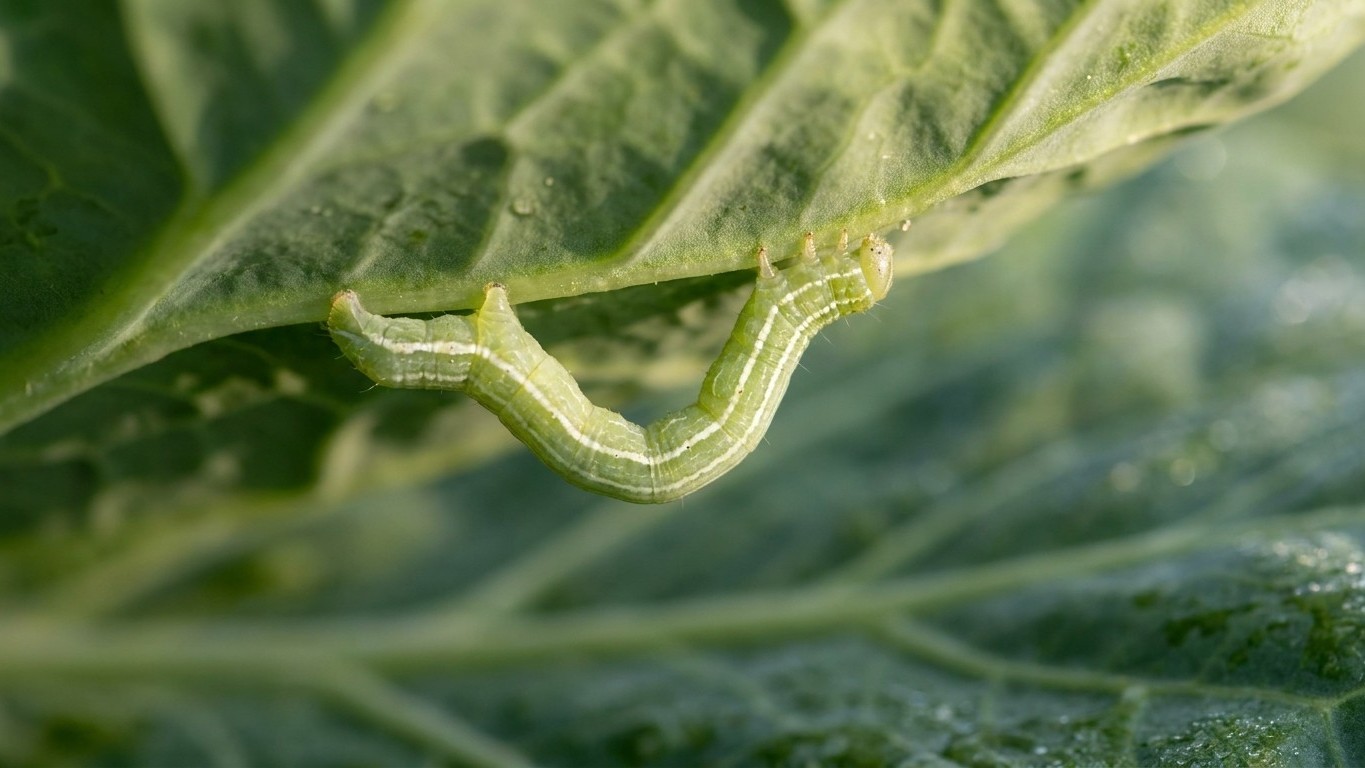
The larva, a pale green caterpillar that arches its back into a distinctive loop as it moves (hence the name), is the life stage doing all the damage. Adult moths don’t feed on the crop; they only mate and lay eggs. That distinction matters for treatment, because anything aimed at moths does nothing to stop the larvae already feeding, and anything aimed at eggs or young larvae stops working once the caterpillar has grown large enough to bore inside a head.
Crops at risk in Texas gardens include:
- Cabbage
- Broccoli
- Cauliflower
- Kale and collards
- Lettuce and spinach
- Tomato and potato foliage
How Texas sits in this pest’s range

Cabbage looper isn’t a species that shows up in some states and skips others. It’s one of the most widely distributed leaf-feeding caterpillars in North American vegetable gardens, and in a state as large as Texas, presence isn’t really the question. Timing is. A gardener in the Rio Grande Valley and one in the Panhandle are both dealing with the same insect, but on completely different schedules tied to their local frost-free season.
That internal variation is the real story for Texas. The state spans four USDA hardiness zones, and the Houston-area frost data available here (February 4 to March 1 for last frost) is specific to the mild Gulf Coast end of that range. The Panhandle freezes months earlier in fall and stays frozen months later in spring, which compresses the growing season and shifts cabbage looper activity into a narrower summer window. Hill Country and North Texas fall somewhere in between. A planting or pest-watch calendar built around Houston numbers simply doesn’t transfer to Amarillo or Lubbock gardens, even though it’s the same pest in both places.
What actually works against it

Home gardeners have several options, and they work best used in this order, starting with the cheapest and least labor-intensive:
- Time transplanting to dodge peak moth activity. Setting out brassica transplants as early as the local frost date allows, or waiting until a known lull between generations, gives seedlings a head start before the most vulnerable young-leaf stage coincides with heavy egg-laying.
- Floating row covers. A physical barrier over young plants keeps adult moths from reaching leaves to lay eggs in the first place. This only works if the cover goes on before moths arrive and stays sealed at the edges; once a moth has already laid eggs underneath, the cover does nothing and can even trap the larvae with the crop.
- Hand-picking. Checking the undersides of leaves for the dome-shaped, ribbed white eggs and for young green larvae, then removing them by hand, is effective while populations are still small and larvae are still on the leaf surface rather than inside a head.
- Crop rotation. Moving brassica plantings to a different part of the garden each year makes it harder for pupae overwintering in old plant debris to find a host crop nearby come spring.
- Clearing garden debris after harvest. Removing old cabbage, broccoli, and collard stalks and leaf litter at season’s end eliminates a sheltered spot where pupae can overwinter close to next year’s planting site.
None of these measures help once larvae have already bored into a developing cabbage or broccoli head. At that point the damage is done, and the only real fix is to cut the head open, remove the caterpillar, and trim away the affected tissue before cooking or storing the crop.
Common questions
Does cold weather kill cabbage looper in Texas?
A hard freeze knocks back adult moth activity and slows the life cycle, but Texas’s mild winters, especially along the Gulf Coast, mean populations rarely disappear completely the way they might further north.
Can cabbage looper damage tomatoes, not just cabbage-family crops?
Yes. While brassicas are the preferred host, cabbage looper larvae also feed on tomato and potato foliage, so a garden growing only tomatoes isn’t automatically in the clear.
Is it worth spraying young transplants preventively?
Preventive measures matter most before eggs are laid. Once larvae are established and large, most sprays and physical barriers lose effectiveness, which is why timing planting and installing row covers early beats waiting until damage appears.