
Thirteen pests keep coming back in Texas vegetable gardens, and most of them are already at work under the leaves — or even underground — before you ever see the adult. Fire ants gardeners deal with, along with squash bug populations, aphids, cucumber beetles, root-knot nematodes that soils here are especially prone to, whiteflies gardeners find clustered under leaves, corn earworm populations feeding on developing ears, spider mites gardeners spot as fine webbing on stressed plants, and grasshoppers growers watch for come summer — the warm season here just gives them more time to breed than a garden further north ever would. Start checking the undersides of squash, cucumber and tomato leaves once a week from early spring on, since that’s where the early damage shows up first, long before anything is visible from the top.
What Texas gardens actually deal with

Texas’s long warm season is exactly what lets these insects multiply the way they do. Many of the moths, beetles and true bugs on this list survive mild winters and start reproducing again as soon as temperatures allow, running through several generations before the season ends. That is a different pest calendar than a short, cool growing season imposes. Gardeners working through garden pests in Alaska or the frost-shortened summers behind garden pests in New Hampshire see far fewer generations per pest per year, because cold cuts the cycle short rather than the season simply running out. In Texas, the length of the growing season is usually what limits pest numbers, not whether the insect survives winter at all.
The pests below are the ones TAMU AgriLife Extension flags as recurring in home vegetable gardens, not a complete list of every insect you might find. A county office can identify anything that isn’t on it.
Flea beetles and cucumber beetles

Flea beetles are shiny black or bronze beetles barely 1/16 inch long that jump like fleas when a leaf is disturbed. Cucumber beetles are larger, about 1/4 inch, yellow-green with black stripes or spots. Both show up on young seedlings in early spring and chew small round holes through leaves, sometimes killing transplants outright, and cucumber beetle adults also spread bacterial wilt as they feed. Floating row cover over seedlings until plants flower keeps both off without a spray.
Cabbage looper and diamondback moth

Cabbage looper caterpillars are pale green and arch into a distinctive loop as they crawl, growing to about 1.5 inches. Diamondback moth larvae are smaller, pale green, tapered at both ends, and the adult moth folds its wings to show a faint diamond pattern. Both feed on cole crops through spring, chewing ragged holes in leaves and boring into developing heads. Bacillus thuringiensis sprayed on young larvae controls both species without harming bees.
Melon aphid and other aphids

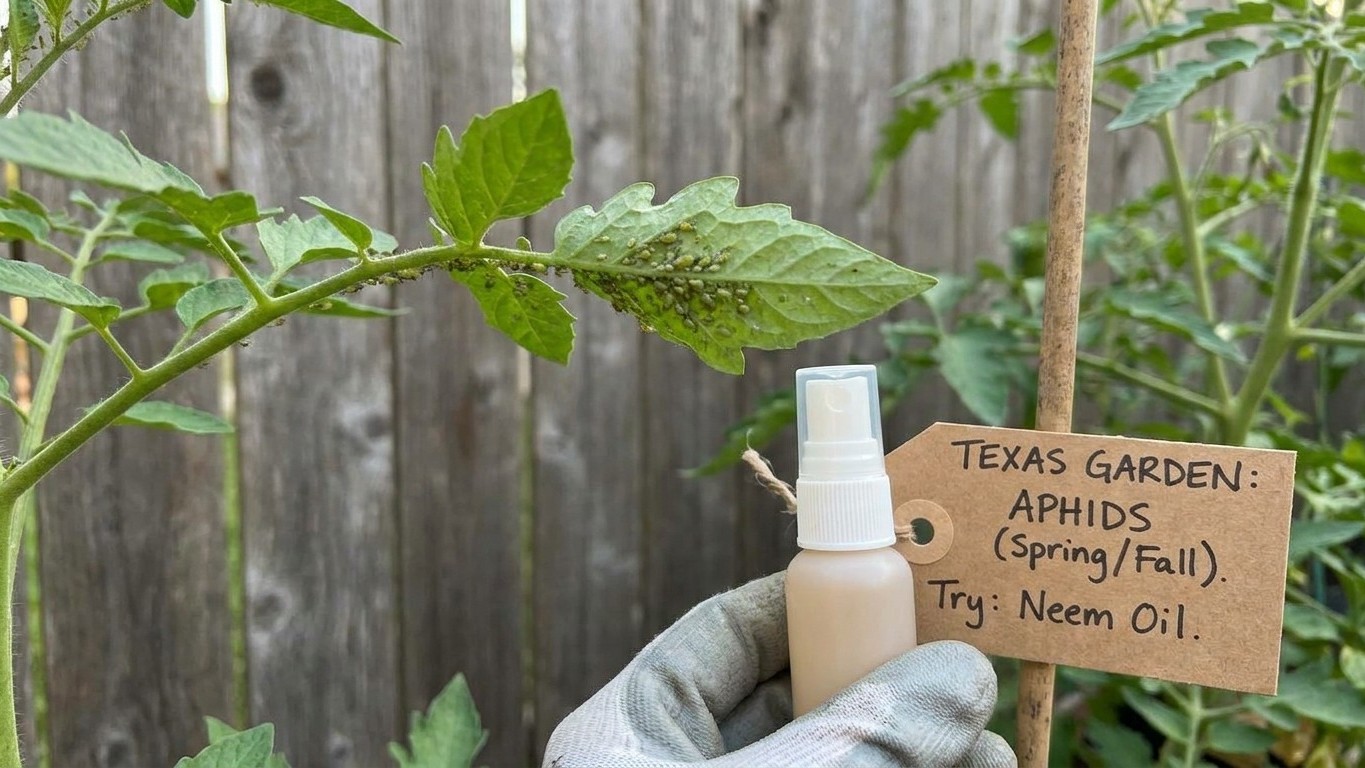
Aphids are soft, pear-shaped insects a few millimeters long, ranging from pale yellow to dark green or black depending on species, and they cluster on new growth and leaf undersides. Both immature and adult stages feed by sucking sap, curling leaves and leaving a sticky honeydew that molds black on lower foliage. Light infestations wash off with a strong stream of water. Heavier ones respond to insecticidal soap sprayed directly on the clusters.
Fire ants

Fire ants are small reddish-brown ants that build dome-shaped mounds of loose soil with no obvious entry hole. They don’t feed on plants directly, but they protect aphids and other sap feeders from predators in exchange for honeydew, and their stings make weeding and harvesting painful. Individual mound treatments with a labeled bait placed directly on the mound work better in a vegetable bed than broadcast granules.
Squash bug

Adult squash bugs are flat, shield-shaped, brownish-gray and about 5/8 inch long. Nymphs are gray with black legs and cluster tightly on leaf undersides, and the bronze, football-shaped eggs are laid in neat rows on the veins. Both nymphs and adults suck sap from squash and pumpkin leaves, causing yellow speckling that turns brown and can collapse whole leaves. Checking leaf undersides for egg clusters weekly and crushing them is the most reliable control, since established adults tolerate most contact sprays.
Squash vine borer

The adult is a day-flying moth that looks more like a wasp, with an orange and black body and hairy orange hind legs. It lays eggs at the base of squash stems in early summer, and the larva that hatches is a white to cream grub with a brown head that tunnels inside the stem, causing sudden wilting of an otherwise healthy-looking vine. Once a larva is inside, the only real fix is slitting the stem to remove it and mounding soil over the wound. Row cover installed before the moths appear works far better than treating after wilting starts.
Leaffooted bug
Adults are narrow, grayish-brown bugs about 3/4 to 1 inch long, named for the flattened, leaf-like widening on their hind legs. They gather in clusters on stems and developing fruit through summer, and their feeding leaves hard, discolored spots on tomatoes and pale, sunken marks on developing pods and melons. Nymphs look similar but smaller, without the full leg flare. Hand picking into a bucket of soapy water in the morning, when they’re sluggish, keeps numbers down.
Whiteflies
Whiteflies are tiny, about 1/12 inch, pale insects that flutter up in a small cloud when a plant is brushed. Nymphs are flat, oval and nearly translucent, fixed to the underside of leaves where they feed. Both stages remove sap and leave sticky honeydew, and heavy infestations weaken plants and coat leaves in sooty mold. Yellow sticky traps catch adults for an early warning, and insecticidal soap or horticultural oil applied to leaf undersides controls nymphs.
Spider mites
Spider mites are barely visible to the naked eye, appearing as tiny red, yellow or pale green specks on the underside of leaves, often alongside fine webbing. Hot, dry weather lets populations explode within days, and their feeding leaves a fine stippled or bronzed look across the leaf surface before it drops. A strong spray of water on leaf undersides every few days disrupts them, and miticides are rarely needed in a home garden if this is kept up.
Corn earworm
The larva is the damage-doing stage, a caterpillar that ranges from light green to pink to brown with pale and dark stripes running the length of its body, growing up to about 1.5 inches. It feeds at the tip of the ear, chewing through kernels and leaving droppings behind, and the same species attacks tomato fruit as the tomato fruitworm. A few drops of mineral oil placed at the tip of each ear just after silks emerge smothers young larvae before they reach the kernels.
Pickleworm and melonworm
Pickleworm larvae are pale green to coppery with dark spots when young, and melonworm larvae are pale green with two white stripes running down the back. Both bore directly into squash, cucumber and melon fruit in late summer, leaving entry holes plugged with frass that go unnoticed until the fruit rots from the inside. Because the damage happens inside the fruit, row cover timed before the moths are active matters more than any spray once larvae have tunneled in.
Grasshoppers
Adult grasshoppers are large, up to two inches or more, colored brown, yellow or green, with long hind legs built for jumping. They chew ragged notches from leaf edges and can strip young transplants to bare stems when populations build through summer into fall, often moving in from adjacent pasture or fields. Floating row cover over young seedlings is the most practical home-garden defense, since grasshoppers arrive on foot and by short flights from outside the garden.
Root-knot nematodes
Root-knot nematodes are microscopic roundworms, invisible to the eye. Damage shows up above ground as stunted, wilting plants that don’t respond to watering, and below ground as swollen galls along the roots when you dig one up to check. Once soil is infested, there’s no practical rescue for that bed in the same season. Rotating out of susceptible vegetables like tomatoes and okra, and choosing resistant varieties where they’re available, are the main long-term controls.
Telling damage apart

Reading the pattern
Most damage falls into a handful of visual patterns, and matching the pattern to the list above narrows the search fast. Chewed leaf edges and ragged notches point to a chewing insect working from the outside in: grasshoppers, cabbage loopers or diamondback moth larvae. Round or angular holes punched straight through the leaf surface, rather than notched edges, point instead to flea beetles or cucumber beetles.
Fine stippling or a bronzed, dusty look across a leaf, especially in hot weather, is spider mite feeding, not a nutrient problem, and checking for fine webbing on the underside confirms it. A sticky film on leaves, sometimes followed by black sooty mold, means a sap feeder is at work overhead: aphids, whiteflies or a scale infestation, all of which excrete the honeydew that feeds the mold.
Sudden wilting of one vine while its neighbors look fine reads differently than a whole bed wilting together. A single wilted squash vine with an otherwise healthy root system usually means a squash vine borer has tunneled into that one stem. A pattern where several plants wilt despite regular watering, and roots pulled up show small knots, points to root-knot nematodes instead. True underwatering wilts a whole planting evenly and the plants recover within hours of a deep soak, which neither borer damage nor nematode damage does.
Discolored, sunken spots on developing fruit with no insect in sight often trace back to leaffooted bugs that have already moved on, and a small entry hole plugged with sawdust-like frass on a cucumber or squash means a pickleworm or melonworm is inside. Disease, by contrast, tends to show as a spreading lesion with a defined margin, a powdery or fuzzy coating, or a pattern that follows water splash and moves from the oldest leaves upward, none of which match insect feeding.
- Notched or chewed edges: grasshoppers, loopers, diamondback moth larvae
- Round holes through the leaf: flea beetles, cucumber beetles
- Stippled or bronzed leaves with fine webbing: spider mites
- Sticky leaves with black mold: aphids, whiteflies
- Single vine wilting, root system intact: squash vine borer
- Multiple plants wilting, roots show galls: root-knot nematodes
What actually works
Prevention first
Floating row cover, installed before pests arrive and removed once plants flower and need pollinators, is the single most effective barrier against flea beetles, cucumber beetles, squash vine borer moths and grasshoppers moving in from outside the bed. Rotating cucurbits, tomatoes and cole crops to a different spot each year breaks the life cycle of soil-dwelling pests like root-knot nematodes, which need a susceptible host root to reproduce and decline without one. Starting vulnerable crops as transplants rather than direct-seeding into bare soil gets seedlings past their most attractive stage before flea beetle and cucumber beetle populations peak.
Leaving some flowering herbs and native plants near the vegetable bed brings in lady beetles, lacewings and parasitic wasps, which handle aphid and small caterpillar populations without any further input. Killing every insect on sight also kills the predators that would otherwise do this work for free, which is one reason broad-spectrum sprays used preventively tend to make aphid and mite problems worse over the following weeks, not better.
When you need to intervene
Bacillus thuringiensis sprayed on young larvae controls cabbage loopers and diamondback moths reliably without harming bees or predatory insects, but it only works while larvae are small and actively feeding, so timing the spray soon after eggs hatch matters more than which product is used. Insecticidal soap and horticultural oil work on soft-bodied sap feeders like aphids and whiteflies only on contact, which means covering the undersides of leaves, not just the tops.
Hand picking and crushing egg clusters remains the most reliable defense against squash bugs, since adults tolerate most sprays well once established. For fire ants, an individual mound bait placed directly on the mound works better in a vegetable bed than a broadcast granule treatment, which covers ground that doesn’t need it and wastes product.
Some popular home remedies do essentially nothing. Diatomaceous earth washes off with the next watering or rain and needs constant reapplication to have any effect. Garlic and pepper sprays repel adult insects only briefly, if at all, and do nothing to eggs or larvae already inside a stem or fruit. Marigolds planted around a vegetable bed haven’t been shown to repel the pests on this list in any consistent way. None of these replace row cover, rotation or timing as the first line of defense.
What control costs
Cost side by side
The four common approaches trade money for time in different proportions, and none of them work as a single one-time fix.
| Method | Money cost | Time cost | How often repeated |
|---|---|---|---|
| Hand picking / egg crushing | None | A few minutes per plant, per visit | Weekly through the pest’s active season |
| Row cover / physical barriers | One-time material cost, reusable for several seasons | Low after installation, aside from removal at flowering | Installed once per planting, removed once |
| Biological controls (Bt, beneficial insects) | Low to moderate per application | Timing matters more than labor | Reapplied after rain or every 1-2 weeks while larvae are active |
| Sprays (soap, oil, contact insecticide) | Moderate, repeat purchases add up | Requires thorough coverage of leaf undersides | Every 5-7 days while the pest is present, more after rain |
For a typical home vegetable bed, hand picking and row cover cost the least in dollars and the most in the gardener’s own attention, paid regularly rather than in a lump sum. Hand picking is the cheapest option outright, but it only holds up on a garden small enough to walk every few days. Row cover asks for one purchase and one installation per planting, then very little else until it needs to come off for pollination.
Sprays, whether soap, oil or a labeled insecticide, cost money every application and need reapplying on a fairly tight schedule to keep up with fast-breeding pests like aphids and spider mites, since neither product kills eggs laid after the previous round. Biological controls split the difference: Bt costs about the same per application as a spray but only needs repeating while larvae are actively hatching, and beneficial insects, once established near the garden, keep working without further cost until a broad-spectrum spray wipes them out.
Local help
TAMU AgriLife Extension runs the county offices that track pest activity across the state and identify specimens gardeners bring in or photograph. If you’re not sure what’s chewing your squash or curling your tomato leaves, a county extension agent can identify it, and their staff see what’s actually active in your area that week, not just what’s on a statewide list. Find your county office through the TAMU AgriLife Extension directory, and check our other Texas guides for planting windows that shape when these pests show up.
Two More Pests Worth Watching
Texas gardens deal with more than just the usual suspects, and two in particular deserve their own close look. If your tomatoes or peppers start showing damage from spring through fall, check out what draws leaffooted bugs to your garden and how to stop them, since these insects turn up across the whole state from early spring through the first hard frost, with June, July, and August bringing the worst of it to home gardens and orchards alike. The good news is that stopping them for good comes down to breaking up their habits early, before populations build.
If squash, zucchini, or other vining crops are on your list, it pays to know when squash vine borer moths start emerging and what actually works against them. Timing varies a lot across Texas: moths can show up as early as late April down in the Rio Grande Valley and Gulf Coast, or hold off until mid-June up in the Panhandle and High Plains. What matters isn’t the date on the calendar so much as the soil temperature, which is why knowing your region’s pattern makes all the difference in catching this pest before it burrows into your plants.
Common questions
Why do I get the same pest every single year in the same bed?
Soil-dwelling problems like root-knot nematodes and the eggs or pupae of some insects overwinter right in that spot and reinfest whatever susceptible crop goes back in. Rotating that bed to an unrelated crop family for a season or two, rather than planting the same thing in the same soil, is what actually breaks the cycle.
Are ladybugs worth buying and releasing in my garden?
Mail-order ladybugs mostly fly off within a day or two of release since there’s no reason for them to stay unless there’s already an aphid population to feed on. Planting flowering herbs and leaving some habitat near the vegetable bed does more to keep predatory insects around than any one-time release does.
Can I just spray something before I see any damage, to be safe?
Spraying before you have a confirmed pest usually costs you the beneficial insects that would have kept populations down on their own, and it does nothing for pests that haven’t arrived yet. Scout first, identify what’s actually there, and treat that specific problem.
Do I need to treat my whole garden or just the plant that’s infested?
Most of these pests start on one plant or one section of a row and spread from there, so spot-treating the affected plants first is usually enough. Treat the whole bed only if you’re seeing the same pest spread across multiple unrelated plants, which is more common with mobile pests like grasshoppers than with something like squash vine borer.