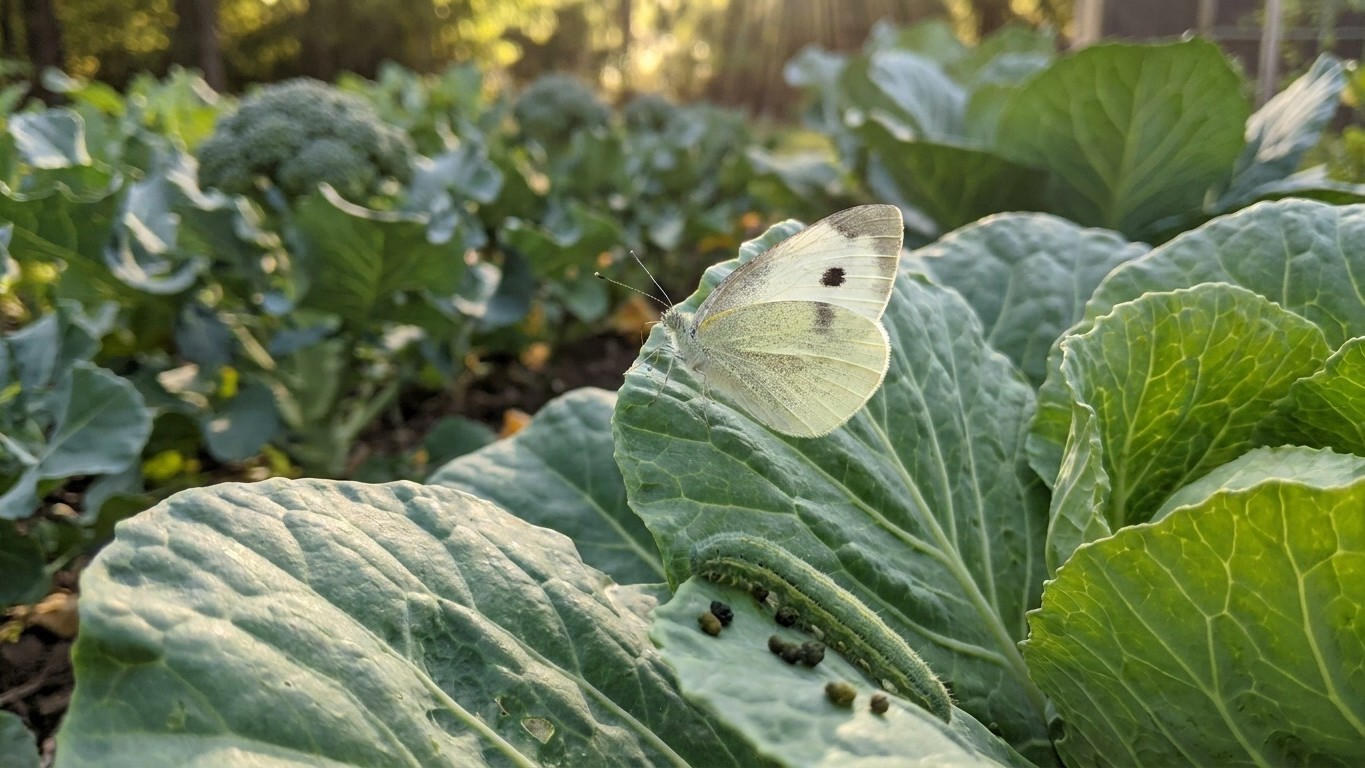

Imported cabbageworm shows up in Washington gardens from mid-spring right through the first hard fall frost, with several overlapping generations feeding the whole time. The single best defense is timing: get a floating row cover over young brassica transplants before the white butterflies start laying eggs, then back it up with weekly hand-picking. Nothing else matters as much once the caterpillars are already established.
The weeks to watch

Washington State University Extension does not publish a specific emergence window for imported cabbageworm in the seasonal data reviewed for this piece, so the timing here follows the general biological pattern documented for this species across temperate North America. Imported cabbageworm overwinters as a pupa attached to old plant debris, fence posts, or garden structures near where brassicas grew the previous year. Adults, the familiar small white butterflies with one or two dark wing spots, emerge once daytime temperatures reliably climb into the low 60s Fahrenheit. In western Washington’s mild maritime climate, that usually means the first flight appears sometime in mid-to-late April; in the colder, drier interior east of the Cascades, expect that first flight to lag by several weeks.
First generation, spring
The earliest butterflies lay pale, ribbed, torpedo-shaped eggs singly on the undersides of young brassica leaves. Those eggs hatch into the first wave of velvety green caterpillars within about a week, and this is the generation most likely to hit spring-planted broccoli and cabbage transplants hard, since the plants are small and every leaf counts.
Later generations, summer into fall
Because the life cycle from egg to adult butterfly can complete in three to four weeks under warm conditions, Washington typically sees three to five overlapping generations by the time cold weather arrives. That overlap means a garden can have eggs, small larvae, and near-mature caterpillars all present at once by midsummer, and it’s why a single treatment early in the season rarely solves the problem for the rest of the year.
Reading the calendar from your last frost

The one date most Washington gardeners actually plan around is the last spring frost, and NOAA’s 1991-2020 Climate Normals for the western Washington station used here put that window between February 27 and March 18 (32°F freeze probability, USW00024233). That’s a mild frost date by national standards, but it doesn’t translate into an early planting date. Cold, wet soil and low spring light in western Washington routinely hold back brassica transplants for weeks after the last freeze has passed, and the caterpillar answers to soil and air warmth, not to a spot on the calendar.
Here’s the arithmetic a gardener can redo with their own numbers:
- Start from the local last-frost window (February 27 to March 18 for this western Washington station). Brassica transplants typically don’t go into the ground until the soil has warmed well past that date, often three to five weeks later depending on the spring.
- Once transplants are in, the first visible cabbageworm damage generally shows up two to four weeks afterward, as soon as the earliest adult butterflies find the new plants and their eggs hatch. That window is when a row cover needs to already be in place, not when the first hole appears.
An early, dry spring pulls that whole sequence forward; a cold, wet one pushes it back. The frost date is a normal drawn from thirty years of records, not a guarantee for any single year.
What it attacks, and what the damage looks like

Most gardeners notice the damage before they ever spot the caterpillar itself. Leaves develop ragged, irregular holes, often chewed between the veins so the leaf looks lace-like from a distance. On heading crops like cabbage, the outer leaves may look fine while the caterpillars work their way toward the developing head, leaving behind small greenish-brown pellets of frass that are often the first sign something is wrong. Younger transplants can show wilting or stunted growth simply from the volume of leaf tissue removed.
The larval stage does essentially all the feeding damage. The caterpillar itself is velvety green with a faint yellow stripe down its back, moves slowly, and can be surprisingly well camouflaged against a cabbage leaf’s veins. Adult butterflies do no plant damage at all; they matter only because every female can lay dozens of eggs over her lifespan.
Crops at risk include:
- Cabbage
- Broccoli
- Cauliflower
- Kale and collards
- Brussels sprouts
- Mustard greens and other brassica relatives
How Washington sits in this pest’s range

Imported cabbageworm has been established across nearly all of North America since it arrived accidentally in the 1860s, and it’s now found in essentially every lower-48 state, Washington included. That widespread distribution means the real question for a Washington gardener isn’t whether the pest is present, it’s when it becomes active and how many generations fit into the local growing season.
Washington’s split climate makes that timing question more interesting than most states. West of the Cascades, mild winters and a long, cool growing season let the pest cycle through several generations at a relatively steady pace, with the mild frost dates noted above allowing early garden activity even if planting itself lags. East of the Cascades, the high desert climate compresses the growing season and delays the first spring flight, but summer heat can speed up the generation cycle once it gets going. Neither side of the state gets a break from the insect; they just experience it on different schedules.
What actually works against it

Control options run from nearly free to labor-intensive, and the order below reflects that, cheapest and most effective first.
- Floating row covers placed over transplants at planting time. The mechanism is purely physical: the fabric keeps adult butterflies from landing on the leaves to lay eggs. It works only if it goes on before the first adults appear and stays sealed at the edges; once eggs or larvae are already on the plant underneath, the cover does nothing but trap them there.
- Weekly hand-picking of caterpillars and the pale, ribbed eggs on leaf undersides. This works at any point in the season and at any larval size, but it depends entirely on the gardener actually checking the undersides of leaves, not just the tops.
- Encouraging natural predators, particularly small parasitic wasps that lay their own eggs inside cabbageworm larvae, along with birds that pick caterpillars off open plants. Avoiding broad, non-selective insect sprays helps preserve these predators rather than wiping them out along with the pest.
- Crop rotation within the garden, moving brassicas to a different bed each year. The mechanism here is indirect: overwintering pupae tend to stay near where the previous crop grew, so relocating the next planting reduces the local carryover population.
- Clearing garden debris in fall, including old brassica stalks and nearby plant litter, removes the surfaces where pupae would otherwise overwinter and emerge the following spring.
None of these measures help once larvae have already bored into a developing cabbage head. At that point the caterpillar is protected inside the wrapped leaves, and the only remaining options are cutting away the damaged section or accepting the loss on that particular plant.
Common questions
Is imported cabbageworm the same as the cabbage looper?
No. They’re often confused because both are green caterpillars on the same crops, but the cabbage looper moves with a distinctive arching, looping crawl and lacks the faint yellow stripe typical of imported cabbageworm. Both respond to the same row-cover and hand-picking approach.
Do row covers need to come off for pollination?
Brassica crops grown for their leaves or heads are almost always harvested before they flower, so a row cover can typically stay on for the entire life of the crop without blocking pollination that the plant actually needs to produce the harvested part.
Can one bad cabbageworm year mean a worse one next year?
A heavy population late in the season can leave more overwintering pupae nearby, which is exactly why clearing debris and rotating brassica beds in fall matters. It reduces, but doesn’t eliminate, the number of adults that emerge locally the following spring, since butterflies can also fly in from surrounding areas.