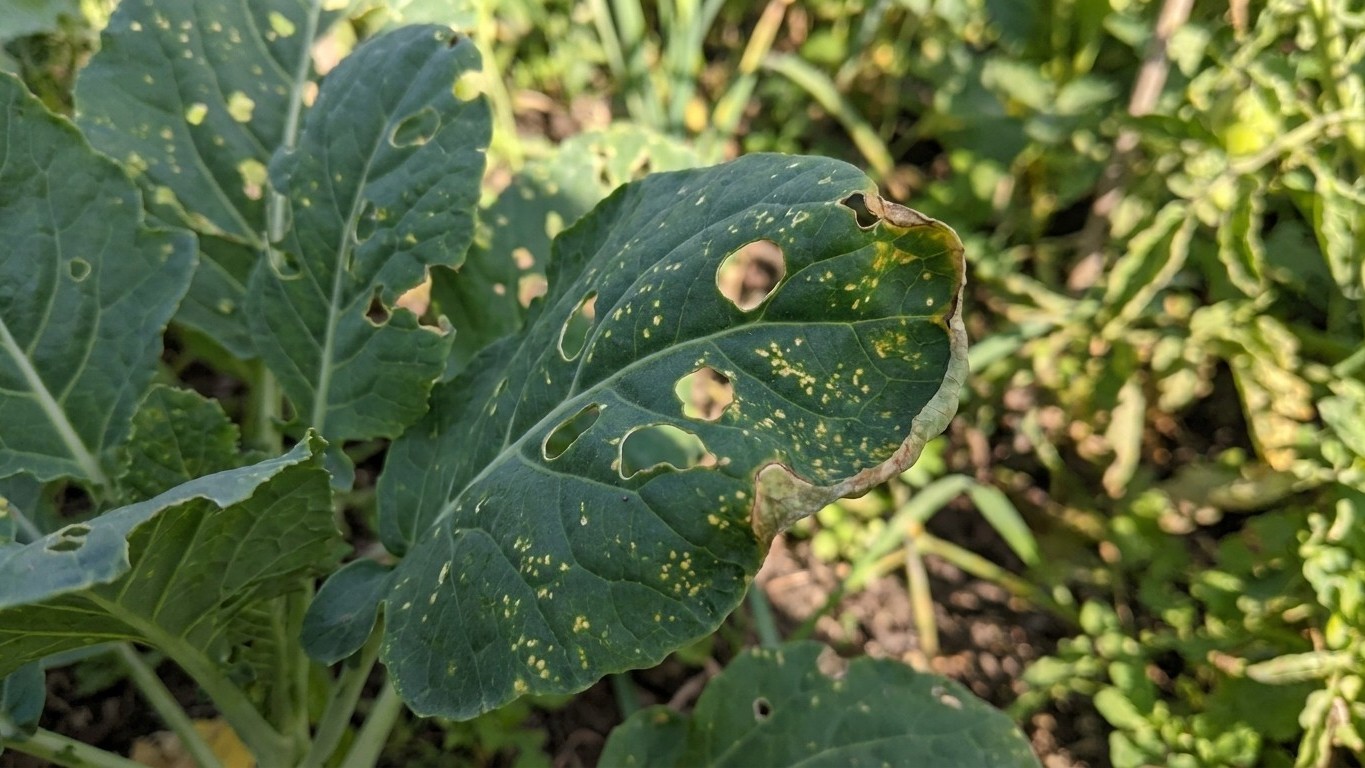

In Saskatchewan gardens, summer squash faces a short list of documented feeders: grasshoppers, thrips, brown marmorated stink bug, and cutworms, the larval stage of the miller moth. Each shows up at a different point in the frost-free window, which runs roughly from May 18 to September 18 at the Saskatoon reference station. Knowing the order they arrive helps catch damage before it spreads across a planting that only has about four months to mature.
Which pests attack Summer Squash in Saskatchewan
Montana State University Extension, Urban IPM and NDSU Extension document eleven pests for this part of the Prairies: Apple maggot, Boxelder bug, Brown marmorated stink bug, Colorado potato beetle, Corn earworm, Emerald ash borer, Grasshoppers, Miller moths, Social wasps, Thrips, and Yellowheaded spruce sawfly. Only four of them ever land on a squash leaf.
Apple maggot lays its eggs in apple flesh, not in vine crops, so it has no reason to visit a squash bed. Boxelder bug feeds on boxelder and maple seeds and mostly wanders into houses looking for a spot to overwinter; it does not chew foliage. Colorado potato beetle is built for the nightshade family (potato, eggplant, tomato) and skips cucurbits almost entirely. Corn earworm targets corn ears and, secondarily, tomato fruit; squash rind is not on its menu in this region. Emerald ash borer and Yellowheaded spruce sawfly are tree pests, one boring into ash wood, the other stripping spruce needles, and neither has any business in a vegetable patch. Social wasps are predators and scavengers: they hunt caterpillars and pick at ripe or split fruit, but they are not a cause of squash damage on their own.
That leaves grasshoppers, thrips, brown marmorated stink bug, and miller moths, and even the last of those needs a caveat. The adult miller moth, the flying stage of the army cutworm, feeds on flower nectar and does no damage to a garden at all. The larval stage, the cutworm, is the one that clips young squash stems at ground level, usually before the moth stage is ever seen. Grasshoppers chew ragged holes in leaves and, in a bad year, can skeletonize a whole squash plant down to the veins. Thrips scrape at the surface of leaves and blossoms, leaving a silvery, stippled look. Brown marmorated stink bug is the newest name on this list in Prairie gardens; it feeds broadly across vegetables, squash included, piercing the fruit and leaving pale, sunken marks under the skin.
Four confirmed feeders is a short list next to what gardeners farther south deal with, and that has as much to do with the province’s short season as with the insects themselves.
When each one shows up, and what it does first
Saskatoon’s climate normal puts the last spring frost at May 18 on average, and the first fall frost at September 18 (Environment and Climate Change Canada, 1981-2010 normals for the SASKATOON SRC station). That’s a four-month window, and because these are averages rather than guarantees, frost actually lands later than May 18 in about half of all years. Squash usually goes into the ground once that risk has passed, so the pest calendar below is built off transplant date, not off a calendar month that shifts depending on where in the province a garden sits.
Cutworms are the first to cause trouble, sometimes within days of transplanting. A stem chewed clean through at soil level, with the top of the seedling lying wilted next to it, is the classic sign; the culprit is usually already gone, curled under the soil surface nearby.
Grasshoppers build up through the season as nymphs mature into adults, so damage tends to worsen as summer goes on rather than appearing all at once. Early feeding shows as small notches along leaf edges; by midsummer, in a heavy year, whole leaves can be reduced to a skeleton of veins, and grasshoppers will move onto the fruit itself once foliage runs short.
Thrips show up once the plant starts flowering and setting fruit, generally a couple of weeks after grasshoppers become noticeable. Look for a dull, silvery sheen on leaf undersides and around the blossom, sometimes with tiny black flecks of excrement. Heavy thrips feeding can distort new leaves as they unfurl.
Brown marmorated stink bug tends to arrive later in the season, closer to fruit set and ripening, since it’s drawn to developing fruit rather than young foliage. The first sign is usually on the squash itself: small, discolored, slightly sunken spots on the skin, matching a puncture where the insect fed underneath.
None of this runs on a fixed date. A garden that gets its transplants in early, right around the mean frost date, sees this whole sequence run a couple of weeks ahead of a garden that waits for extra insurance against a late frost.
Telling the damage apart from everything else
A chewed leaf isn’t proof of an insect. Saskatchewan’s growing season brings its own stresses, wind, hail, dry spells between rains, and powdery mildew in humid stretches, and several of these can look enough like pest damage to send a gardener chasing the wrong problem.
| What you see | Likely cause | What settles it |
|---|---|---|
| Silvery, stippled patches on leaves | Thrips, or ordinary sun scorch on a dry stretch | Thrips damage stays confined to leaf undersides and new growth; scorch appears evenly across the oldest, most exposed leaves |
| Whole leaves reduced to veins | Grasshoppers, rarely anything else at this scale | Grasshopper feeding leaves ragged, irregular edges; disease-related leaf loss, like powdery mildew, starts as a white or yellow coating before tissue dies |
| Stem cut clean at the soil line | Cutworm larvae, or mechanical damage from a hoe or trimmer | A cutworm cut is jagged and chewed; a tool cut is a clean, straight slice |
| Sunken, discolored spots on the fruit skin | Stink bug feeding, or scarring from irregular watering | Insect punctures sit at random points on the fruit; watering-related marks concentrate at the blossom end |
| Pale, mottled, or curled leaves with no visible chewing | Nutrient deficiency, viral mosaic, or herbicide drift | None of these produce a bite mark, hole, or puncture; if nothing is physically missing from the tissue, the cause isn’t an insect |
The single most useful rule is to look for a mark left behind, a hole, a puncture, or a chewed edge, before assuming an insect is responsible. Environmental stress and disease change color and texture; they don’t remove tissue or leave a feeding wound. When the cause still isn’t obvious, a regional agriculture office can look at a photo or a sample and narrow it down faster than any general description can.
What actually works here, and what is a waste of time
Physical barriers do more work than anything sprayed on, mostly because Saskatchewan’s season is too short to waste weeks on a fix that doesn’t pan out. A cardboard or plastic collar pushed an inch into the soil around a young transplant blocks a cutworm from reaching the stem, and it costs nothing but the time to cut it. Floating row cover keeps grasshoppers and stink bugs off young plants entirely, but it has to come off once the first flowers open, since squash needs insect pollinators to set fruit, and a cover left in place blocks bees along with pests.
Grasshoppers are harder to exclude once they’re adults and flying, since row cover alone won’t stop a mature grasshopper from landing on exposed fruit or plants once the cover comes off for pollination. Keeping the ground around a squash bed mowed short reduces the egg-laying and shelter sites grasshoppers favor, which matters more here than in most gardens, because grasshopper outbreaks on the Prairies tend to build up in untended grassy margins before moving into cultivated ground.
Thrips and stink bugs are the two hardest to manage without a targeted product, and this is exactly where a general gardening guide should stop and hand off to a professional: what’s registered for use on vegetable crops in Saskatchewan, at what rate, and at what interval before harvest, is a question for the provincial agriculture office, not a general article.
What doesn’t help: spraying anything before confirming which pest is actually present, since a product aimed at soft-bodied thrips does nothing to a grasshopper and vice versa. Planting later to dodge early-season pests is also a poor trade here, since it eats into an already short frost-free window without guaranteeing the pest arrives any later.
Where to check this for your own county
The pest list above comes from Montana State University Extension, Urban IPM and NDSU Extension, two services documenting insects for the climate belt just south of the border, since Saskatchewan doesn’t run its own county-by-county pest bulletin the way American states do. That gap matters: what’s documented at this scale says nothing about which of these four insects is actually present on a particular property in a given year.
For anything specific to a garden in Saskatchewan, the provincial resource to check is the Saskatchewan Ministry of Agriculture’s agribusiness, farmers, and ranchers page. It’s the starting point for reaching a regional crop specialist, and those specialists track pest pressure at a finer scale than any provincial or cross-border list ever could, because grasshopper numbers in particular swing sharply from one rural municipality to the next depending on the previous year’s egg-laying conditions.
A garden thirty miles away can have a heavy grasshopper year while another sits nearly untouched, which is the reason a province-wide or cross-border pest list works as a starting point for identification, never as a forecast for one specific yard. Photograph the damage, note when it appeared relative to transplanting, and bring both to a regional specialist or a Rural Municipality’s agriculture office rather than guessing from a general description alone.