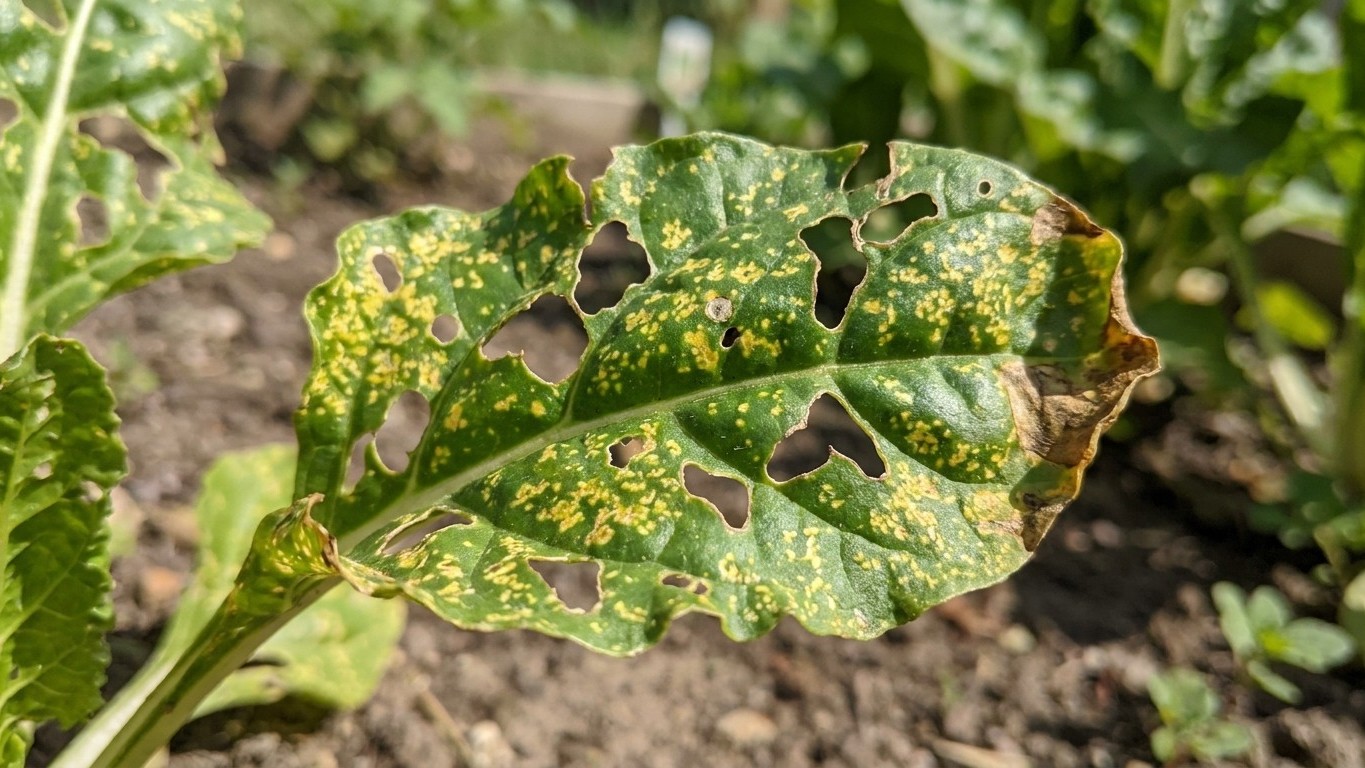

Six insects account for nearly all the squash damage reported across South Carolina gardens, and each one appears on a different clock tied to the state’s frost-free window. Knowing which pest shows up first, and what its damage looks like before you spot the bug itself, saves a squash planting that would otherwise collapse by midsummer.
Which pests attack Summer Squash in South Carolina
Clemson Cooperative Extension Home and Garden Information Center documents ten insect pests for this territory’s vegetable gardens overall:
- Brown and green stink bugs
- Cabbage looper
- Corn earworm (Helicoverpa zea)
- Diamondback moth (Plutella xylostella)
- Leaffooted bug (Leptoglossus phyllopus)
- Silverleaf whitefly and potato aphid
- Spotted cucumber beetle
- Squash vine borer
- Striped cucumber beetle
- Tobacco and tomato hornworms
Not all ten touch a squash plant. Four of them belong to other crops entirely, and a gardener who blames the wrong insect ends up treating the wrong problem. Cabbage looper and Diamondback moth are brassica specialists: their larvae feed on cabbage, collards, and kale leaves, and they have no particular interest in a squash vine. Corn earworm targets corn ears and, as the tomato fruitworm, tomato fruit; it does not bore into squash. Tobacco and tomato hornworms are solanaceous feeders, meaning tomato, pepper, and eggplant foliage, not cucurbits.
That leaves six that actually attack Summer Squash in South Carolina: brown and green stink bugs, Leaffooted bug, silverleaf whitefly and potato aphid, spotted cucumber beetle, squash vine borer, and striped cucumber beetle. The two beetles and the vine borer are cucurbit specialists, meaning squash, cucumber, pumpkin, and melon are essentially all they eat. The stink bugs and leaffooted bug are generalist sap feeders that move onto squash once fruit starts forming. The whitefly and aphid pair colonizes the undersides of leaves and builds populations through the season rather than arriving all at once.
This is a short list by design. Clemson’s Home and Garden Information Center documents these six for squash specifically; it does not document a longer roster, and padding the list with insects that belong to tomatoes or cabbage would misdirect anyone trying to diagnose a real problem in a real garden.
When each one shows up, and what it does first
South Carolina’s frost-free season runs from a last spring frost between February 28 and March 17 to a first fall frost between November 20 and December 5, according to NOAA climate normals for the reference station. Squash pest arrival tracks that window rather than a fixed calendar month, since planting dates themselves shift across the state’s zones.
Striped cucumber beetle is usually the first insect a gardener notices, often within days of seedlings emerging or transplants going in the ground. It chews small, ragged holes in the first true leaves and can girdle a stem at the soil line on a very young plant, sometimes killing it outright before flowering even starts.
Spotted cucumber beetle follows a similar early timeline but tends to do less seedling damage and more feeding on blossoms once the plant starts flowering, which shows up as chewed petals and a scattering of small holes in open flowers.
Squash vine borer arrives a few weeks into vegetative growth, once vines have real length to them. The first sign is rarely the moth, which resembles a wasp and is easy to miss; it is usually a small pile of moist, sawdust-like frass sitting at the base of the plant near a stem, followed within days by sudden wilting of one runner while the rest of the plant still looks fine.
Stink bugs and leaffooted bug move in later, once fruit has set, since they feed by piercing developing squash and sucking sap rather than chewing leaves. Their first sign is a cluster of small, discolored, slightly sunken dimples on the fruit surface, sometimes with a faint corky texture underneath the skin.
Silverleaf whitefly and potato aphid build up gradually across the whole season rather than announcing themselves on one date. The earliest clue is usually a sticky residue on upper leaf surfaces (honeydew dropped from insects feeding above) followed by a fine, sooty mold growing on that residue.
Telling the damage apart from everything else
A squash plant can look damaged for reasons that have nothing to do with an insect, and treating for a pest that is not actually present wastes both time and product. The distinguishing detail is usually where the damage sits on the plant and whether it spreads in a pattern.
A single wilted runner on an otherwise healthy plant, with dry soil ruled out, points toward squash vine borer rather than drought stress, because drought wilting affects the whole plant evenly while borer wilting is isolated to one vine. Sunken, discolored dimples confined to fruit that touches the soil, without any insect visible, often trace back to blossom end rot or contact rot rather than stink bug feeding, since piercing damage from insects tends to appear on fruit still hanging clear of the ground.
| Symptom | Likely insect cause | What rules it in or out |
|---|---|---|
| Ragged holes in young seedling leaves | Striped or spotted cucumber beetle | Beetles are often visible on the leaf itself; holes appear within the first two weeks after emergence |
| Sudden wilting of one vine, sawdust-like debris at the base | Squash vine borer | Rest of plant stays turgid; a slit stem reveals tunneling and frass inside |
| Sunken dimples on hanging fruit | Stink bug or leaffooted bug feeding | Damage sits on fruit surface, not where it contacts soil; no fungal growth present |
| Sticky leaves with sooty mold | Whitefly or aphid honeydew | Tiny insects visible on leaf undersides when disturbed; mold wipes off, distinguishing it from a leaf disease |
| Yellowing between leaf veins, whole plant affected evenly | Usually not an insect | Even, plant-wide pattern points to a nutrient deficiency or watering problem instead |
Nothing here replaces an in-person look at an actual plant. When a symptom does not match cleanly to one row, that is the moment to send a photo or a sample to a local extension office rather than guess.
What actually works here, and what is a waste of time
South Carolina’s long, hot season, with an average of 55.1 days a year reaching 90°F or higher, means squash plants grow fast and pests move through generations quickly too. Timing a physical barrier to the plant’s earliest, most vulnerable weeks does more than any single treatment applied later.
Covering seedlings and young transplants with a lightweight row cover from the moment they go in the ground blocks striped and spotted cucumber beetles during the exact window when they do the most damage, and it also keeps squash vine borer moths from laying eggs at the stem base. The cover has to come off once flowering starts, though, since squash needs insect pollination to set fruit, and that removal date is the point where scouting has to start.
Checking the stem base for frass every few days once vines start running catches a vine borer problem while a single stem can still be salvaged, versus discovering it only after an entire runner has already collapsed. Hand-picking beetles and squishing egg clusters on leaf undersides works on a small home garden scale in a way it simply cannot on a market-garden scale, and it costs nothing.
What tends to disappoint gardeners is spraying broadly and on a fixed schedule rather than in response to an actual sighting, since it kills the pollinators and predatory insects a squash planting depends on without necessarily hitting the pest at the life stage that is actually vulnerable. Any product decision, including what is labeled for use on cucurbits in South Carolina, belongs to a conversation with the local extension office rather than a general recommendation made from outside the state.
Where to check this for your own county
Statewide documentation is a starting point, not a diagnosis. Clemson Cooperative Extension maintains county offices across South Carolina, and pest pressure inside a single state varies enough that a garden in the Upstate and one on the coast can face a different lead pest in the same week.
The Home and Garden Information Center, reachable through Clemson Cooperative Extension, publishes fact sheets and takes questions through county offices, and that county office is the right next call when a symptom does not match anything described here. A local agent knows what has actually been reported nearby that season, which a general list, however well sourced, cannot capture.
The most useful single habit a squash grower can build is walking the planting every few days starting the week transplants go in, rather than waiting for a problem to become visible from a distance. A stem base checked early, a leaf underside turned over before flowering starts: those few minutes catch a squash vine borer or a beetle population while a county office can still offer a meaningful answer, instead of after the vine is already gone.