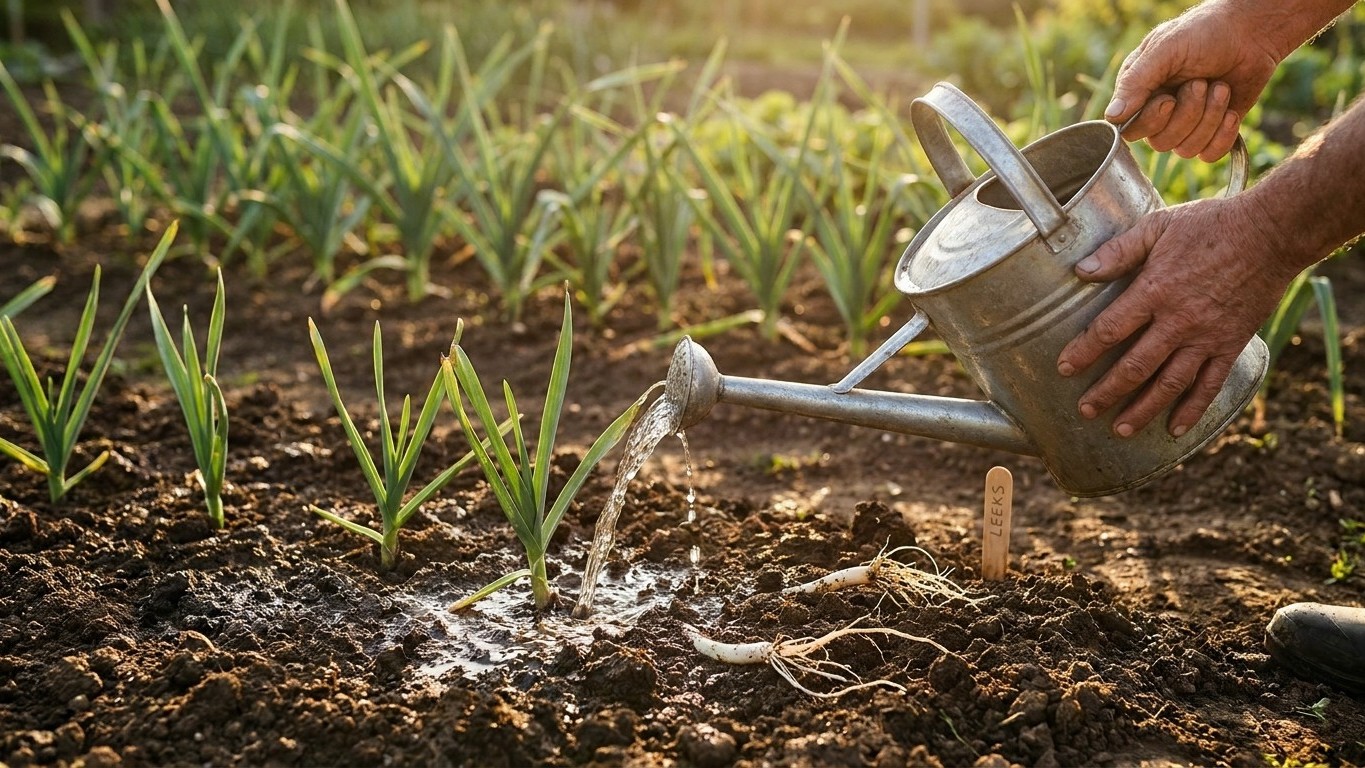

Utah State University Extension puts it plainly: leek soil needs to stay moistened to a depth of 18 inches, refreshed every 7 days, because the plant’s rooting system is shallow. That’s the whole rule in one sentence. Skip a cycle and the crop feels it fast, since there’s no deep reserve of moisture down below for the roots to lean on.
The short answer
Water thoroughly to a depth of 18 inches every 7 days, and keep the soil near field capacity the whole season, according to Utah State University Extension’s guidance on leeks in the garden. That’s not a suggestion for dry spells. It’s the baseline routine, rain or no rain, from the time leeks go into the ground until harvest.
The reason comes down to one structural fact: leek roots don’t go deep. Where a tomato or a squash plant can chase moisture several feet down, a leek’s root system stays close to the surface. Utah State University Extension notes that “water needs are critical since rooting depth in leeks is shallow” and that drought stress during growth will decrease yield. That’s a direct cause-and-effect statement, not a general reminder to water your garden. The shallow roots are the mechanism. The watering schedule is the response to that mechanism.
This changes how you should think about the 18-inch figure. You’re not soaking the soil that deep because the roots are down there waiting for it. You’re soaking it that deep because moving that much water through the top layer keeps the entire root zone, thin as it is, consistently wet at field capacity. A shallow, frequent light sprinkle wets the top inch or two and then evaporates before the next watering. A thorough soak to 18 inches pushes moisture through and past the root zone, so the band where the roots actually sit stays saturated for longer between waterings.
Seven days is the interval Utah State University Extension gives, and it’s worth treating as a maximum rather than a target to relax toward. In sandy soil or during a stretch of hot, dry, windy weather, that interval will need to shrink. Leeks don’t have the root reserve to coast through a missed week the way a deeper-rooted crop might. Once drought stress sets in, the yield loss doesn’t reverse itself with a single catch-up watering later on. The stalk that would have bulked up during that stressed week simply doesn’t, and no amount of water afterward recovers that lost growth.
So the short answer is really two numbers working together: 18 inches of depth, every 7 days, without exception, because there’s no deep root system to buy you slack.
What actually decides it

Three things drive the leek-specific rules around water, feeding, and weeding, and all three trace back to the same root architecture.
Shallow rooting changes where the water has to go
A leek’s root mass sits in a thin band near the surface. That band dries out quickly because it has almost no buffer of moist soil surrounding it the way a deep taproot does. Watering to 18 inches isn’t about reaching the roots directly. It’s about recharging the whole soil profile so the thin root band stays wet by proximity, not by depth. This is why “watering deeply but less often” advice for other vegetables doesn’t map cleanly onto leeks: less often means the shallow band dries out before the next soak arrives.
Field capacity is a maintained state, not a one-time fix
Field capacity means the soil is holding as much water as it can without becoming waterlogged. Utah State University Extension frames the goal as keeping soils “maintained near field capacity,” which is a continuous state, not a single deep watering that carries the plant for weeks. That distinction matters. A gardener who waters heavily once and then waits two or three weeks isn’t following the same practice as one who waters to 18 inches every 7 days, even if the total gallons applied end up similar over a month.
Nitrogen timing follows the same shallow-root logic
Utah State University Extension calls for side-dressing nitrogen at a rate of 1/4 lb. of 21-0-0 per 100 square feet, applied at two separate points in the growing season rather than as one dose up front. A shallow root zone holds less reserve nutrient capacity than a deep one, and frequent watering to field capacity moves nitrogen through that zone faster too. Splitting the feeding into two applications, one when plants are young and establishing and another later in the season as they bulk up, keeps nitrogen available in that thin root band without relying on a single large dose that could leach through before the plant uses it.
Weed competition hits hardest early because roots can’t out-compete
Utah State University Extension is specific that weeding matters most “during the first 2 months of growth when plants are growing slowly and compete poorly.” A shallow, still-developing root system can’t out-race weeds for surface moisture and nutrients the way an established, deep-rooted plant might. That same shallow root system is also easy to damage with aggressive cultivation, which is why careful, shallow weeding is the recommended approach rather than deep hoeing.
How to do it
- Count backward six to eight weeks from your own area’s last spring frost date to know when to start leek seeds indoors. Every region’s last-frost date is different, so use your local date, not a calendar month, as the anchor point.
- Move Transplants outdoors once your local frost risk has passed and the soil can be worked, based again on your own last-frost timing rather than a fixed date.
- Water the transplants in thoroughly right away, soaking the soil to a depth of 18 inches so the root zone is fully recharged from the start.
- Keep watering to that same 18-inch depth every 7 days for the rest of the season, adjusting only to water more often if soil is drying faster between cycles, never less often.
- Hand-weed carefully during the first eight weeks after transplanting, since this is when the young, shallow root system competes poorly against weeds and is also easiest to damage with a hoe or tiller.
- Side-dress nitrogen at a rate of 1/4 lb. of 21-0-0 per 100 square feet once plants are young and actively establishing.
- Apply a second side-dressing at the same rate later in the season, once plants have moved into their bulking-up growth stage, matching the two-stage feeding schedule Utah State University Extension recommends.
What goes wrong

- Watering lightly and often instead of deeply. A quick surface sprinkle wets the top inch of soil and evaporates before it does the shallow root band any good. The remedy is the same 18-inch soak every 7 days that Utah State University Extension specifies, not a splash on the surface every day or two.
- Letting the soil dry out between scheduled waterings. Because leek roots have no deep reserve to draw on, even a few dry days during a hot stretch can trigger drought stress that permanently caps that week’s growth. The remedy is treating the 7-day interval as a ceiling, watering sooner rather than later if soil is drying out faster than expected, and keeping the whole root zone near field capacity rather than letting it swing between wet and dry.
- Hoeing or tilling deeply to control weeds early in the season. Aggressive cultivation near the surface tears into the same shallow band where the roots live, undoing more than the weeds themselves would have cost. The remedy is gentle, shallow hand-weeding during the first eight weeks, when weed pressure matters most and root damage is easiest to cause.
- Applying all the nitrogen in a single dose, or skipping the second application entirely. A shallow root zone can’t hold a large nutrient reserve the way a deep one can, so one big feeding either leaches away before it’s used or leaves plants short later in the season. The remedy is following the two-stage schedule: 1/4 lb. of 21-0-0 per 100 square feet when plants are young, and the same amount again once they’ve moved into a later growth stage.
Common questions
Why do leeks need more frequent watering than other root vegetables?
Because their root system stays shallow rather than extending deep into the soil profile. Utah State University Extension identifies this shallow rooting directly as the reason water needs are critical, since there’s no deep reserve of moisture for the plant to draw on between waterings.
What happens if I miss a watering cycle?
Drought stress during growth decreases yield, according to Utah State University Extension. Because leeks lack a deep root system to compensate, a missed cycle during a critical growth window isn’t something a later heavy watering fully corrects.
Can I water leeks less often if I water more heavily each time?
The guidance calls for maintaining soil near field capacity with soakings to 18 inches every 7 days, which describes a maintained state rather than a bank of moisture to draw down slowly. Stretching the interval risks the shallow root band drying out before the next soak.
Why does weeding technique matter so much for leeks specifically?
Because the same shallow roots that need frequent watering are also easily damaged by aggressive cultivation. Utah State University Extension points to the first two months of growth as the period when weeds compete most successfully against slow-growing young plants, making careful, shallow hand-weeding the safer approach during that window.