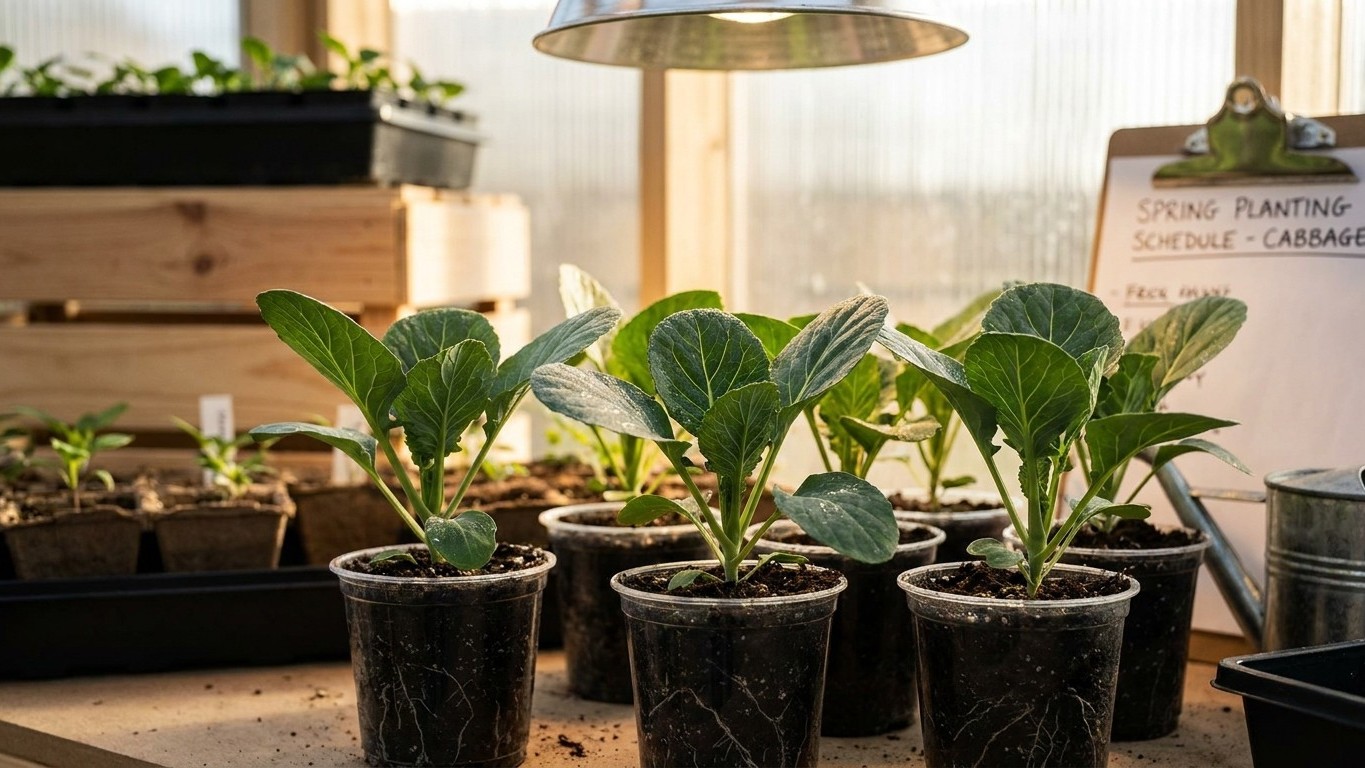

Six to seven weeks. That’s the figure Utah State University Extension gives for growing cabbage Transplants indoors to the size they need before they go into the garden: four to six mature leaves and a well-developed root system. Just as important, those transplants don’t wait for frost to clear. They go into the ground two to three weeks before your last frost-free date, seed sown directly outdoors on that same schedule.
The short answer
Why the range is six to seven weeks, not a fixed number
Utah State University Extension’s guide, Cabbage in the Garden, doesn’t pin the indoor growing period to a single number because seedling growth isn’t purely a matter of days on a calendar. Six weeks versus seven weeks comes down to how much light and warmth the seedlings get while they’re indoors. Weak light or cool room Temperatures slow leaf and root development, pushing a batch toward the longer end. Strong, steady light and consistent warmth can get seedlings to transplant size closer to six weeks. Either way, the target is the same: four to six mature leaves and roots developed enough to support the plant through the stress of transplanting.
The part that trips up gardeners used to tomatoes
Here’s where cabbage breaks from the pattern most home gardeners know. Warm-season vegetables like tomatoes go outside after the last frost has passed. Cabbage does the opposite. Utah State University Extension is explicit that transplants should be planted two to three weeks Before the Last Frost-free date for the growing area, and seeded cabbage can go in on that same early schedule. Cabbage is a cool-season crop built to handle cold soil and lingering frost risk. Treating it like a warm-season crop and waiting until after the last frost means transplanting two to three weeks later than the plant actually wants to be in the ground.
Fall cabbage runs on different math entirely. Utah State University Extension recommends planting a fall crop 50 to 75 days before the anticipated maturity date, timed so that maturity lands about one to two weeks after the first fall frost. Cultivar choice shifts that planting date by a wide margin: Golden Acre matures in 65 days, Ruby Ball in 55, Savoy Ace in 80, and Danish Ball Head in 100. A gardener planting Ruby Ball for a fall harvest starts weeks later than one planting Danish Ball Head for the same target date.
What actually decides it
Root mass is the transport system, and more weeks alone won’t fix a shortage of it
Utah State University Extension specifies leaf count and root development as the readiness markers, not just elapsed time, and there’s a reason for that. Roots are the plant’s transport network for water and nutrients. A seedling with a small, underdeveloped root system can’t move enough water into its leaves fast enough to survive the shock of being pulled from a tray and set into garden soil. That’s a transport problem, not a shortage of water or fertilizer in the soil. Watering more or feeding more won’t compensate for roots that simply haven’t had time to grow. Only additional weeks of indoor growth, under decent light, build the root mass that lets a transplant recover quickly once it’s in the ground.
Cold tolerance is why cabbage goes out early, not why it waits
Cabbage tolerates cold down to 25 degrees Fahrenheit and tops out its comfortable range around 80 degrees Fahrenheit. That spread explains the two-to-three-week early transplant window. Rather than sitting indoors until frost danger has fully passed, cabbage transplants go into the ground while the weather is still cool, using that window to establish roots in the garden before summer heat pushes past the 80-degree ceiling that slows the plant down. Frost isn’t the threat here that it is for a tomato or pepper. Cold soil and a lingering frost are within the range cabbage is built to handle.
Fall timing counts backward from two anchors, not one
Spring planting counts back from a single date, the last frost-free date. Fall planting counts back from the maturity date, which itself is set relative to the first fall frost. Utah State University Extension’s 50-to-75-day planting window before anticipated maturity, combined with a maturity date one to two weeks after the first fall frost, means the fall gardener is solving for two moving targets at once: how long the chosen cultivar takes to mature, and when the first fall frost is expected to arrive.
How to do it
- Find your own last frost-free date. Every step that follows counts backward from this single date, so it’s the number to have in hand before doing anything else.
- Add the six-to-seven-week indoor growing period to the two-to-three-week early transplant window. Six to seven weeks of growing seedlings indoors, plus another two to three weeks needed to have those transplants already in the ground before your last frost-free date, adds up to roughly nine weeks before that date. That’s when seed goes into trays.
- Sow seed 1/4 to 1/2 inch deep in trays or containers indoors, under the best light available.
- Once seedlings reach 3 to 4 true leaves, thin them so each plant has its own space to develop roots and leaves without competing with neighbors.
- Keep growing indoors until seedlings reach 4 to 6 mature leaves with a well-developed root system, the marker Utah State University Extension uses for transplant readiness rather than a fixed day count.
- Harden off the seedlings by moving them outdoors for gradually longer stretches over several days, exposing them to outdoor light, wind, and cooler temperatures in stages. This gesture lets the plant’s tissues adjust to conditions down toward its 25-degree cold tolerance before it faces those conditions full-time in the garden.
- Transplant into the garden two to three weeks before your last frost-free date, or direct-seed outdoors on that same schedule.
- For a fall crop, count back 50 to 75 days from the maturity date you’re targeting, choosing a cultivar, Golden Acre at 65 days, Ruby Ball at 55, Savoy Ace at 80, or Danish Ball Head at 100, so that maturity lands one to two weeks after your area’s first fall frost.
What goes wrong
- Waiting until after the last frost to transplant. Cabbage isn’t a warm-season crop despite going in around the same general time as some. It belongs in the ground two to three weeks before the last frost-free date, not after it. Move the planting date up.
- Seed sown too deep or too shallow. Utah State University Extension calls for 1/4 to 1/2 inch. Deeper delays or prevents emergence; shallower dries out before the seed can germinate. Stay inside that range.
- Skipping the thinning step. Leaving seedlings crowded past the 3-to-4-true-leaf stage means each plant competes for light and root space, producing weak transplants regardless of how many weeks they’ve had. Thin promptly at that stage.
- Transplanting before the plant meets the size marker. A seedling rushed into the garden before it has 4 to 6 mature leaves and a developed root system faces transplant shock it can’t recover from quickly, because its transport system, the roots, isn’t built out yet. Hold off until it hits that mark, even if that means leaning toward seven Weeks Instead of six.
- Ignoring cultivar maturity days when planning a fall crop. Planting Danish Ball Head, at 100 days to maturity, on the same fall schedule as Ruby Ball, at 55 days, misses the one-to-two-week window after first fall frost that Utah State University Extension targets. Match the 50-to-75-day backward count to the specific cultivar’s maturity days.
- Skipping hardening off. Moving seedlings straight from indoor conditions to the garden without a gradual adjustment period leaves them unprepared for outdoor Temperature swings, even within cabbage’s tolerant 25-to-80-degree range. Harden off over several days before the final transplant.
Common questions
Can cabbage seed be sown directly outdoors instead of starting it indoors?
Yes. Utah State University Extension notes that seeded cabbage may be planted at the same time as transplants, meaning direct-sown seed goes into the garden two to three weeks before the last frost-free date, at a depth of 1/4 to 1/2 inch, with thinning once seedlings reach 3 to 4 true leaves.
What happens if seedlings haven’t reached transplant size by the six-to-seven-week mark?
The size marker matters more than the calendar count. If seedlings haven’t yet developed 4 to 6 mature leaves and a well-developed root system, they need more time indoors before transplanting, since a smaller root system can’t yet move enough water to support the plant through transplant stress.
How does timing a fall cabbage crop differ from timing a spring crop?
Spring planting counts backward from the last frost-free date. Fall planting counts backward from an anticipated maturity date, using a 50-to-75-day window, with that maturity date set to land about one to two weeks after the first fall frost. Cultivar choice, from 55 days for Ruby Ball to 100 for Danish Ball Head, determines exactly when to plant.
Why does cabbage go into the ground before the last frost instead of after it, unlike tomatoes?
Cabbage tolerates cold down to 25 degrees Fahrenheit and grows best in cooler conditions, topping out around 80 degrees Fahrenheit. Utah State University Extension’s two-to-three-week early transplant window takes advantage of that cold tolerance, letting the plant establish roots in cool soil before summer heat arrives, rather than waiting out a frost risk it’s already built to handle.