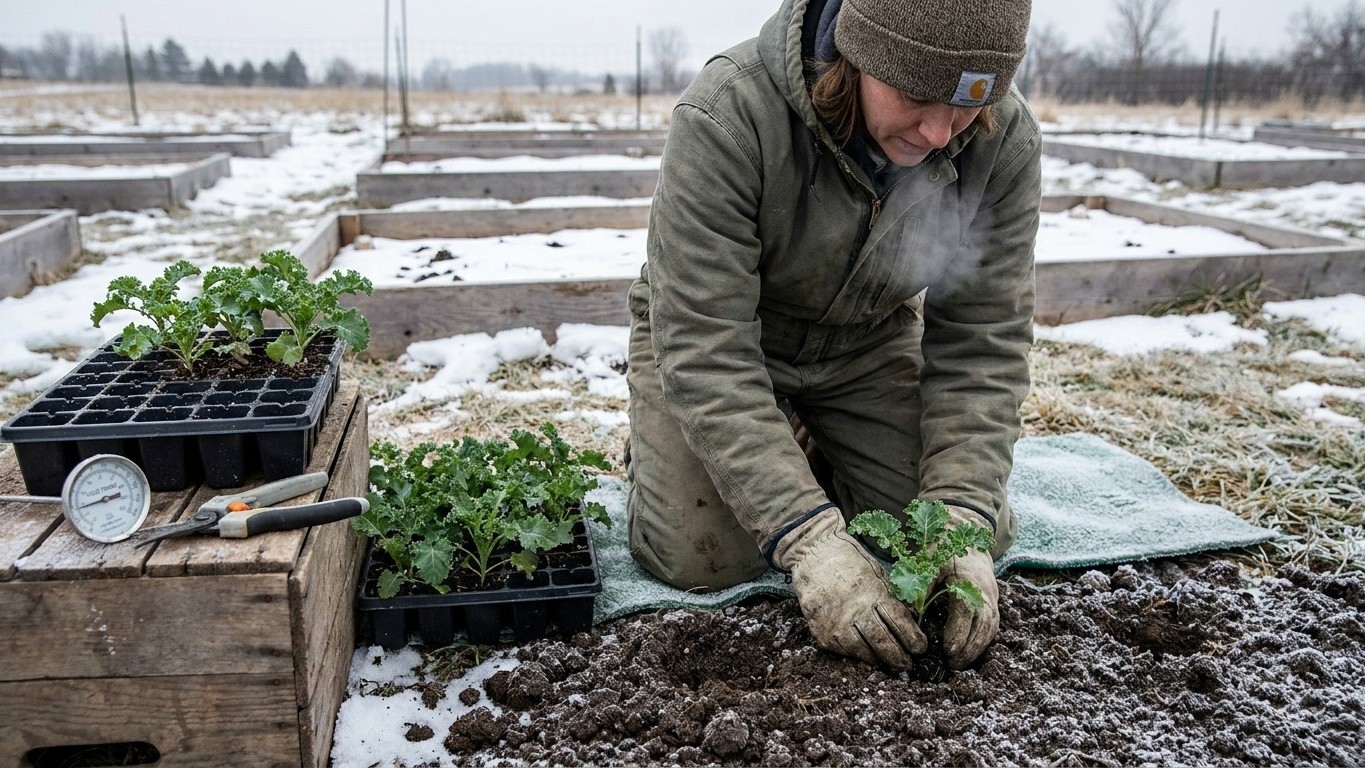

Kale transplants go into the ground 4-5 Weeks Before the last frost free date for your area, according to Utah State University Extension. That’s not a typo and it’s not a rounding of “a month.” It’s the earliest planting window of any crop in this garden series, and it means kale is often in the soil while snow is still a real possibility overnight.
The short answer
Utah State University Extension’s guide Kale in the Garden puts it plainly: transplants should be planted 4-5 weeks before the last frost free date for the growing area, and seeded kale may go in at the same time. Count backward from whatever date you use as your average last frost, and that’s your kale date. If your last frost typically falls in late April, kale goes into the ground in late March. If it falls in mid-May, you’re planting in mid-April. The math is always the same: subtract 4 to 5 weeks from your own local number.
That timing puts kale ahead of nearly every other cool-season vegetable in this cocoon. Cabbage and broccoli transplants go out 2-3 weeks before the frost date. Cauliflower follows at 1-2 weeks before. Lettuce goes in right around the frost date itself. Eggplant, a heat lover, doesn’t go out until well after frost has passed. Line them up and kale is first by a wide margin, sometimes by two to three full weeks compared to broccoli, and by nearly a month compared to lettuce.
Why does the source allow such an early date? Because kale’s foliage tolerates cold that would set back or kill a tomato or pepper seedling outright. Utah State University Extension notes that young kale plants can take temperatures down to 25 F. That’s a specific, sourced number for young plants only. Mature plants get a different, non-numeric description: “extremely hardy,” with no degree figure attached. Those two facts describe two different life stages and shouldn’t be merged into one blanket cold-hardiness number.
Practically, this means gardeners shouldn’t treat kale like the rest of the brassica family when it comes to scheduling. Growers who wait until the cabbage or cauliflower window to move kale outside are giving up several weeks of productive cool-weather growth, and kale actually improves in flavor with cold exposure. Getting the timing right isn’t just about survival, it’s about matching the plant to the part of the season it’s actually built for.
What actually decides it
Three separate mechanisms interact here, and Utah State University Extension provides a figure for some of them and none for others. Keeping them separate matters, because carrying a number across stages where the source didn’t give one leads to bad guesses.
Transplant readiness, not the calendar
Indoors, kale transplants generally need 5-6 weeks to grow to a usable stage, described specifically as 4-6 mature leaves and a well-developed root system. That’s the benchmark for “ready to go outside,” not simply a number of days since sowing. A seedling with thin, pale leaves and a shallow root mass at week 5 isn’t ready even if the calendar says it should be. Growers starting seed indoors need to count back that 5-6 week growing period from their planned transplant date, which itself is set 4-5 weeks before the last frost.
Cold tolerance splits by plant age
This is where the two hardiness facts diverge. Young plants, the kind just moved outdoors as transplants, tolerate cold down to 25 F according to the source. Mature plants are described only as “extremely hardy,” with no specific low-Temperature threshold given. That absence isn’t an oversight to fill in with a guess; the source simply doesn’t quantify mature-plant hardiness the way it does for young plants. A gardener shouldn’t assume mature kale also stops at 25 F, and shouldn’t assume it survives colder than that either. The honest answer is: young plants have a number, mature plants don’t.
Seed depth and thinning shape stand quality
Whether direct-seeded or grown for transplants, kale seed goes in 1/4 to 1/2 inch deep. Once seedlings reach 3-4 true leaves, they’re thinned, and Utah State University Extension notes the thinnings themselves can be moved to adjacent areas rather than discarded. That’s a mechanism worth using: a single seeding effort can supply two planting areas if the thinnings are transplanted rather than composted.
How to do it
- Find your average last frost date. Every step below counts backward from this single number, so pin it down first using your own local records.
- If starting seed indoors, count back 5-6 weeks from your transplant date to sow. Since transplants go outside 4-5 weeks before the last frost, and they need 5-6 weeks to grow to size indoors, seed starting happens roughly 9 to 11 weeks before your last frost date. Sow at 1/4-1/2 inch deep.
- Watch for 4-6 mature leaves and a solid root system, not just a date on the calendar. That combination, not the number of days elapsed, is the actual sign of transplant readiness.
- Move transplants outside 4-5 weeks before your last frost free date. If direct-seeding instead, seed can go into the ground at this same point in the schedule; no separate calendar is needed for the two methods.
- Space plants 12 inches apart within the row, with rows set 2 feet apart. This spacing applies whether the kale came from transplants or from direct-seeded and later thinned plants.
- Thin direct-seeded rows once seedlings reach 3-4 true leaves. Use the thinnings as transplants in another bed rather than discarding them, stretching one seeding into two plantings.
What goes wrong
- Starting seed too late for the 5-6 week window. Gardeners who count backward only from their transplant date, and forget to add the 5-6 weeks of indoor growing time, end up moving underdeveloped seedlings outside. Recheck the arithmetic: sowing needs to happen roughly 9-11 weeks ahead of the last frost date, not just 4-5.
- Copying the cabbage or cauliflower schedule instead of kale’s own. Kale’s 4-5 week window is earlier than cabbage and broccoli’s 2-3 weeks, and earlier still than cauliflower’s 1-2 weeks. Planting kale on a broccoli schedule wastes several weeks of cool-season growth the plant is capable of using.
- Assuming mature plants share the young-plant cold threshold. The 25 F figure belongs to young transplants specifically. Treating a mature stand as though it has the same numeric floor, or assuming it must be tougher without evidence, both misread what the source actually says: “extremely hardy” with no number attached.
- Skipping the thinning stage on direct-seeded rows. Crowded seedlings competing for space rarely reach the 4-6 leaf, well-rooted stage evenly. Thin at 3-4 true leaves, and move the surplus seedlings to fill another row rather than letting the whole planting stay crowded.
- Ignoring the 12-inch, 2-foot spacing once transplants go in. Tight spacing on the theory that kale is small early on leads to crowding later, since the spacing recommendation is meant for the plant’s full mature size, not its transplant size.
Common questions
Can I direct-seed kale instead of using transplants?
Yes. Utah State University Extension states seeded kale may be planted at the same time as transplants, meaning direct seeding follows the same 4-5 week-before-last-frost timeline rather than a separate schedule.
Utah State University Extension, Kale in the Garden (Drost & Johnson, March 2020).
Is kale really the earliest crop to go outside compared to other brassicas?
Within this garden lineup, yes. Kale’s 4-5 weeks before frost is earlier than cabbage and broccoli’s 2-3 weeks and cauliflower’s 1-2 weeks, making it the first of the group into the ground each spring.
Does the 25 F cold tolerance apply to kale at any age?
No. That figure is specific to young plants. Mature kale is described only as “extremely hardy” without a numeric threshold, so the two shouldn’t be treated as interchangeable.
Do the named varieties, like Starbor or Red Russian, need different timing?
The source credits Starbor (green, 55 days), Red Russian (purple, 50 days), and Scarlet (redleaf, 55 days) all with cold hardiness, but it doesn’t assign any of them a different planting window. The 4-5 week rule applies across the varieties named.