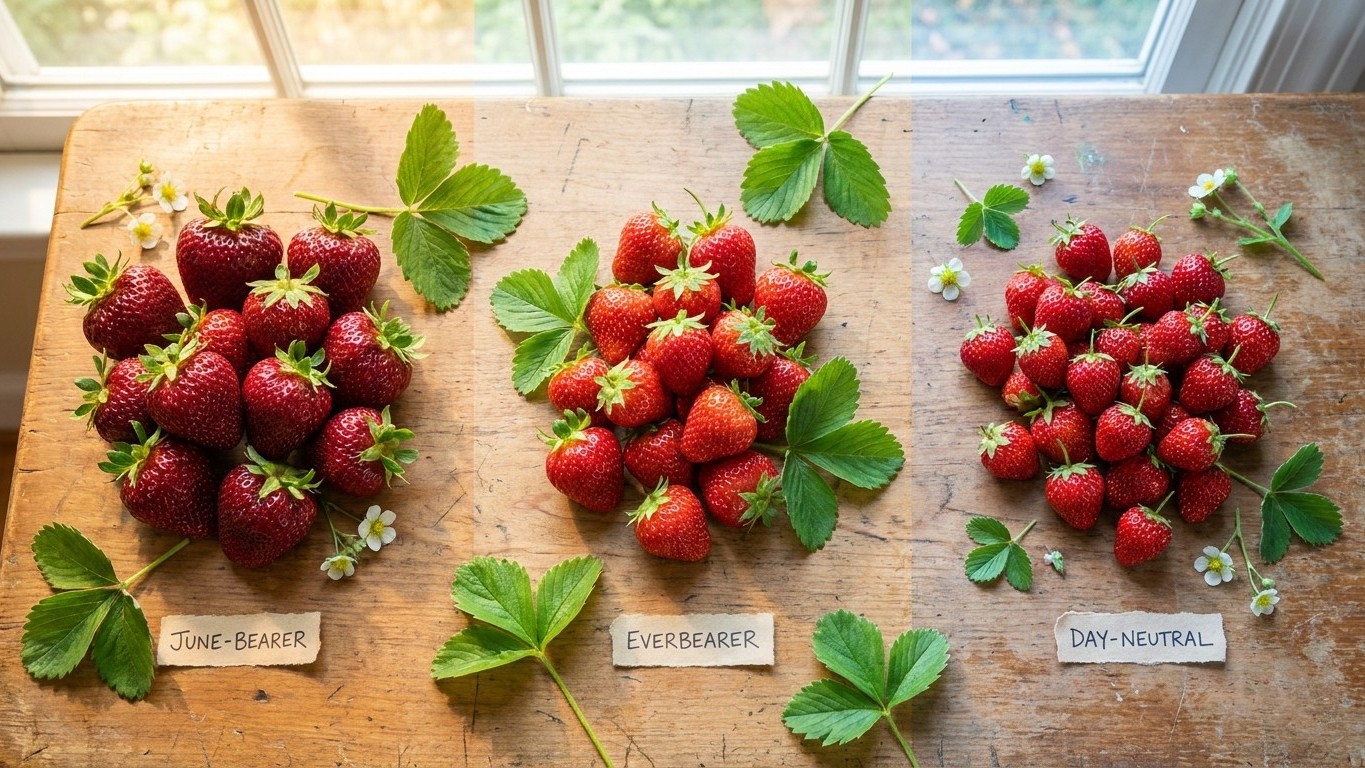

Three kinds, and the split comes down to what triggers flower formation. Utah State University Extension groups strawberries by flowering habit, not by taste or size: June-bearers, everbearers, and day-neutrals. Each type reads day length differently, and that single biological cue decides when the plant makes flower buds, and therefore when you get fruit.
The short answer
Utah State University Extension, in its guide Strawberries in the Garden, sorts every Strawberry variety into one of three groups based on how the plant responds to day length. June-bearers “initiate flower buds under the short days of autumn, with the flowers opening the following spring, and the subsequent fruit ripening in late May to June.” That’s the classic single, heavy harvest gardeners picture when they think of strawberry season.
Everbearers work the opposite way. They “initiate flower buds under long days and will generally produce a small crop in the spring and crop again in the fall.” Two smaller harvests instead of one big one, timed to the stretch of long summer daylight.
Day-neutrals ignore day length almost entirely. According to the source, they “initiate flower buds regardless of day length when temperatures are below about 70 F.” Temperature, not sunlight, runs the show for this group, which is why a day-neutral plant can keep setting buds through spring, into early summer, and again once fall cools things down, wherever the mercury stays under that threshold.
None of this is marketing language. It’s a description of a real physiological trigger inside the plant, and it’s the reason the same strawberry bed can behave Completely differently depending on which type went into the ground. A gardener who picks June-bearers and expects a second flush in September is misreading the plant’s biology, not experiencing a failed crop. Understanding which trigger applies to your plants is the single most useful piece of information before you ever dig a hole.
What actually decides it
Day length as the flower switch
The mechanism is straightforward once you see it laid out. Short autumn days push June-bearers to form flower buds that stay dormant until spring warmth opens them. Long summer days do the equivalent job for everbearers, telling the plant to build flower buds while daylight still stretches late into the evening. Day-neutrals skip the light-sensing step altogether and respond to a temperature band instead, which is why they don’t fit neatly into either camp.
Why the category names mislead
Here’s where instinct runs into trouble. The word “everbearer” suggests constant fruit, and “day-neutral” sounds like a separate, precise category. Utah State University Extension flags this directly: “under most home garden conditions, Everbearers and Day-neutrals behave similarly… many of the newer varieties sold as everbearers are actually day-neutrals.” In practice, the label on a plant tag tells you less than the description of its flowering habit does. Before assuming a variety will crop twice on a fixed spring/fall schedule, check what triggers its flowering, because the marketing name and the biological behavior often don’t match.
The temperature ceiling that changes everything
Day-neutrals look like the low-maintenance choice on paper, continuous production without waiting for a seasonal cue. But temperature cuts both ways. The source notes that “in cool climates, day-neutrals can continue to produce a light crop throughout the summer,” which sounds ideal. The catch is regional: “summer temperatures in Utah are generally too warm for season long production” once conditions climb above roughly 75 F. That’s a warm-summer limitation specific to places like Utah, not a rule that applies everywhere day-neutrals grow. In a milder coastal climate, the same plant might keep cropping straight through August.
How to do it
- Decide which flowering habit fits your climate and your patience. A single heavy harvest points to June-bearers. Two smaller harvests spread across the season points to everbearers. A longer, temperature-dependent stretch of light picking points to day-neutrals, keeping in mind the warm-summer ceiling above roughly 75 F that can shut down day-neutral production in hot-summer regions.
- Source clean, dormant, bare-root plants from a reputable nursery. The source is explicit on this point: “start with clean disease- and virus-free plants from a reputable nursery.” Skip the plant catalog fantasy of starting strawberries from seed indoors; they aren’t sown, they’re planted dormant.
- Resist digging up runners from an existing bed, yours or a neighbor’s. The extension guide warns that transplants from an established planting will “likely be starting off with plants that have plant viruses or root rot diseases.” A tempting shortcut, but not one worth the risk to a new bed.
- Plant while the roots are still dormant. Because the plants go in dormant rather than actively growing, there’s no need to time planting around the danger of a late frost the way you would with tender seedlings.
- Spread winter mulch in late November to protect the crowns and roots through the cold months once the plants have had a season to establish.
- Feed the bed in August, the point in the season the source ties fertilizer application to, supporting the plant as it builds strength for the following year’s flower buds.
What goes wrong
- Starting a bed from a friend’s runners instead of clean nursery stock. This is how root rot and plant viruses get into a new planting, and there’s no cure once a virus is established in the plant. The only real fix is removing the infected stock and starting over with certified clean, disease-free plants.
- Expecting day-neutrals to fruit all summer in a hot climate. Once temperatures push past roughly 75 F, production stalls in warm-summer regions such as Utah. The remedy isn’t more water or fertilizer, it’s adjusting expectations to a spring and fall crop instead of a continuous one, or choosing a June-bearer or everbearer suited to the local season.
- Buying an “everbearing” variety expecting two distinct, reliable flushes. Since many everbearing varieties sold today actually behave as day-neutrals, the fix is to read the flowering habit description rather than trust the category name on the tag.
- Planting a variety poorly matched to a cold region. The source notes Honeoye is “not well suited to many parts of Utah,” and Chandler “may not be hardy enough for the coldest regions of Utah.” Both are Utah-specific cautions, not blanket flaws in either variety, but they’re worth checking against your own region’s winters before committing a bed to one type.
Common questions
Can strawberries be started from seed like tomatoes or peppers? No. Utah State University Extension describes strawberries going into the garden as dormant bare-root plants, not seeds started indoors under lights.
Is there a real difference between everbearers and day-neutrals in a home garden? Not much of one, according to the source, which states the two groups “behave similarly” under typical home garden conditions, even though they’re triggered by different cues, long days versus a temperature range.
Why did my everbearing strawberries stop producing in midsummer? If you’re in a warm-summer region, temperatures above roughly 75 F can halt production in varieties that behave as day-neutrals, which many everbearers do. The plants typically resume once temperatures cool in fall.
Can I dig up plants from my own established bed to start a new patch? The extension guide advises against it. Existing beds are a common source of plant viruses and root rot, and neither has a cure once established, so a new bed should start from clean nursery stock instead.