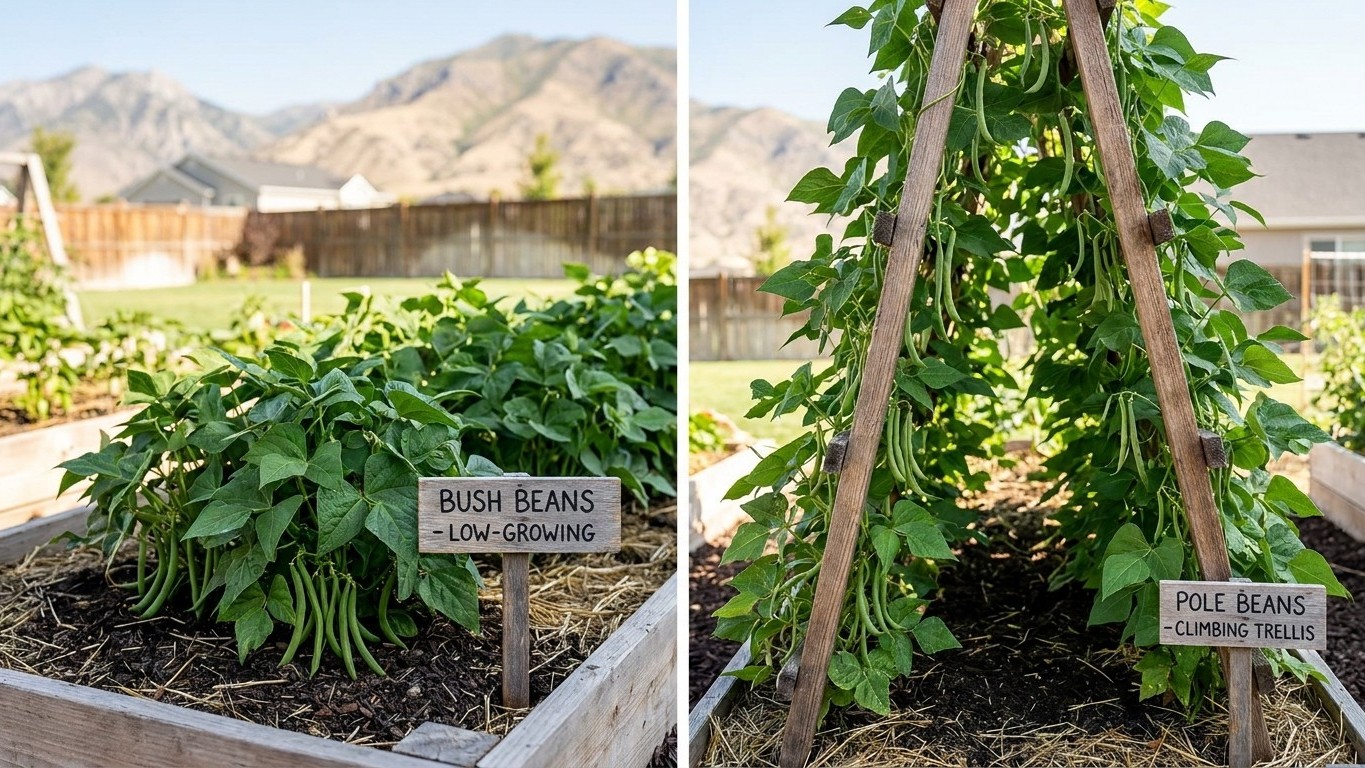

Space and support decide it. Utah State University Extension sorts garden beans into three plant types, bush, pole, and dry, and each one asks something different of your yard and your trellis budget. Bush beans need zero support and finish in a hurry. Pole beans climb, bear far longer, and demand a structure. Dry beans are really about storage, not fresh eating. The right pick depends less on taste and more on how much vertical space you’re willing to build.
The short answer
If you’ve got a small bed and no interest in building a trellis, bush beans are the practical choice. Utah State University Extension lists Blue Lake, Greencrop, Gold Crop, Kinghorn Wax, Royal Burgundy, Slenderette, Strike, and Tendercrop as bush varieties. They need no staking, mature in 50 to 60 days, and produce 7 to 10 pounds of beans per 10 feet of row. That’s a fast, low-maintenance crop, but the harvest window is short, bearing lasts only 2 to 3 Weeks Before the plants are spent.
Pole beans flip that trade. Blue Lake types, Kentucky Wonder, and Romano climb, which means they need a trellis, but the same extension source notes they yield 10 to 12 pounds per 10 feet of row and bear for 5 to 6 weeks, roughly double the bush bearing window. The extra pounds come from time, not from a bigger plant footprint. A pole bean vine occupies the same ground space as a bush plant while producing overhead instead of outward.
Dry beans, the third category, are neither about speed nor about a long harvest window. Kidney, Great Northern, Pinto, Blackbean, and Blackeye Pea are grown to fill out and dry on the plant, yielding about 20 to 25 pounds of seed per 100 feet of row. You’re not eating these fresh off the vine. You’re storing them.
None of this is about a calendar month. Beans are direct-sown, and the timing question that actually matters is how many days remain before your first fall frost when you’re deciding whether to put in one more sowing. Count backward from that date using the 50 to 60 day maturity window for bush beans, and you’ll know whether there’s still time.
| Type | Support needed | Yield per 10 ft row | Bearing duration | Example varieties |
|---|---|---|---|---|
| Bush | None | 7-10 lbs. | 2-3 weeks | Blue Lake, Tendercrop, Royal Burgundy |
| Pole | Trellis | 10-12 lbs. | 5-6 weeks | Kentucky Wonder, Romano, Blue Lake types |
| Dry | Varies | ~20-25 lbs. seed per 100 ft | Grown to full dry-down | Pinto, Kidney, Great Northern |
What actually decides it
Beans are a Warm-Season Crop, so the whole planting question sits between two frost dates: the last spring frost you’re waiting out and the first fall frost you’re racing against. That’s where a lot of gardeners get confused, because sowing “late” in the season for a warm-season plant sounds backwards. It isn’t, once you separate the two mechanisms driving the timing.
The frost-window mechanism
Beans go in the ground after the soil has warmed past the spring frost risk. From there, the only real deadline is the fall frost, which kills the plants outright. Utah State University Extension gives bush beans 50 to 60 days to maturity, so any sowing that still has that many days before the first fall frost has a real shot at producing a crop. Sow later than that window and the plant runs out of season before it runs out of growth.
The nitrogen mechanism
Here’s where beans break the usual garden rulebook. Most vegetables want a nitrogen boost to push growth. Beans don’t, because they fix Their Own Nitrogen through root nodules formed with soil bacteria. Extra nitrogen fertilizer doesn’t help the plant, it actively delays flowering and reduces pod set, according to Utah State University Extension. If you’ve gotten into the habit of feeding every bed the same way, beans are the exception that needs you to stop.
The support mechanism
Pole beans climb naturally, and once they’ve got something to climb, they keep flowering over a much longer stretch than bush types. The extension source is direct about this: pole beans “flower over long time periods thus yielding more when trellised,” and the trellis also makes harvest easier since the pods hang at an accessible height instead of hiding in low foliage. The plant does the climbing work itself. The gardener’s only job is putting the structure in place before the vines need it.
How to do it
- Decide type based on space and support, not taste. Bush beans fit a small bed with no vertical structure. Pole beans need a trellis, stakes, or fence line already standing or ready to build.
- Skip the nitrogen fertilizer at bed prep. Because beans fix their own nitrogen, adding a high-nitrogen amendment before sowing works against pod formation instead of helping it.
- Direct-sow after your soil has warmed past the spring frost risk. Beans are not started indoors or transplanted, the seed goes straight into the garden bed.
- Install the trellis for pole varieties at or before sowing. Building it after the vines start climbing means fighting tangled growth to get the structure in place.
- Plant enough row for how you’ll use the harvest. The extension guidance is 5 to 15 feet of row per person for fresh eating, with an additional 10 to 20 feet per person if you plan to can or freeze the surplus.
- Keep sowing bush beans in succession while 50 to 60 days remain before your first fall frost. Once that window closes, a new sowing won’t mature before the cold shuts it down.
- Harvest through the bearing window appropriate to the type. Expect roughly 2 to 3 weeks of picking from bush plants, and 5 to 6 weeks from a trellised pole variety.
- For dry bean types, leave pods on the plant until they dry down fully rather than picking them at the tender fresh stage.
What Goes Wrong
- Lush vines, disappointing pods: This usually traces back to one cause, nitrogen fertilizer applied out of habit. Because beans fix their own nitrogen, extra feeding delays flowering and cuts pod set. The fix is simple: leave the fertilizer bag closed for this crop.
- Pole beans sprawling on the ground with rotted or hard-to-find pods: This is a support failure, not a variety problem. Pole types climb naturally and need the structure in place early. Add the trellis and the same plant that looked like a sprawling mess starts producing at an easy picking height.
- Bush beans quitting after a couple of weeks: That’s not a disease or a mistake, it’s how the type works. Bush varieties bear for 2 to 3 weeks by nature, not because something went wrong. Succession sowing, not troubleshooting, is the answer if you want beans over a longer stretch.
- Running out of beans mid-season for canning or freezing: This comes from under-planting. The 5 to 15 feet of row per person covers fresh eating only; preserving requires an additional 10 to 20 feet per person built into the original planting plan.
- A late sowing wiped out by the first cold snap: This happens when a succession planting goes in without counting days to maturity against the fall frost date. Once fewer than 50 to 60 days remain before that frost, a new bush bean sowing won’t finish in time.
Common questions
Can I grow bush and pole beans in the same garden?
Yes. Nothing in Utah State University Extension’s guidance suggests they compete or cross in a way that matters for the home gardener. Many gardeners use bush beans for a fast early crop and pole beans on a trellis for a longer summer harvest from the same bed layout.
Do pole beans really need a full trellis, or will a few stakes do?
The extension source specifies a trellis or comparable support structure, noting that plants “climb naturally so little additional work is required other than construction of the supports.” The structure needs to be sturdy enough to hold vine weight through the full 5 to 6 week bearing window.
Why shouldn’t I fertilize beans like the rest of my vegetable garden?
Because beans fix their own nitrogen through bacteria in their root nodules, added nitrogen fertilizer doesn’t feed growth the way it does for crops like tomatoes or squash. Instead, Utah State University Extension notes it delays flowering and reduces pod set, the opposite of what most gardeners expect from feeding a bed.
How much row do I actually need to plant?
Utah State University Extension recommends 5 to 15 feet of row per person if you’re eating the beans fresh, plus an additional 10 to 20 feet of row per person if you’re planning to can or freeze part of the harvest for later.