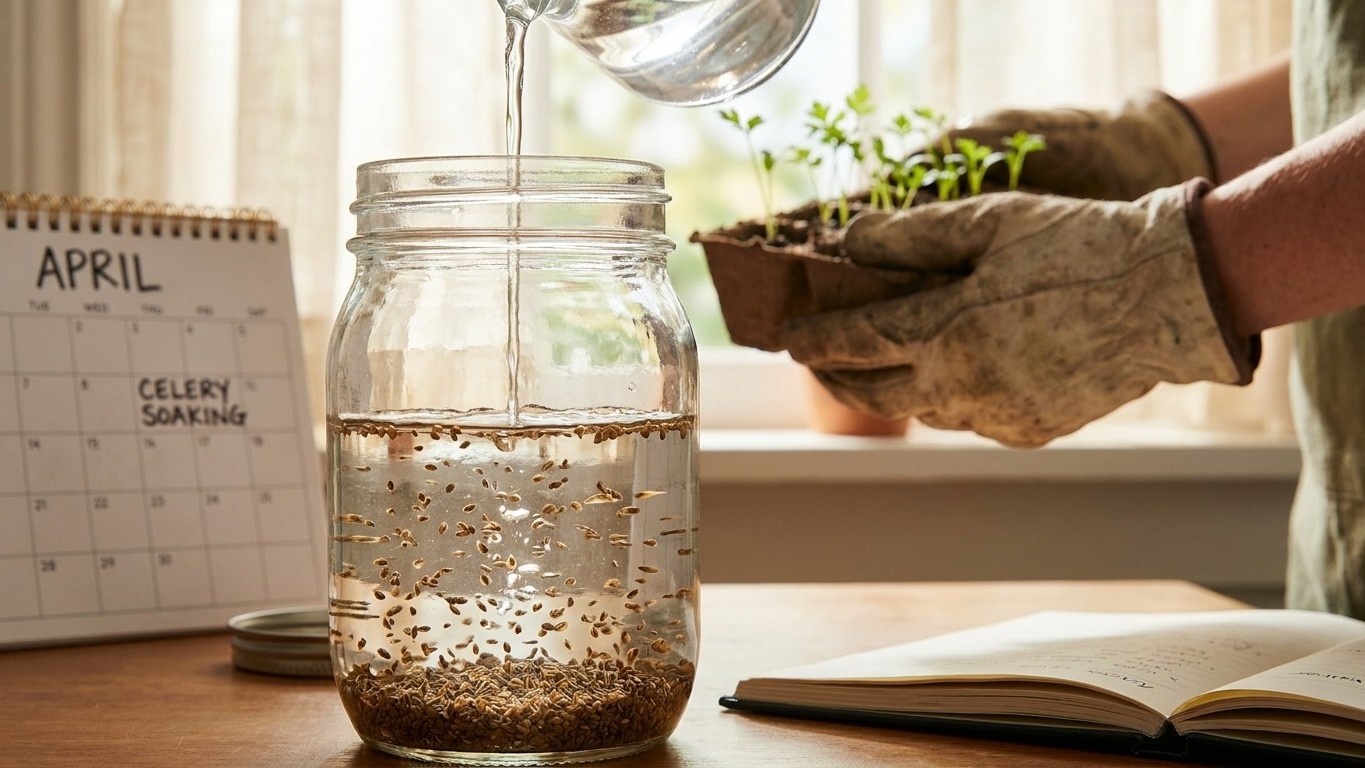

Soak celery seed in water before you sow it, and change that water every day until you plant. Utah State University Extension says the seed carries natural germination inhibitors, and soaking is what leaches them out. Then count nine to thirteen weeks of indoor growth before the seedlings go into the garden, not a month circled on a wall calendar. What actually triggers the move outdoors is three to four mature leaves and a root system that holds together, not a date.
The short answer
Utah State University Extension lays out celery’s timeline in Celery in the Garden, and the guidance splits into two separate pieces of information that gardeners often blur into one guess. The first is germination itself: seed soaked in water, with that water swapped out daily, breaks dormancy far more reliably than seed sown dry, because the seed coat holds chemical inhibitors that only leaching removes. Skip the soak and you get patchy, staggered sprouting that has nothing to do with soil Temperature or planting depth.
The second piece is the indoor growing period, and here the source gives a range rather than a single number: nine to thirteen Weeks Before the seedlings are ready to move outside. That four-week spread is not vagueness. It reflects how much celery’s early growth bends around light, warmth, and how consistently the water in the seed tray gets changed at the start. A slower run of soaking or a cooler windowsill pushes a grower toward the thirteen-week end. A well-managed tray under steady conditions can hit the nine-week mark.
What decides when those nine to thirteen weeks actually start is not a fixed date either. Utah State University Extension ties the count to your own last frost date, and explicitly says the outdoor transplant timing depends on your area. So the arithmetic runs backward from a date only you know: your local average last frost, which your county extension office publishes. Count nine weeks back from that date for the earliest reasonable start, thirteen weeks back for the latest, and you have your entire indoor sowing window without a single month name attached to it.
Transplants themselves should show three to four mature leaves and a well-established root system before they leave their trays. That is the actual green light. It matters more than which week of the nine-to-thirteen-week window you land on, because a seedling that hits that leaf and root benchmark early is ready early, and one that hits it late needs the extra time regardless of what the calendar says.
What actually decides it
The seed’s built-in germination inhibitors
Celery seed is chemically stubborn on its own. Utah State University Extension explains that the seed contains natural inhibitors, compounds baked into the seed coat that suppress sprouting until conditions leach them away. Soaking in water, with a daily water change, is the leaching mechanism. Skip it, or soak once and let the water sit, and some seeds break dormancy while others stall, which is exactly why a single seed packet sown dry so often comes up in uneven waves over a week or two instead of together.
Readiness is a leaf count, not a page on the calendar
The nine-to-thirteen-week window exists because celery’s early development is genuinely variable, and the source builds its transplant rule around a physical marker instead of a fixed day: three to four mature leaves, plus roots that hold the root ball together when you lift the tray. A seedling grown under strong light and consistent warmth can reach that marker near the nine-week mark. One grown on a cooler windowsill, or started from seed that took longer to break dormancy, needs closer to thirteen. Checking leaves and roots, rather than counting to a specific week, is what actually tells you the plant is ready.
Why celery is planted close together
Spacing is not cosmetic. Utah State University Extension explains that a tight planting forces tall growth and long petioles, which is exactly what a home gardener wants from celery, since the stalk is the harvested part. Crowd the plants and they compete upward for light rather than sprawling outward, which is the mechanism behind the spacing instruction that follows.
How to do it
- Find your area’s average last frost date. Your local extension office publishes it by county, and every later step counts backward from that single date.
- Count backward nine weeks from your last frost date for the earliest sensible indoor sowing, and thirteen weeks back for the latest. That gap is your entire sowing window, expressed only in weeks before frost.
- Soak the seed in water before sowing, and change that water every day while it soaks, per Utah State University Extension. This leaches out the seed’s natural germination inhibitors and evens out sprouting.
- Sow the soaked seed indoors, inside the window you just counted, and grow the seedlings on under consistent light and warmth.
- Watch the seedlings, not the days. Transplant once they show three to four mature leaves and a well-established root system, whichever week of the nine-to-thirteen-week window that happens to land on.
- Space transplants 12 inches apart, in rows spaced 2 feet apart. That tight spacing is deliberate: it forces the tall growth and long petioles that loose spacing works against.
What goes wrong
- Germination comes up patchy and staggered. The seed went into the tray dry, or was soaked once without a daily water change, so the natural inhibitors in the seed coat never fully leached out. There is no fixing that batch once it is sown. Soak the next round of seed and change the water every day until you sow.
- Transplants sulk or stall after moving outside. They went into the garden before reaching three to four mature leaves and a solid root system, chasing a week on the calendar instead of the actual readiness marker. Once they are set back this way, that setback stands. Wait for the leaf-and-root benchmark on the next batch rather than a target week.
- Petioles come out short and stringy instead of long. The plants were spaced wider than 12 inches, which let them sprawl instead of compete upward for light. That shape gets locked in early in the plant’s growth and cannot be corrected partway through the season. Next planting, hold to 12 inches apart in rows 2 feet apart.
- Seedlings turn leggy and weak before transplant day. They sat indoors past the thirteen-week mark, waiting on a date rather than moving once they hit three to four mature leaves and an established root system. Once seedlings outgrow their trays, that stress is already on the books. Transplant as soon as the leaf-and-root marker is met, even if it lands earlier in the window than expected.
Common questions
Why did my celery seed germinate unevenly? Utah State University Extension attributes uneven celery germination to natural inhibitors inside the seed coat. Soaking the seed in water, with a daily water change, leaches those inhibitors out before sowing. A batch already sown dry cannot be corrected retroactively; the fix applies to the next round of seed.
Can I just sow celery seed straight into the garden bed? Utah State University Extension describes celery as generally transplanted, grown from seed indoors first and moved outside once the seedlings are ready. The source’s guidance centers on indoor sowing and transplant timing rather than direct garden sowing.
How do I know exactly when to transplant celery seedlings? Look at the plant, not the date. Utah State University Extension sets the marker at three to four mature leaves plus a well-established root system, something that can happen anywhere within the nine-to-thirteen-week indoor window depending on light, warmth, and how the seed was handled at sowing.
Why does spacing change how tall celery grows? Utah State University Extension explains that a tight planting, 12 inches apart in rows 2 feet apart, forces tall growth and long petioles by pushing plants to compete upward for light. Wider spacing removes that competition and tends to produce shorter, less desirable stalks.