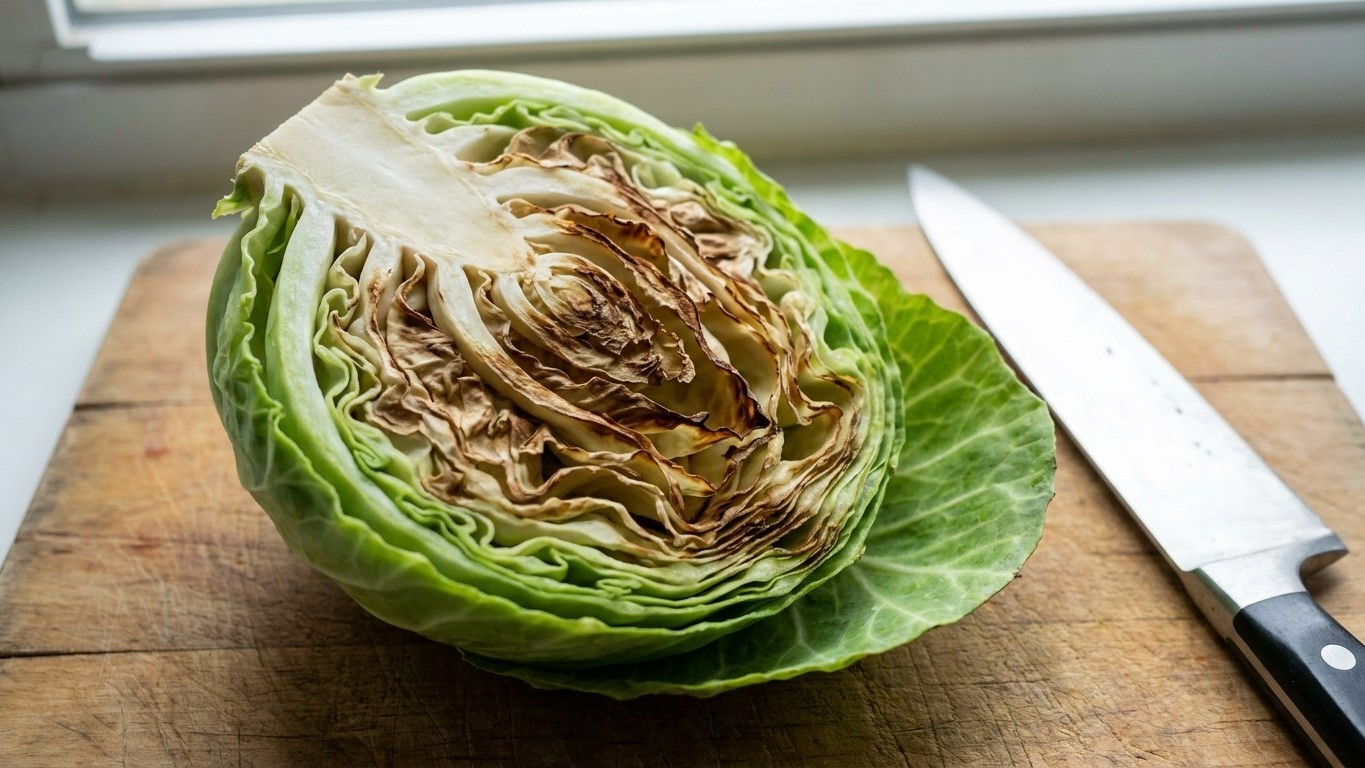

Tipburn shows up as brown, dead edges on the inner leaves of a cabbage head, and the fix is not more calcium in the soil. According to Utah State University Extension, most Utah soils already carry very high calcium levels. The real cause is a transport failure: during irregular growth spurts, calcium never reaches the young inner leaves, and the tissue burns from the edges in.
The short answer
Utah State University Extension states it plainly in its guide, Cabbage in the Garden: “Most soils in Utah are very high in calcium so plants have access to plenty of this nutrient. However, when plants go through irregular growth periods, calcium is not adequately transported to these younger, inner leaves and this causes the leaf edges to ‘burn’ or turn brown.” That single sentence rules out the instinct most gardeners have when they see a scorched leaf edge, which is to reach for a calcium supplement or a handful of extra fertilizer.
The frustrating part of tipburn is that it hides. The outer wrapper leaves of the head look Completely normal, green, crisp, unblemished. The damage is happening on the inner leaves, tucked inside the developing head where nobody can see it until the cabbage is cut open in the kitchen. A gardener can walk past a row of cabbage all season, admire the tight, heavy heads, and only discover the brown, papery edges once the knife goes in.
That delayed reveal is exactly why the diagnosis matters. If the soil already has plenty of calcium, and Utah’s soils generally do, then pouring on more calcium (through lime, gypsum, or a calcium spray) does nothing to solve a problem that was never about supply. The nutrient is sitting right there in the root zone. The plant’s own internal plumbing failed to move it to where it was needed, at the moment it was needed, in the amount it was needed.
Utah State University Extension’s stated remedy has nothing to do with adding calcium at all. It points instead to “uniform irrigation, moderate fertilizer additions, and mulches,” and it specifically warns growers to “avoid excess fertilizer and water stress during head development.” That is a watering and feeding discipline, not a soil amendment. The short answer to why calcium never reached the inner leaves is that the plant’s growth was uneven, usually because water supply was uneven, and the internal transport system that carries calcium simply could not keep pace with the leaves that needed it most.
What actually decides it

Calcium travels with water, not on its own
Calcium does not move through a plant the way sugars do. It rides along with the water stream pulled up through the xylem as the plant transpires. Leaves that are actively pumping a lot of water through themselves pull a lot of calcium along with it. Leaves that are shaded, young, or growing more slowly, like the tightly wrapped inner leaves of a forming cabbage head, pull comparatively little water and therefore receive comparatively little calcium, even while they are surrounded by soil that has plenty of it sitting untouched.
Irregular growth periods break the supply line
This is the mechanism Utah State University Extension points to directly. A cabbage plant that grows steadily keeps a steady, predictable pull of water and calcium moving toward every part of the plant, inner leaves included. A plant that alternates between drought stress and a sudden flush of water, or between a lean stretch and a sudden burst of fertilizer, grows in fits and starts. Each growth spurt after a stall creates new tissue faster than the plant’s calcium delivery can catch up, and the newest, innermost leaves are the ones left short.
Why adding more calcium does not fix a transport problem
This is worth restating because it goes against instinct. Tipburn looks like a deficiency symptom, brown, dying leaf margins are the classic textbook picture of “not enough of a nutrient.” But when the soil test already shows abundant calcium, dumping in more does not create a bigger supply line into the inner leaves; it just adds to a surplus that was never the bottleneck. The bottleneck is the water-driven transport pathway itself, and the only way to fix a transport problem is to make the transport more even, not to make the supply bigger.
How to do it
- Get transplants in the ground Before the Last Frost. Cabbage, like broccoli, goes in before the last frost date rather than waiting for frost danger to pass the way a tomato would. Count backward from your own local last frost date to time your transplant window, since cabbage tolerates cold down to 25 degrees Fahrenheit once established, giving it real margin against a late cold snap that would set back a more tender crop.
- Choose a variety with a maturity length that matches your season. Utah State University Extension lists Golden Acre at 65 days to maturity, Ruby Ball at 55 days, Savoy Ace at 80 days, and Danish Ball Head at 100 days. A shorter-season variety like Ruby Ball reduces the total stretch of time during which an irrigation lapse could trigger an irregular growth spurt.
- Water on a uniform schedule, not a reactive one. The gesture here is simple: irrigate on a fixed interval rather than waiting for the soil to look dry or the plant to look wilted. The mechanism behind it is that consistent soil moisture keeps the plant’s water uptake, and therefore its calcium uptake, moving at a steady rate instead of stalling and then surging.
- Lay down mulch around the base of each plant. Mulch buffers soil moisture swings between waterings, which is the same uniform-supply logic applied passively, so the root zone stays evenly moist even if a watering gets delayed by a day or two.
- Keep fertilizer moderate, especially as heads begin to form. Cabbage tops out its heat tolerance around 80 degrees Fahrenheit, and heavy fertilizer pushes rapid leafy growth right when the plant should be settling into steady head development. Utah State University Extension specifically advises against excess fertilizer during this stage, since a growth surge at exactly the wrong time is what starves the inner leaves of calcium.
- Avoid water stress through the entire head-development stage. This is the stretch where the inner leaves are forming and are most vulnerable to a transport gap, so the discipline of even watering matters more here than at any earlier point in the plant’s life.
What goes wrong

- Treating tipburn as a calcium deficiency and adding more calcium to the soil. Since Utah soils are already very high in calcium, per Utah State University Extension, this does nothing. The remedy is uniform irrigation and moderate fertilizer, not a soil amendment.
- Letting the soil dry out, then flooding it to compensate. This swing is precisely the “irregular growth period” the source describes as the trigger for tipburn. The fix is a fixed watering interval reinforced with mulch to smooth out the gaps between waterings.
- Watering overhead and inviting Alternaria leaf spot. This disease shows up as spots in concentric circles, sooty black, and Utah State University Extension recommends avoiding overhead irrigation and rotating crops to prevent it. Switching to drip or furrow irrigation removes the wet-leaf conditions the disease needs.
- Assuming a damaged head is disease when it is actually pests. Cabbage worms and loopers hide inside the heads themselves, flea beetles can reduce plant stands or kill seedlings outright, and aphids crinkle the leaves. Each of these looks like a different kind of trouble than tipburn, and confusing them delays the correct response, whether that is handpicking, row covers for seedlings, or targeted monitoring for aphid colonies.
- Pushing excess fertilizer to “help” a struggling plant. A stressed cabbage plant often gets a heavy feeding as a reflex fix. Utah State University Extension specifically warns against excess fertilizer during head development, since it accelerates the very growth spurts that leave inner leaves short on calcium.
Common questions
Does tipburn mean my soil needs a calcium supplement?
No. Utah State University Extension states that most Utah soils are already very high in calcium. Tipburn is a transport failure during irregular growth, not a shortage in the ground.
Will I see tipburn before I cut the head open?
Usually not. The outer leaves develop normally while the damage occurs on the younger inner leaves, which stay hidden until harvest.
Can spraying calcium on the leaves prevent tipburn?
The source does not list a foliar spray as a remedy. Its stated fix is uniform irrigation, moderate fertilizer, and mulch, addressing the growth pattern rather than the calcium supply itself.
Is tipburn the same problem as Alternaria leaf spot?
No. Alternaria leaf spot is a fungal disease that produces sooty black spots in concentric circles and is controlled by avoiding overhead irrigation and rotating crops, a separate issue from the calcium transport failure behind tipburn.