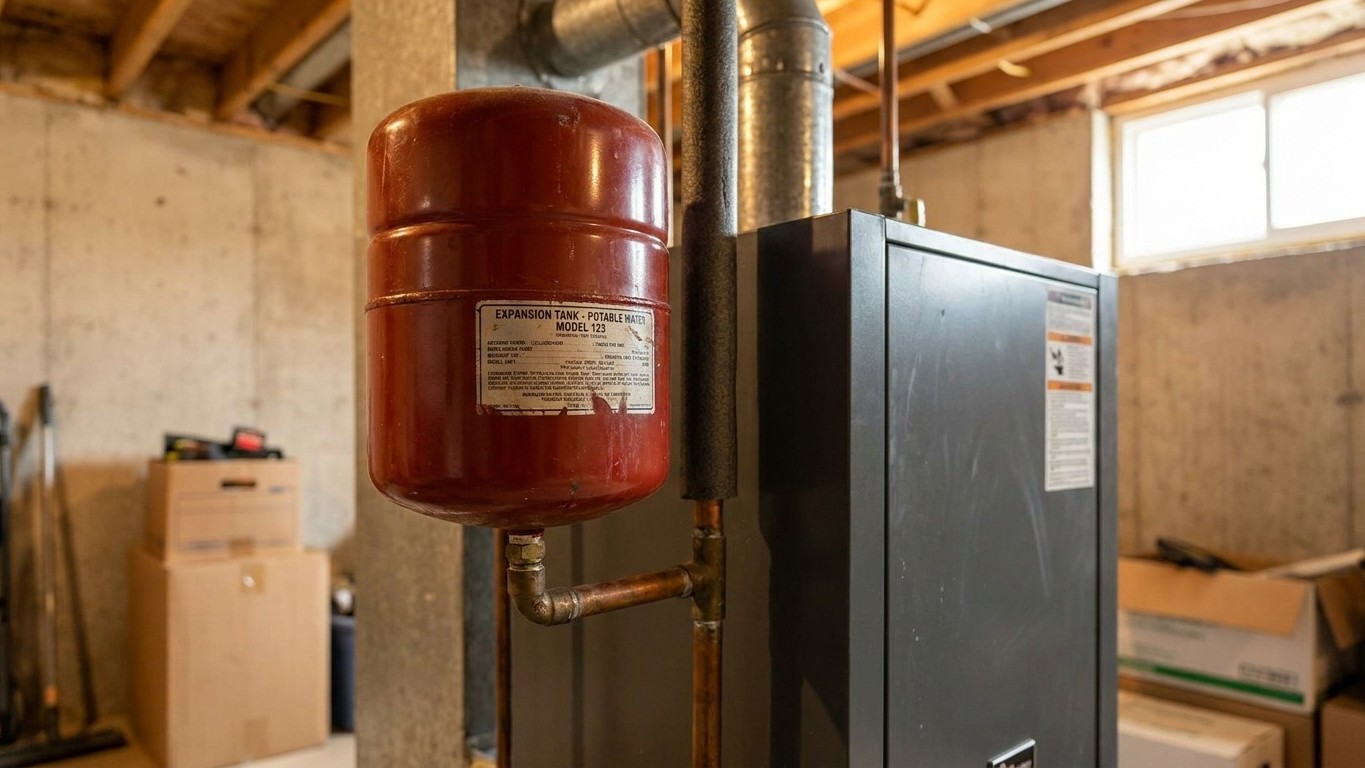

An expansion tank absorbs the extra volume water creates as it heats up in a closed boiler loop. Most homeowners never look at it, never test it, and often can’t name what it’s for. That’s a problem, because a failed expansion tank shows up not as a leak in the tank itself, but as pressure swings and relief valve discharges everywhere else in the system.
Water expands, and something has to give

Heat water in a sealed loop and it needs more room than it had cold. There’s no place for that extra volume to go unless something in the system gives way. That’s the entire job of the expansion tank: it holds a cushion of air (or a bladder pressing against air) that compresses as water expands into the tank, then relaxes as the water cools and contracts back. Without that cushion, a closed hydronic system would see pressure spike every time the burner fires.
Look for it near the boiler itself, usually connected by a short pipe off the main supply or return line. In older systems, it’s frequently mounted overhead, sometimes tucked against a joist near the ceiling of a basement or utility room. It’s small, usually a steel drum, sometimes gray or red, roughly the size of a large fire extinguisher or a bit bigger, depending on the size of the system it serves. Modern replacements are usually diaphragm or bladder-style tanks, more compact, often mounted low near the boiler rather than overhead.
The tank doesn’t do anything dramatic when it’s working right. That’s the point. There’s no motor, no moving parts you’d notice, no sound. It sits there holding a pocket of compressed air on one side of an internal barrier (or, in the oldest designs, floating loose at the top of an air-filled steel shell with no barrier at all). Water pushes in during heating cycles, air compresses, pressure stays inside a normal working range. When the water cools, the air pushes back, water recedes, pressure drops back down. That quiet cycle repeats every single time the boiler runs, for years, without anyone thinking about it.
That silence is exactly why nobody checks it. A furnace filter gets dirty and you can see it. A thermostat misbehaves and you notice right away. The expansion tank fails slowly, invisibly, and by the time its effects show up, the tank itself is rarely the first place anyone looks. It’s an appliance whose entire function is to absorb pressure changes, and it’s usually a footnote in the manual, if it gets mentioned by name at all. The U.S. Fire Administration advises that people “Maintain heating equipment and chimneys by having them cleaned and inspected each year by a professional,” and the expansion tank sits inside that broader inspection, one small component among many that a technician is trained to check but a homeowner typically isn’t.
How it fails
Two things go wrong inside an expansion tank, and both end the same way: the tank stops cushioning anything.
The air charge leaks out
In older, non-bladder tanks, the air pocket at the top can slowly absorb into the water or leak out through fittings over years of operation. Once that air charge is gone, the tank has nothing left to compress. Water fills the space where air used to be, and the tank becomes, in effect, just another length of pipe. It’s no longer absorbing anything.
The bladder splits
In newer diaphragm and bladder-style tanks, the rubber membrane that separates air from water can crack or tear after enough expansion and contraction cycles. Once it splits, water crosses into the air chamber, waterlogging the tank from the inside. Same result as the older design losing its charge: no more cushion, no more room for the expanding water to go.
Either failure produces the same downstream symptom. With nowhere left to absorb the volume increase, pressure inside the closed loop swings hard between the cold, idle state and the hot, running state. That swing has to be released somewhere, and the system’s relief valve is built to do exactly that when pressure exceeds its rated threshold. So a waterlogged expansion tank often shows up first as a relief valve that starts weeping or discharging water, sometimes only during heating cycles, sometimes constantly. Many homeowners replace the relief valve, see the dripping stop for a while, and never realize the tank upstream is what actually caused it to open in the first place.
There’s a simple physical check that points toward a waterlogged tank, though it doesn’t replace a professional inspection. A healthy tank, tapped gently, sounds and feels different top to bottom: hollow and cool near the top where the air pocket sits, heavier and warmer lower down where water sits. A waterlogged tank feels heavy and uniformly cool (or uniformly warm, depending on system temperature) from top to bottom, because it’s full of water with no air cushion left to separate. Another sign worth noting on the pressure gauge near the boiler: pressure that climbs sharply as the system heats up, rather than staying in a steady, narrow band, suggests the tank isn’t doing its job of absorbing that expansion anymore.
None of this is about combustion, but it’s worth remembering the boiler underneath the plumbing is still a fuel-burning appliance in most homes. That means the standard rules around carbon monoxide apply in full: it’s a colorless, odorless gas, and a functioning CO alarm is required. An electric boiler doesn’t carry that particular risk, since it burns nothing, but gas- and oil-fired units do, and a pressure problem is a separate issue entirely from a combustion problem, even though both trace back to the same appliance.
Whose job it is
Checking an expansion tank’s air charge isn’t a five-minute homeowner task, and it’s worth being direct about that. To test or recharge the air side of the tank correctly, a technician generally needs to isolate that section of the system and drain water out of it first, since the air charge is checked and adjusted while the tank is disconnected from system pressure. That’s plumbing and hydronic work, not something to attempt by opening a valve at random on a pressurized closed loop.
This is a service task, plain and simple, one that belongs in the same annual visit the U.S. Fire Administration recommends for heating equipment generally. And it’s worth putting the cost of neglect in perspective: an expansion tank is one of the cheapest individual parts on a boiler system, replaced far less often than filters or valves, yet it’s also among the components most often skipped entirely during routine service calls, precisely because it sits quietly and gives no obvious sign of trouble until a relief valve starts dripping or a pressure gauge starts climbing where it shouldn’t.
None of this connects to the boiler’s combustion efficiency rating, which is a separate measure entirely. AFUE (Annual Fuel Utilization Efficiency) describes the ratio of a boiler’s annual heat output to the total annual fossil fuel energy it consumes, so an AFUE of 90% means 90% of the fuel’s energy becomes usable heat in the home while the remaining 10% is lost up the flue and elsewhere. The U.S. Department of Energy’s Federal Energy Management Program notes that an ENERGY STAR-qualified residential gas boiler meets 0.90 AFUE, and its own worked example compares models rated at 0.84, 0.90, and 0.97 AFUE. That guidance is written specifically for federal purchasers weighing procurement costs, not for a household deciding whether to replace a boiler, so its dollar thresholds shouldn’t be read as consumer advice. It’s a useful number for understanding how a boiler burns fuel, but it has nothing to do with whether the expansion tank downstream is holding its charge.
Controls matter here too, in a different way. A separate DOE study on hydronic heating, “Optimizing Hydronic Heating for Comfort and Performance,” found that “Unfortunately, control settings are often best guesses and are not typically optimized.” That study focused on multifamily buildings and central hydronic systems, where its measured savings (an average of 11% in gas use, with a maximum of 33%) apply to that building type specifically and shouldn’t be assumed to carry over to a single-family home. Still, the underlying point translates loosely: a lot of what keeps a hydronic system running well, tank pressure included, gets set once at installation and never revisited.
Where numbers matter, like the correct air charge pressure for a specific tank or the system’s target operating pressure, that information belongs to the appliance’s own label and installation manual, and any question about how those figures interact with local plumbing code should go to the local code office rather than a general guide. Every system is sized and set differently, and the label on the tank itself is the accurate source, not a rule of thumb.
Common questions
How long does a boiler expansion tank typically last?
There’s no single fixed lifespan quoted across all systems, since it depends on tank design, water quality, and how many heating cycles the system runs through each year. What matters more than counting years is having a technician check the tank’s condition during the same annual inspection recommended for the rest of the heating equipment.
Can I check the expansion tank myself without draining the system?
A rough external check, tapping the tank to feel for a hollow top and heavier bottom, can give a hint that something’s off, but confirming and correcting the air charge requires isolating and draining part of the system. That step is best left to a qualified technician.
Does a waterlogged expansion tank always cause a leak?
Not necessarily a leak from the tank itself, but it commonly causes the relief valve elsewhere in the system to start discharging, since pressure has nowhere else to go once the tank’s air cushion is gone. Replacing a leaking relief valve without addressing a waterlogged tank often means the same symptom returns.
Is a bad expansion tank a safety hazard?
It’s primarily a pressure and equipment-wear issue rather than a combustion safety issue. That said, the boiler itself remains a fuel-burning appliance in most gas and oil systems, so a working carbon monoxide alarm is still essential regardless of what’s happening with the expansion tank, since CO is colorless and odorless and gives no other warning.