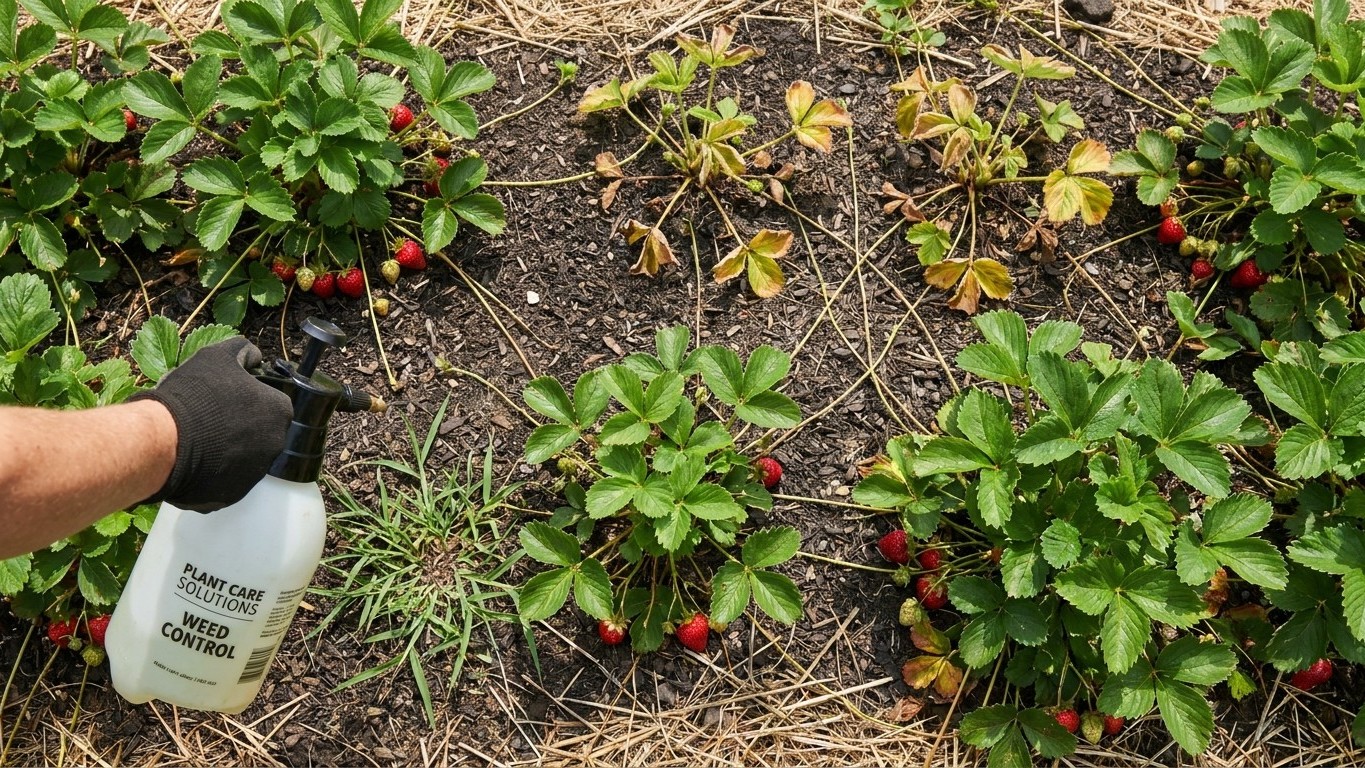

A systemic weedkiller applied near one strawberry plant in a matted row can kill or stunt plants several feet away that were never touched by spray. Utah State University Extension explains why in its guide Strawberries in the Garden: matted-row plants stay connected through runners into one interconnected network, and a systemic herbicide that reaches a single daughter plant travels back through that network into the rest of the bed.
The short answer
The damage isn’t drift. It’s plumbing. Strawberries grown in the matted-row system spread by runners that root into daughter plants, and those daughter plants stay physically and vascularly linked to the mother plant and to each other. Utah State University Extension is blunt about what that means for herbicide use: “Systemic herbicides such as RoundUp should not be used in or around strawberry beds, particularly in matted rows.” The reasoning follows directly from how the plants grow. A systemic product doesn’t just kill the tissue it lands on. It’s designed to move inside the plant, and in a matted row that internal plumbing doesn’t stop at one crown. It runs through the whole network.
That’s the part almost no home gardener expects. You spray a patch of crabgrass creeping in at the edge of the bed, maybe brush a strawberry runner while you’re at it, and weeks later plants in the middle of the row start yellowing or dying for no visible reason. There was no visible reason at the spray site either, because the runner that got hit wasn’t the plant that died. The chemical moved.
Utah State University Extension frames this inside a bigger point about weeds in strawberry beds generally: “The most common limiting factor in the life of a strawberry patch is weeds. Strawberries do not compete well with weeds for water and nutrients.” The fix the source recommends is prevention, not correction. “Sites should be free of perennial weeds before planting.” That single sentence does more work than any herbicide applied after the fact, because it removes the need to spray inside or near an established bed at all.
This is also why the timing of planting matters less than gardeners assume. Strawberries go into the ground as dormant bare-root plants, not seed, and because they’re dormant there’s no need to wait for frost danger to pass the way you would with a tender seedling. The plant isn’t actively growing yet. That earlier planting window gives roots time to establish before the bed fills in and before any weed problem gets established alongside it.
What actually decides it
Why the network problem starts at planting, not at spraying
The herbicide risk is really a design consequence of the matted-row system itself. Matted rows are built to fill in: mother plants send out runners, runners root as daughter plants, and within a season or two the row is a solid mat of connected crowns rather than individual, isolated plants. That’s the whole point of the system for production. It’s also exactly what makes a systemic herbicide dangerous anywhere near the bed. There’s no way to treat “just one plant” in a network that shares tissue.
This is why site prep before planting carries so much weight in Utah State University Extension’s guidance. Clearing perennial weeds from the site before the strawberries go in isn’t a nice-to-have step. It’s the only window where an aggressive weed-control approach is actually safe to use, because once the bed is planted and the runners start connecting plants to each other, herbicide options narrow sharply.
Why plastic mulch and straw solve different halves of the same problem
Physical control methods split along the same divide as the two production systems themselves. In the hill system, where runners are removed and each plant stays separate, plastic mulch laid within the row controls weeds effectively because there’s no matted network to worry about disturbing. In matted rows, straw mulch gives partial control, but it isn’t a complete solution. Utah State University Extension is clear that hand weeding is still needed under both approaches. Neither mulch replaces the work; both reduce it.
That distinction matters when a gardener is deciding which system to plant in the first place. A hill system with plastic mulch trades some upfront labor and material cost for a weed-control method that doesn’t carry the systemic-herbicide risk in the same way, simply because the plants aren’t interlinked. A matted row trades that safety margin for higher plant density and less initial setup, at the cost of needing hand weeding as the primary tool for the life of the bed.
How to do it
- Clear the site of perennial weeds before planting. Utah State University Extension names this as the condition for a healthy bed: sites should be free of perennial weeds before the strawberries go in, because established perennial weeds compete with strawberries for water and nutrients in a way the plants can’t outcompete on their own.
- Plant dormant bare-root plants without waiting on frost. Because the plants are dormant at planting, there’s no need to hold off for frost danger to pass the way you would with tender transplants.
- Choose the production system before the runners start. Decide on hill system (runners removed, individual plants) or matted row (runners kept, daughter plants allowed to root) at planting, since this decision determines which weed-control tools stay safe to use later.
- Lay plastic mulch within the row if growing on the hill system. This controls weeds within the row for plants that remain physically separate from each other.
- Use straw mulch for partial control if growing matted rows. Expect it to reduce, not eliminate, the weed load, and plan on hand weeding as the backup for both systems.
- Remove first-year flowers. This directs the plant’s energy into establishing roots and runners instead of fruit production before the bed is mature enough to support a crop.
- Spread winter mulch in late November. This is the point in the season when Utah State University Extension ties mulching directly to protecting dormant crowns through winter.
- Feed the bed in August. This is the fertilizer application the source ties to a specific task in the plant’s annual cycle, supporting the next season’s flower bud development.
- Keep any systemic herbicide away from the bed entirely once planted. There is no safe way to spot-treat one weed inside or beside a matted row without risking the whole interconnected network.
What Goes Wrong
- A systemic herbicide touches one runner and the damage shows up rows away. This is the matted-row network problem: the chemical moves through the connected plants, so the fix is prevention, keeping systemic herbicides out of and away from the bed rather than trying to contain the spread after the fact.
- Weeds take over because the site wasn’t cleared before planting. Strawberries don’t compete well with established weeds for water and nutrients, and once the bed is planted and runners are filling in, aggressive weed removal options are limited. The remedy is upstream: clear perennial weeds from the site before the plants go in, not after.
- Straw mulch is treated as a complete weed solution in a matted row. It only provides partial control. The gap has to be closed with hand weeding, not with a second layer of herbicide.
- Plastic mulch is expected to work the same way in a matted row as in a hill system. It’s suited to the hill system, where plants stay separate within the row. In a matted row, it doesn’t substitute for the straw-plus-hand-weeding approach the source recommends.
- A plant shows a virus-like decline with no herbicide or weed cause in sight. Strawberry viruses have no cure. There’s no remedy to offer here beyond recognizing that this is a different problem than herbicide damage or weed competition, and it calls for removing affected plants rather than treating them.
Common questions
Can I spot-treat just one weed inside a matted row with a systemic herbicide?
No. Utah State University Extension is explicit that systemic herbicides shouldn’t be used in or around strawberry beds, particularly matted rows, because the connected network of plants means the chemical will move from wherever it lands into plants elsewhere in the bed.
Is straw mulch enough to control weeds in a matted row on its own?
Not entirely. Straw gives partial control in matted rows, according to Utah State University Extension, but hand weeding is still needed to close the gap.
Do I need to wait for the last frost to plant strawberries?
No. Strawberries are planted as dormant bare-root plants, and because they’re dormant at planting, there’s no need to wait for frost danger to pass the way you would with actively growing transplants.
What should I do before planting to avoid weed problems later?
Clear the site of perennial weeds first. Utah State University Extension identifies weeds as the most common limiting factor in a strawberry patch’s life, and getting the site free of perennial weeds before planting is the point where aggressive weed control is still safe to use, before the bed fills in.