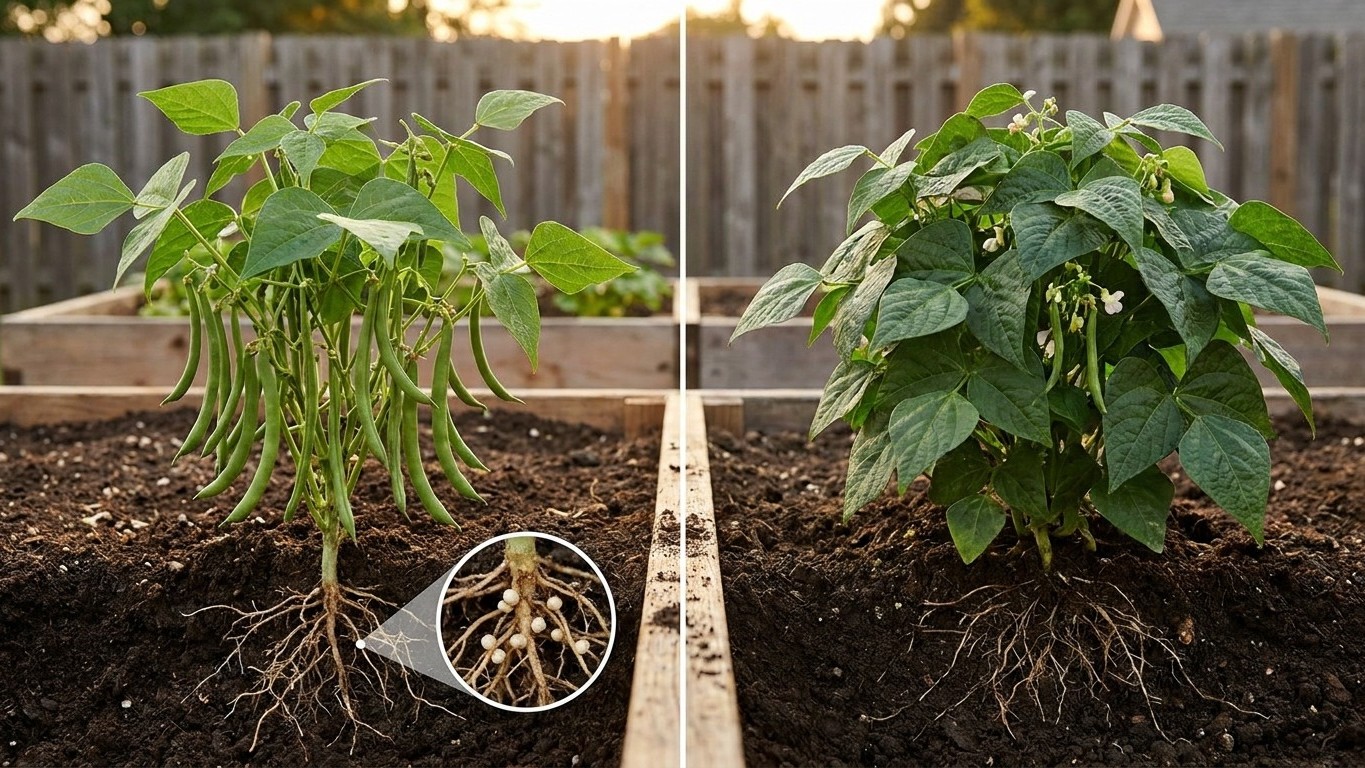

Beans manufacture their own nitrogen underground, using bacteria that live on their roots. Feed them more nitrogen and you don’t get more beans, you get more leaves, later flowers, and fewer pods. That single fact from Utah State University Extension flips the standard fertilizing playbook on its head, and it changes how you should treat this crop from the day you open the seed packet.
The short answer
Utah State University Extension states it plainly: beans fix nitrogen from the air through soil bacteria attached to their roots. That’s not a bonus feature, it’s the reason the plant has a low fertilizer requirement in the first place. An all-purpose fertilizer and compost worked into the soil at planting time is enough. Nothing more is needed for the rest of the season.
Here’s where most gardeners trip up, because it goes against everything they’ve learned growing tomatoes, squash, or leafy greens. Those crops reward a mid-season nitrogen boost with bigger yields. Beans do the opposite. Extra nitrogen stimulates excessive leaf growth, delays flowering, and reduces pod set. You end up with a bushy, dark-green plant that looks healthy and produces almost nothing. The fertilizer bag becomes the problem, not the solution.
Timing matters too, but not the way it does for transplanted crops. Beans go straight into the ground as seed, no indoor head start, no hardening off. Bush varieties need 50 to 60 days to mature. So instead of circling a date on a calendar, count backward from your own first fall frost. As long as 50 to 60 days remain before that date, you can still drop bush bean seed in the ground and expect a harvest. Once the countdown runs shorter than that window, further sowing is a gamble.
The practical upshot: skip the mid-season feeding routine you use elsewhere in the garden. Put your effort into weed control instead, since that’s the maintenance task that actually moves the yield needle for beans. The plant is handling its own nutrition. Your job is to stay out of its way and keep it from competing with weeds for water and light.
What actually decides it
The nitrogen-fixing partnership
Bean roots host colonies of soil bacteria that pull nitrogen gas from the air pockets in the soil and convert it into a form the plant can use. This is a two-way trade: the bacteria get sugars from the plant, the plant gets nitrogen it would otherwise have to absorb from the soil through its roots. Because this system runs continuously as long as the plant is alive, dumping additional nitrogen fertilizer on top doesn’t help the exchange, it short-circuits it. The plant senses abundant nitrogen already available and channels its energy into leaf and stem growth instead of setting flowers. Fewer flowers means fewer pods. This is the mechanical reason behind the instruction to stop after the initial compost and all-purpose fertilizer application at planting.
Warm-Season crop, direct-sown seed
Beans are frost-sensitive, which normally would suggest starting seed indoors for a head start, the way gardeners do with tomatoes or peppers. But beans get direct-sown, and both facts are true at once for a specific reason: bean roots are notoriously intolerant of disturbance. Pull a bean seedling out of a tray to transplant it and you damage the fine root hairs, along with the young nodules where those nitrogen-fixing bacteria are just beginning to establish. The setback from transplant shock often costs more time than the head start gained indoors. Germination is also fast once soil has warmed, so the plant doesn’t need the indoor jump that slower-germinating crops require. Sow the seed directly into warm soil after frost danger has passed, and the plant catches up on its own schedule.
Why weeds matter more than feeding
With fertilizer largely off the table as a maintenance task, weed pressure becomes the main variable a gardener actually controls. Regular cultivation, especially while plants are small, keeps competing weeds from stealing water and light during the seedling’s most vulnerable stretch. Closer row spacing and the resulting dense canopy do double duty: they shade out weed seedlings before they can establish, cutting down on the cultivation workload later in the season.
How to do it
- Work compost and an all-purpose fertilizer into the bed before sowing. This single application supplies what the plant needs for the entire season.
- Direct-sow seed once soil has warmed past frost risk. Skip trays and transplants entirely; bean roots don’t recover well from disturbance.
- Space rows closer together rather than wider. Denser growth shades out weed seedlings and reduces the cultivation burden later.
- Cultivate shallowly while plants are small. Pull or hoe weeds early, and avoid digging deep enough to nick the root zone where nitrogen-fixing nodules are forming.
- Withhold additional nitrogen fertilizer for the rest of the season. The compost and starter fertilizer already applied is the full feeding program.
- Count backward from your first fall frost before each new sowing. While 50 to 60 days still remain before that date, bush beans planted now will have time to mature. Once fewer days remain, hold off on further sowing.
- Harvest through the bearing window. Bush types bear over roughly 2 to 3 weeks; pole types bear over a longer 5 to 6 week stretch, so keep picking as pods mature to encourage the plant to keep setting more.
What Goes Wrong
- Lots of leaves, almost no pods. This is nearly always leftover or added nitrogen fertilizer talking. The plant is already fixing its own supply from the air; extra feeding stimulates leaf growth, delays flowering, and reduces pod set. Stop feeding and let the compost applied at planting carry the season.
- Weeds overrunning young seedlings. Bean seedlings are shallow-rooted early on and lose the water-and-light competition fast if weeds get ahead of them. Cultivate regularly while plants are small, but shallowly, since deep cultivation damages roots and the nodules attached to them.
- A late sowing that never produces a harvest. This traces back to sowing after the maturity window has closed. Count days to your first fall frost before planting; once fewer than 50 to 60 days remain, a new bush bean sowing won’t have time to mature.
- Pole beans still producing while bush plants are finished. This isn’t a failure, it’s the plant type doing what it does. Bush beans bear over a short 2 to 3 week window; pole beans bear over 5 to 6 weeks. If you want a longer harvest stretch from a single planting, that difference in plant type is the reason to choose pole over bush, not a sign anything went wrong.
Common questions
Do beans need fertilizer at all?
Yes, but only once. Utah State University Extension notes beans have a low fertilizer requirement and don’t need additional feeding if an all-purpose fertilizer and compost were applied at planting. That single application covers the season.
Why are beans direct-sown instead of started indoors?
Bean roots don’t tolerate the disturbance that comes with transplanting. Combined with fast germination once soil warms, direct-sowing avoids transplant shock and lets the plant establish its root system, and its nitrogen-fixing bacteria, undisturbed.
How late can I plant beans before frost?
There’s no calendar date that applies everywhere, since frost dates vary by location. Instead, count backward from your own first fall frost. Bush beans need 50 to 60 days to mature, so keep sowing as long as that many days remain before frost.
Why do my bean plants have lots of leaves but few pods?
Excess nitrogen is the usual cause. Beans fix their own nitrogen through root bacteria, so additional fertilizer pushes the plant toward leaf and stem growth instead of flowering, cutting into pod set.