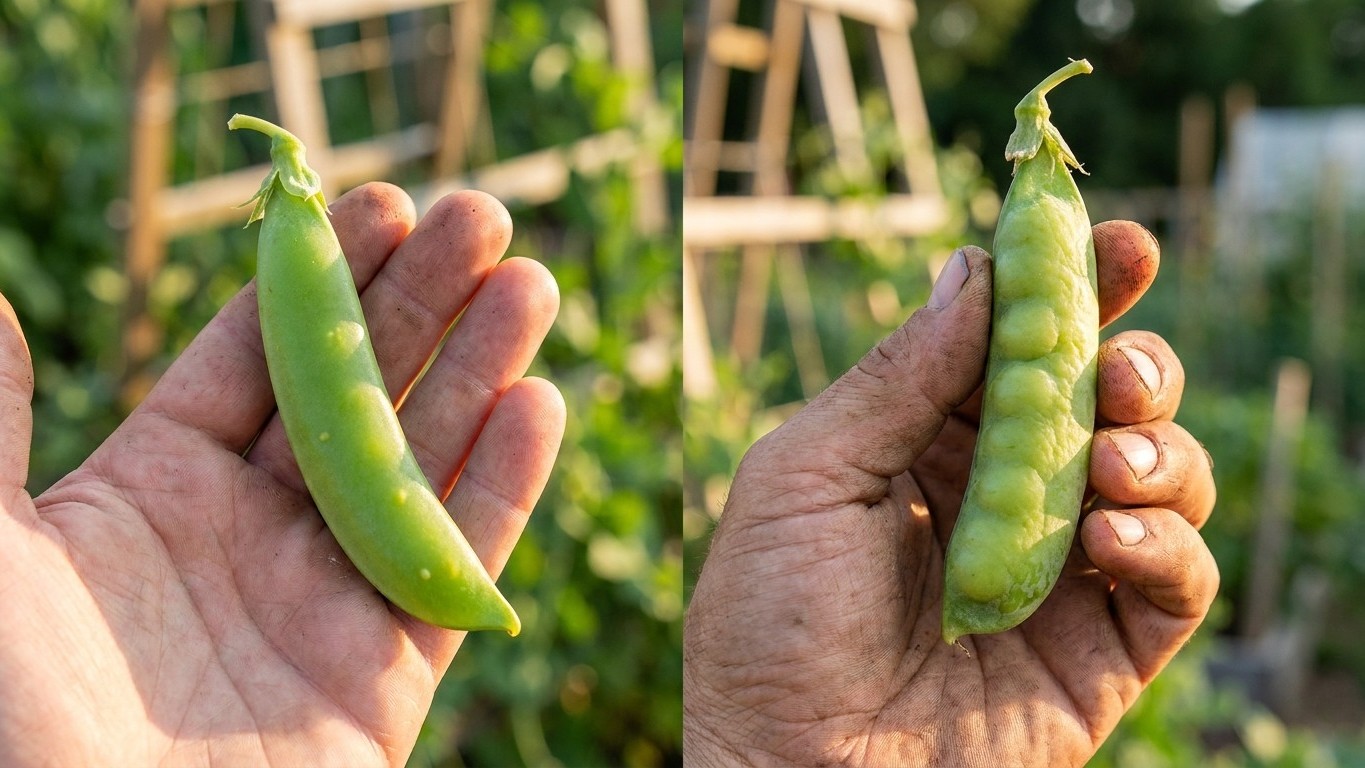

Snap peas are ready 5-8 days after flowering. Shelling (garden) peas need 18-21 days after flowering before the pods are worth picking. That’s the gap in the title: roughly two weeks between two crops that can sit on the same trellis, planted the same afternoon. Utah State University Extension lays out both windows in its guide Peas in the Garden, and mixing up which rule applies to which pod is the single most common reason home-grown peas disappoint.
The short answer
Two numbers, two crops. Snap peas (the kind where you eat the whole pod, edible-pod types) are ready for harvest about 5-8 days after flowering, according to Utah State University Extension. At that point the pod should be full size, the seeds inside still small, and the flesh firm and crisp when you bite it. Garden peas, the shelling type where you discard the pod and eat only the seed, need about 18-21 days after flowering. You pick those pods when the seeds inside have plumped up, then shell them before cooking.
Apply the wrong number and you get a wrong pea. Pick a shelling pea on the snap-pea schedule and you’ll shell a pod full of seeds the size of BBs, hardly worth the effort. Wait on a snap pea until it hits the shelling-pea window and the pod turns tough and stringy, the kind you have to fight through with a knife. The variety you planted tells you which clock to watch. Everything else, when to sow, how to support the vines, how long the harvest window stays open, follows from that same source.
Peas don’t run on a calendar the way frost-tender crops do. They’re frost tolerant and direct-sown straight into the garden bed, no seed trays, no transplant shock to manage. The cue for sowing isn’t a count of weeks before your last frost date. It’s whether the soil can be worked, whether it crumbles instead of clumping when you squeeze a handful. Gardeners who wait for warm weather before planting peas are solving a problem peas don’t have. The plants actually suffer once air temperatures climb past 80 degrees Fahrenheit, which flips the usual planting logic: with peas, early is safe and late is risky, the opposite of how most people are taught to garden.
Once flowering starts, though, the countdown is fixed. Five to eight days for snap peas. Eighteen to twenty-one for garden peas. Mark the date the first flowers open on a given vine and you can predict harvest almost to the day, which is more precision than most vegetables offer.
What actually decides it

Flowering is the clock, not the calendar
Every timing decision for peas traces back to a single event: the first open flower. Utah State University Extension frames both harvest windows from that moment, not from the sowing date, not from a fixed number of weeks in the ground. That’s because pea plants don’t mature on a uniform schedule; soil temperature, day length, and moisture all shift how fast a plant gets to flower. But once it flowers, the pod-to-harvest interval is remarkably consistent. Track flowering and you’ve solved harvest timing for the whole planting, snap or shelling, in one observation.
Temperature above 80°F breaks the whole system at once
Peas are a cool-season crop, and heat doesn’t just slow them down, it aborts flowers outright. That single threshold, roughly 80 degrees Fahrenheit, decides multiple outcomes simultaneously: whether flowers set at all, whether pods reach full size, and whether the plant keeps producing through its normal 3-4 week picking window. Miss the early-sowing window and a late heat spell can shut down flowering before the harvest count ever starts. This is also where peas and beans get confused. Beans tolerate heat up into the 90s and germinate best in warmer soil. Peas do the opposite: they germinate at cooler soil temperatures and stall out in the heat that beans shrug off. Treating pea timing like bean timing is an easy mistake to make and a costly one, since it pushes sowing later, straight into the temperature range that kills pea flowers.
Support decides both yield and how easy the harvest is
Most pea varieties are self-supporting as they grow, but Utah State University Extension notes that taller varieties are more productive and easier to pick when caged, trellised, or fenced. Snap and snow peas climb naturally, so a trellis decision made at sowing time pays off twice: more pods per plant, and pods you can actually find and reach once the vines fill in. Skip the trellis on a tall variety and you’re not just losing yield, you’re hunting for pods buried in a tangled mat of vines at the exact moment they’re most perishable.
How to do it
- Check soil workability, not the calendar. Peas are direct-sown and frost tolerant. The signal to plant is soil that crumbles in your hand rather than clumps, not a specific week before your last frost.
- Decide on support before the seeds go in the ground. If you’re growing a taller variety, or a snap or snow pea that climbs, set a cage, trellis, or fence in place first. Adding support after vines are established damages roots and tangles growth.
- Sow directly into the bed. No indoor starting is needed for a normal planting; Utah State University Extension mentions pre-germinating seed indoors only as a trick for getting an unusually early sowing into cold ground, not as a standard step.
- Watch for flowering, not for a date on the calendar. This is the moment that starts the harvest clock for every pod on that plant.
- Count days from first flower according to your pea type. Snap peas: pick around 5-8 days after flowering, when pods are full size, seeds still small, flesh firm and crisp. Garden peas: pick around 18-21 days after flowering, once seeds inside have plumped, then shell before use.
- Pick on a rolling basis. The source notes plants will flower and mature pods for 3-4 weeks, so harvest is repeated, not a single event.
- For dry peas, let the plants finish in the field. Harvest when pods are fully mature and beginning to dry, then pull up whole plants and lay them in a row in the garden for 5-7 days before shelling.
- Store dry seed properly. Keep dried peas in sealed containers in a cool, dry place for long-term storage.
What Goes Wrong
- Sowing too late in the season. Since the trigger is workable soil, not a countdown of weeks before frost, gardeners who wait for warm weather often sow right as temperatures start climbing toward the 80-degree threshold that halts flowering. The fix is to test the soil as soon as it can be worked and sow then, accepting that peas tolerate the cold better than they tolerate heat.
- Picking snap peas by the shelling-pea clock. Waiting 18-21 days on an edible-pod variety produces a tough, stringy pod because that pod was only ever meant to be harvested at 5-8 days. Know which type is in the ground before the first flower opens, and count from there.
- Picking shelling peas by the snap-pea clock. Pulling garden peas at 5-8 days gives seeds too small to bother shelling. The remedy is the same as above in reverse: confirm the type, then wait the full 18-21 days for plump seed.
- Skipping the trellis on a tall variety. Vines left to sprawl produce less and hide the pods that do form, which means missed harvests and pods that overmature unseen. Set support at sowing time rather than trying to add it once the vines are tall.
- Adding extra nitrogen fertilizer. Peas fix their own nitrogen through their root nodules, and applying more delays flowering and increases aphid numbers on the plants. If the bed already grows vegetables reasonably well, skip the nitrogen feed for peas specifically.
- Letting harvest slide once picking starts. Pods left too long past their window stall the plant’s production, since a pea vine keeps flowering and setting new pods for 3-4 weeks only if mature pods are removed regularly. Pick on a rolling schedule rather than waiting to gather a large batch at once.
Common questions
How do I know if I’m growing a snap pea or a garden pea?
Snap and snow peas are edible-pod types where the whole pod is eaten; garden (shelling) peas are grown for the seed inside, with the pod discarded. Check what you planted before flowering starts, since that determines whether you count 5-8 days or 18-21 days to harvest.
Do peas need to be started indoors?
No. Peas are direct-sown into the garden and are frost tolerant. Utah State University Extension mentions germinating seed indoors only as a technique for pushing an especially early sowing into cold soil, not as a routine step for a normal planting.
What yield should I expect per row?
Utah State University Extension reports 2-3 pounds of shelled peas per 10 feet of row from garden types, 3-4 pounds of pods from snap or snow pea types, and about 15-20 pounds of seed per 100 feet of row for dry peas.
Why does my pea plant flower but never set pods?
Temperatures above 80 degrees Fahrenheit cause peas to abort their flowers rather than set pods. This is one of the clearest differences from beans, which tolerate much warmer conditions before flowering suffers. If flowering stalls out during a hot stretch, the plant is responding to heat, not to a lack of care.