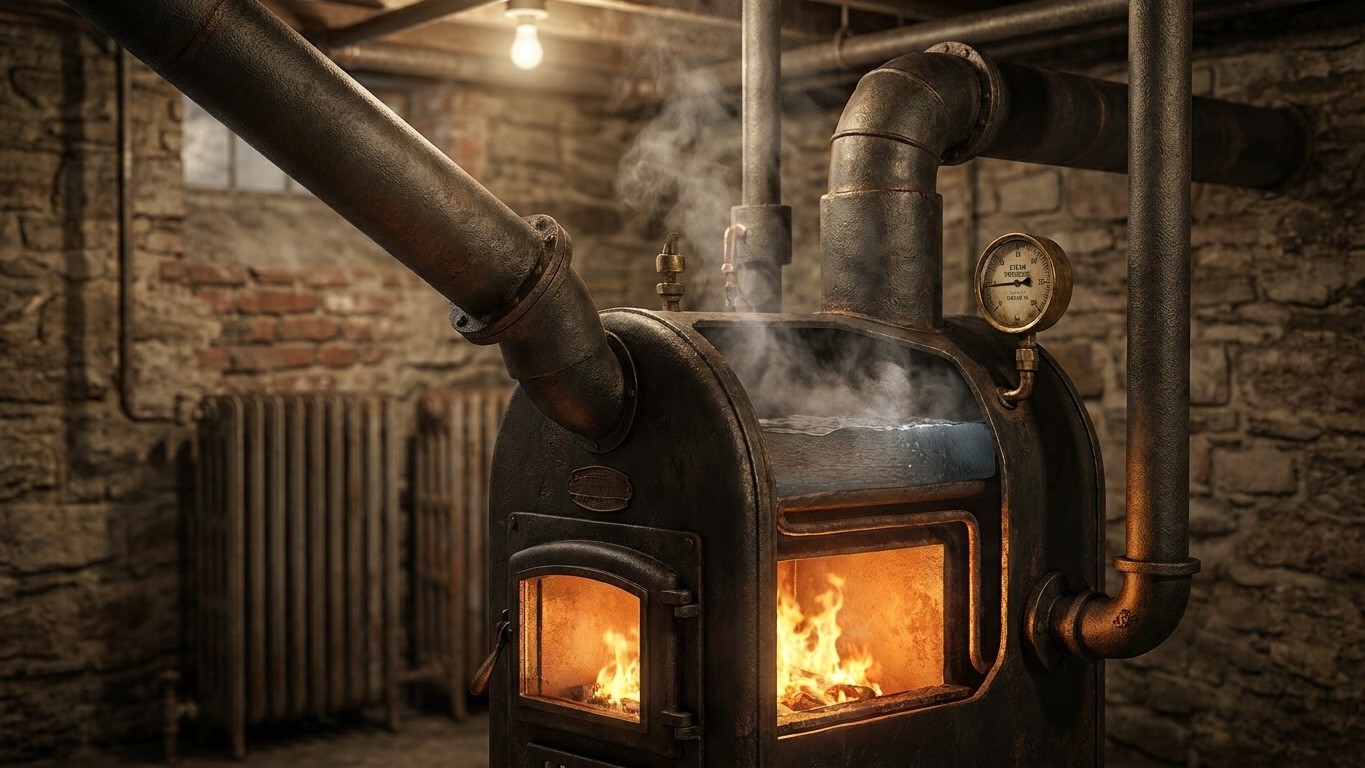

A steam boiler doesn’t push hot water through pipes with a pump. It boils water into steam, which expands and rises on its own into radiators, gives up its heat, turns back into water, and drains back to the boiler by gravity. That single fact, no pump, no closed pressurized loop, explains almost everything about how these systems behave, misbehave, and need to be checked.
No pump, no loop, no pressure gauge you know

Open the access panel on a steam boiler and you won’t find a circulator relay or an expansion tank sized to a sealed loop. You’ll find a boiler that heats water until it flashes into steam, a main that carries that steam to the radiators, and a return line that carries the condensed water back down. Gravity does the return trip. No motor moves it. The system only works because steam takes up far more space than the water it came from, so it self-pressurizes just enough to travel through the pipes and reach the radiators before it cools.
That mechanical difference is why steam systems get so little attention in general heating advice, and why most of that advice, written with hot-water (hydronic) systems in mind, doesn’t apply. A hydronic system is tuned by adjusting flow, balancing valves, and circulator speed. A steam system has none of those. Its entire personality is set by pipe pitch, main size, and the vents that let air escape ahead of the steam. Turn up a thermostat expecting a hydronic-style gradual warmup and you’ll be disappointed; steam systems tend to run in short, full-throttle bursts because the boiler is either making steam or it isn’t.
Efficiency labeling doesn’t change with the mechanism, though. AFUE, or annual fuel utilization efficiency, is the ratio of a boiler’s annual heat output to the total annual fossil fuel energy it consumes. A boiler rated at 90% AFUE turns 90% of the fuel’s energy into heat delivered to the home; the other 10% goes up the flue or is lost elsewhere. The U.S. Department of Energy’s Federal Energy Management Program uses that same 90% AFUE threshold to define an ENERGY STAR-qualified residential gas boiler, and its own worked comparison lines up models at 0.84, 0.90, and 0.97 AFUE to show the range on the market. That guidance was written for federal purchasing decisions, not for a homeowner pricing a replacement, so its cost-effectiveness math doesn’t transfer directly to a single house. What does transfer is the AFUE number itself: it’s printed on the boiler’s label, and it tells you what fraction of every therm of gas actually becomes heat in your living room rather than in the chimney.
The vents do the balancing
Steam can’t enter a radiator until the air already inside it has somewhere to go. That’s the job of the small air vent screwed into the side of every steam radiator, and of the larger vents mounted along the main pipes. When the boiler fires, steam pushes the air out through those vents; once the air is gone, steam fills the radiator and the vent’s valve closes against the heat and moisture. Get the vent sizing wrong, radiator by radiator, and the whole system falls out of balance.
This is the single detail that decides whether a steam-heated house feels even or frustrating. A radiator at the far end of the main, last in line for steam, needs a larger vent so it can clear its air quickly and get its share of steam before the cycle ends. A radiator close to the boiler needs a smaller vent, or it will hog steam and run hot while the far end stays cold. A cold radiator at the back of the house is rarely a boiler problem; it’s almost always a vent that’s undersized, clogged with mineral deposits, or simply worn out and stuck shut. Vents are inexpensive, radiator-specific, and one of the few adjustments a steam system actually has, which is why balancing a steam house is a matter of matching vent sizes room by room rather than adjusting flow at a manifold the way you would on a hydronic system.
Banging and knocking in the pipes is a different symptom with a different cause: water where steam should be. It usually means condensate is pooling somewhere it shouldn’t, on a main pitched the wrong way, in a return line with a low spot, or in a radiator that isn’t tilted slightly toward its outlet valve. Steam moving fast rushes into that trapped water and collapses instantly, and the shock of that collapse is the knock you hear at 2 a.m. It is not a bleeding problem and it has nothing in common with the air-bleeding advice written for hot-water radiators; there is no bleed valve to open here, and trying to apply that fix does nothing for a steam system. Pipe pitch and radiator tilt are what quiet a banging steam system down, not venting more air out of a radiator that’s already venting fine.
The U.S. Department of Energy has noted, in a study of hydronic heating in multifamily buildings, that “control settings are often best guesses and are not typically optimized.” That study covers central hydronic systems in apartment buildings, not single-family steam heat, and its savings figures, an average of 11% and a maximum of 33% in gas use, belong strictly to that building type. But the underlying idea travels well: on any steam or hydronic system, the small adjustments, vent sizes, pipe pitch, timing, are frequently left as guesswork rather than measured and tuned, and that guesswork is usually where comfort problems in a steam house actually live.
Water level and low-water cutoff
A steam boiler needs a minimum amount of water in it at all times to make steam safely. If that level drops too far, typically from a leak, a stuck feed valve, or ordinary evaporation over a long heating season, the heating surfaces inside the boiler can be exposed to fire with nothing there to absorb the heat. That’s the specific failure a low-water cutoff (LWCO) is built to prevent: it senses when the water has dropped below a safe level and shuts the burner off before the boiler runs dry.
The reading itself comes from the sight glass, the narrow tube mounted on the front of the boiler where the water level is visible directly. Checking it regularly, and knowing what the boiler’s own manual specifies as the correct range for that glass, is the routine maintenance task specific to steam heat that a hot-water system simply doesn’t have. Many steam boilers also have a manual reset or test procedure for the low-water cutoff itself, so the device can be checked to confirm it actually trips when water is low rather than assuming it works because it’s installed. The exact test procedure and the correct water level are called out on the appliance label and in its manual, and that documentation, not general advice, is the authority on both.
None of this replaces professional service. The U.S. Fire Administration advises to “maintain heating equipment and chimneys by having them cleaned and inspected each year by a professional,” and a steam boiler’s low-water cutoff, feed valve, and pressure controls are exactly the kind of components that inspection covers. For more on how that safety device works and what a professional inspection checks, see our dedicated page on boiler safety.
A steam boiler is also a fuel-burning appliance, gas or oil, which means the same carbon monoxide rules that apply to any combustion heating equipment on this site apply here in full. CO is colorless and odorless, and a CO alarm in the home is required for that reason alone. An electric steam boiler is the exception, since it burns nothing and produces no combustion byproducts to detect.
Common questions
Why does my steam radiator make a loud banging noise at night?
It almost always means condensate water is trapped somewhere it shouldn’t be, often because a main or a radiator isn’t pitched correctly. Fast-moving steam collapsing against that trapped water causes the knock. Checking pipe pitch and radiator tilt addresses this; it isn’t an air-venting issue.
Can I bleed a steam radiator the way I would a hot-water radiator?
No. Steam radiators have air vents, not bleed valves, and they work on a completely different principle: they let air escape so steam can enter, then close automatically. There’s no manual bleeding step to perform.
How do I know if my low-water cutoff is working?
Check the sight glass regularly against the level specified in the boiler’s manual, and follow the manufacturer’s test procedure for the cutoff itself if one is listed. An annual professional inspection, as recommended by the U.S. Fire Administration, should also verify it.
Does AFUE mean the same thing for steam boilers as for other boilers?
Yes. AFUE measures the ratio of annual heat output to fuel energy consumed regardless of whether the boiler makes steam or hot water. A steam boiler rated 90% AFUE wastes the same 10% up the flue as a hydronic boiler with the same rating; the number is printed on the appliance label.