
Hot water running out fast almost always points to one of four things: a broken dip tube letting cold water leak into the outlet, a failed lower heating element on an electric unit, sediment eating up tank volume, or a household that’s grown past what the tank was ever sized to handle. The fix depends entirely on which one it is, and the symptoms are different enough to tell them apart without opening the tank.
The part that fails invisibly
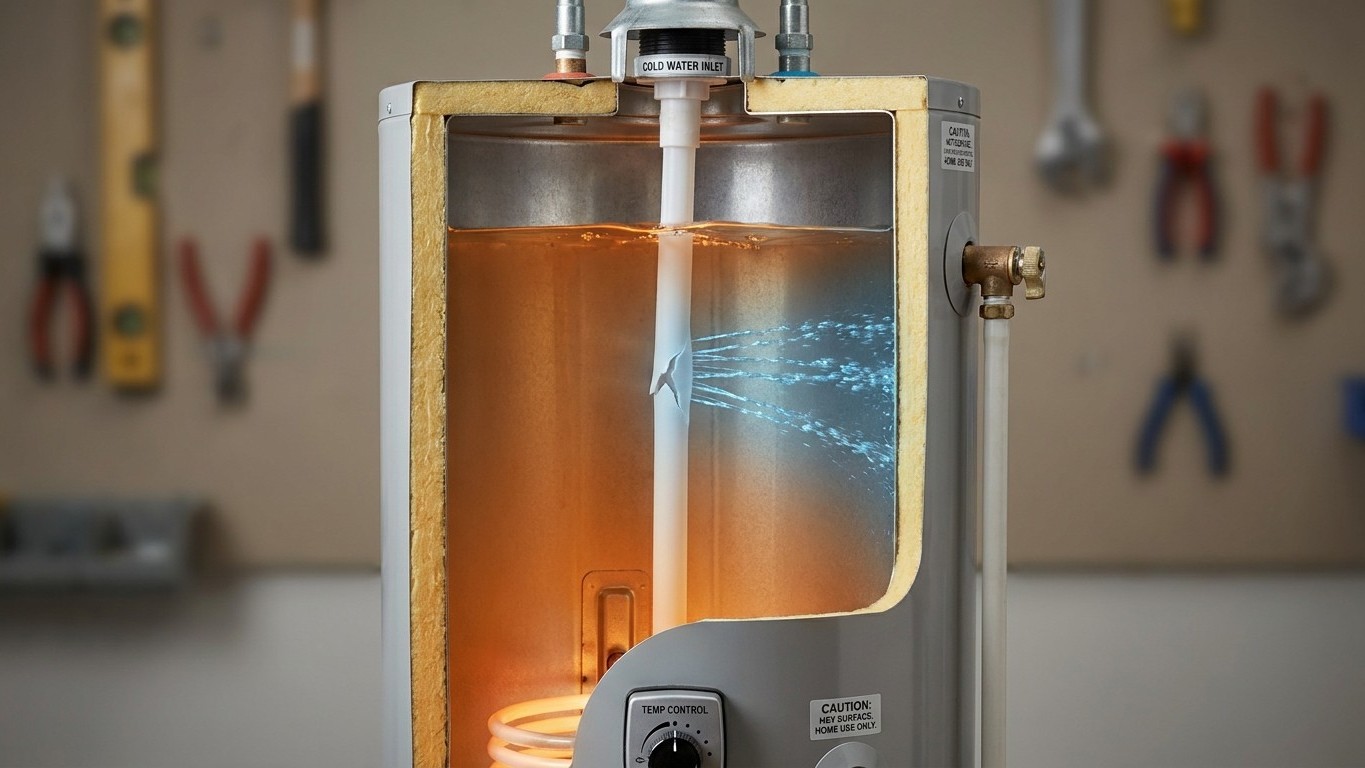
Every tank-style water heater relies on a plastic tube, the dip tube, to push incoming cold water down to the bottom of the tank where the burner or lower element can heat it. That’s the whole design: cold in at the bottom, hot drawn off at the top. When the dip tube cracks or breaks off, cold water dumps in near the top of the tank instead, and it mixes almost immediately with the hot water waiting at the outlet. The tank can be completely full and still send you a lukewarm shower in under five minutes, because the water leaving the tank is diluted the moment it enters.
This failure is easy to mistake for a tank that’s simply too small, since the pattern looks the same from the shower: strong start, quick fade. The difference is speed. A dip tube failure produces a sharp, sudden drop, often within the first few minutes of a shower that used to run for fifteen or twenty. An undersized tank fades more gradually as the reserve genuinely depletes.
Diagnosing it doesn’t require draining the tank. Plumbers typically pull the cold water inlet fitting on top of the heater and lift the dip tube out to inspect it. A healthy tube is a straight, rigid plastic pipe reaching most of the way to the tank bottom. A failed one is often cracked, shortened, or has disintegrated into pieces, some of which end up clogging faucet aerators and shower heads throughout the house, a secondary clue that’s sometimes noticed before the Temperature problem even gets diagnosed. Gritty plastic fragments in your screens are a strong hint the dip tube, not the thermostat or the burner, is the culprit.
If the unit runs on gas or propane, this is a fuel-burning appliance, and that matters beyond the hot water complaint. Any work near the burner assembly, or any troubleshooting that involves the gas control valve, should be done with the understanding that carbon monoxide is colorless and odorless, and a functioning CO alarm near the unit is not optional. Electric units carrying a broken dip tube don’t carry that risk, since there’s no combustion involved, but the cold-water-at-the-top mechanism is identical either way.
A dead lower element does the same thing
Electric water heaters split the work between two elements: an upper one that recovers the top of the tank quickly after a draw, and a lower one that does the heavy lifting for the bulk of the tank’s volume. The lower element is the one actually responsible for most of your stored hot water. When it fails, the upper element keeps working fine, and you still get a normal-feeling first few minutes, because that top layer is genuinely hot. The problem is what’s underneath: cold water sitting untouched for the rest of the tank’s height.
The result feels almost identical to a broken dip tube from the shower, a strong start followed by a fade, but the mechanism and the fix are completely different. A dip tube failure lets cold water contaminate the hot supply immediately. A dead lower element simply means there’s a smaller genuine reserve of hot water, full stop, with nothing coming in to replace it once it’s used.
The tell that separates the two
There’s a reliable way to distinguish them without any tools. Only electric water heaters have this failure mode at all, since gas and propane units don’t use lower heating elements, they use a single gas burner at the bottom of the tank. If your water heater burns fuel, a dead lower element isn’t on the list of suspects, and a dip tube or sediment problem is more likely.
On an electric unit, a tripped breaker that resets and trips again shortly after, or a breaker that’s fine but the shower still goes cold fast, points toward the lower element specifically rather than a wiring issue upstream. Technicians test this with a multimeter across the element terminals after cutting power at the breaker, checking for continuity. No continuity means the element has burned out and needs replacement, a straightforward job but one that requires draining the tank partway and working with the power confirmed off, not just the switch, since these run on 240-volt circuits in most residential setups.
Because this is purely an electrical failure with no combustion involved, there’s no carbon monoxide consideration here, unlike gas-fired troubleshooting. The safety concerns shift entirely to electrical shock risk during the repair itself.
Sediment steals capacity
Unlike a broken dip tube or a dead element, sediment buildup doesn’t announce itself with a sudden change. It creeps. Minerals suspended in your water supply, calcium and magnesium mostly, settle to the bottom of the tank over months and years, and in areas with harder water, this happens noticeably faster. That layer does two things at once, and both work against you.
First, it simply occupies space. A tank rated to hold a given volume of water is holding measurably less once a few inches of sediment have settled at the bottom, since that layer doesn’t heat or hold usable hot water, it just sits there taking up room. Second, and often worse, it insulates the bottom of the tank from the heat source. On a gas unit, the burner fires directly against the tank bottom, and a sediment layer acts like a blanket between the flame and the water, meaning more fuel burned for less water actually heated. On an electric unit, the lower element can end up partially buried in sediment, reducing its ability to transfer heat efficiently and sometimes shortening its working life.
The audible sign is a distinctive one: rumbling, popping, or cracking noises coming from the tank during the heating cycle, caused by water trapped under and within the sediment layer turning to steam pockets that escape upward. Homeowners who hear this and assume it’s just an old, noisy appliance are often missing a genuine capacity problem that’s only getting worse with time. Recovery time, how long it takes the tank to reheat after a big draw, stretches out gradually as the sediment layer thickens, which is exactly the kind of slow fade that’s easy to write off as normal aging rather than a fixable issue.
This is a maintenance problem with a maintenance solution, not a replacement-only one, at least when caught before it’s severe. For the actual flushing procedure, frequency guidance, and what to do if the drain valve is clogged or the water won’t run clear, see our guide to flushing sediment from a water heater.
Or the household simply outgrew it
Sometimes nothing has failed at all. A tank sized correctly for a two-person household with one bathroom doesn’t magically expand when a bathroom gets added, a soaking tub replaces a standard one, or a third and fourth person move in. The tank’s recovery rate and total capacity are fixed numbers set at installation, and household hot water demand is not fixed at all, it tends to only grow.
This is worth taking seriously in a broader sense, too. The Department of Energy attributes roughly 14% to 25% of a home’s total energy consumption to water heating, a meaningful share of a monthly bill that most households never think about until something forces the issue. A tank working harder than it was designed for, whether because of sediment, a failed element, or genuine demand growth, is spending more energy for the same or less delivered hot water, which compounds the cost of ignoring the underlying cause.
One place this shows up directly is the thermostat setting. The Department of Energy recommends setting a water heater thermostat to 120°F, describing that setting as comfortable for most household uses. It’s presented as a recommendation, not a code requirement, and it represents a genuine trade-off: a lower setting reduces both energy use and the risk of scalding, while a higher setting does the opposite on both counts. There’s a second side to that trade-off worth naming honestly. Stored water held too cool is a recognized concern for bacterial growth, including legionella, and this creates real tension with the energy-saving case for a lower setting. No single temperature threshold for that risk has been independently verified here, so rather than picking a number, households with infants, elderly residents, or anyone with a compromised immune system should raise the question with their doctor or their local water utility before settling on a thermostat setting.
If the household has genuinely grown, the honest fix isn’t a repair at all, it’s reassessing whether the current tank’s capacity and recovery rate still match actual demand. That’s especially relevant for anyone shopping for a replacement now: amended federal efficiency standards have pushed common electric storage water heaters up to the efficiency level of an entry-level heat pump water heater, a change that affects newer electric storage models specifically rather than older installed units still in service. Working out the right capacity and recovery rate for your actual household, not the one the previous owner had, is covered in our water heater sizing guide.
Common questions
Can a broken dip tube be replaced without buying a new water heater?
Yes. It’s a part replacement, not a full unit replacement, done by removing the cold water inlet fitting and swapping in a new tube. It’s a far cheaper fix than the symptoms suggest.
Does flushing sediment restore a tank to its original capacity?
Flushing removes loose sediment and restores the volume it was occupying, along with improving heat transfer to the water. It won’t undo any damage already done to a lower element or burner, but it addresses the root cause rather than a symptom.
Is a sudden cold shower always the dip tube, or could it be the thermostat?
A thermostat set too low produces water that’s warm rather than truly hot from the very first minute, consistently. A dip tube or lower element failure instead produces a strong hot start that fades, which is the pattern worth paying attention to when narrowing down the cause.
Should I lower my thermostat to 120°F even if my household includes an elderly or immunocompromised person?
That’s exactly the situation where the trade-off between energy savings and bacterial growth risk matters most. Rather than guessing, it’s worth a conversation with your doctor or your local water utility before changing the setting.