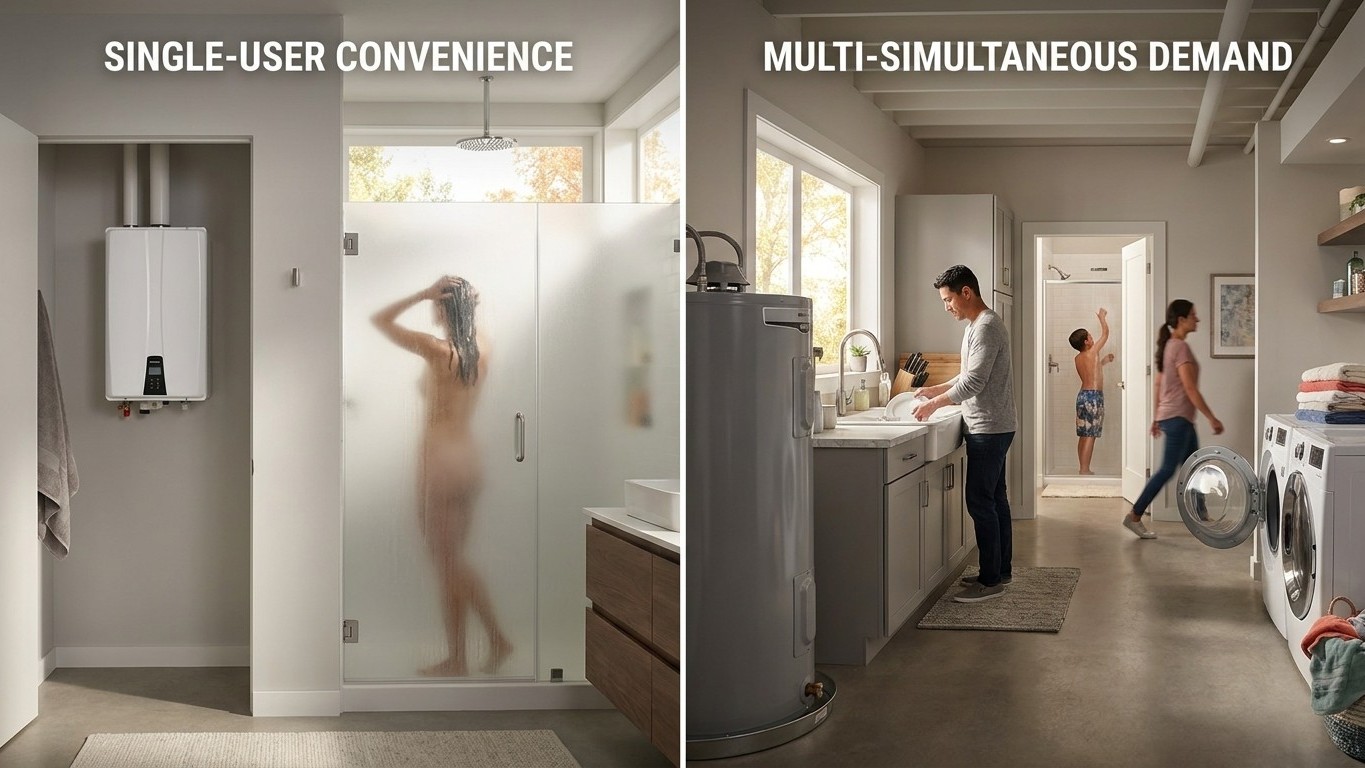

The right choice isn’t tankless or tank in the abstract. It’s tankless or tank for your household’s specific pattern of hot water use. A single person who showers at odd hours gets more from a tankless unit’s endless supply. A family of five running showers, a dishwasher, and a washing machine in the same 45-minute window at 7 a.m. often does better with a tank sized to meet that spike, because tankless units have a flow-rate ceiling that a big tank simply doesn’t.
It depends on how your household uses hot water
Here’s the criterion most buying guides skip: it’s not about which technology is “better,” it’s about the shape of your demand curve. A tankless heater delivers hot water on demand, indefinitely, but only up to a fixed flow rate at a given Temperature rise. Ask it to serve two showers and a dishwasher at once in a cold-climate winter, and it may struggle to keep up, even if it never runs out. A storage tank has the opposite personality: it holds a finite reserve, but within that reserve, it can serve several simultaneous draws without missing a beat, then needs time to recover.
That’s why a household with staggered routines, one person showers at 6, another at 6:45, dishes run midmorning, tends to be happy with tankless. A household where three people leave for school and work in the same half hour, all wanting hot water at once, tends to be happier with a tank matched to that peak, or with two tankless units installed in parallel to cover the surge.
Comparing the two on the criteria that matter
Footprint and installation cost matter too, especially in a smaller home or a condo where mechanical space is tight. Lifespan expectations differ as well, though exact years vary by manufacturer, water quality, and maintenance, so treat the row below as a general pattern rather than a guarantee tied to any specific product.
| Criterion | Tankless | Storage tank |
|---|---|---|
| Peak demand handling | Limited by flow rate; can be overwhelmed by simultaneous draws | Handles simultaneous draws well until reserve is depleted |
| Standby loss | Minimal; heats only on demand | Ongoing; tank loses heat to surrounding air between uses |
| Footprint | Compact, wall-mounted | Larger floor or closet space required |
| Installation cost | Often higher, especially if venting or gas lines need upgrading | Often lower, especially as a like-for-like replacement |
| Lifespan expectation | Generally longer-lived with proper maintenance | Generally shorter-lived; varies with water hardness |
None of these rows works in isolation. A tankless unit’s lower standby loss is a real advantage, but if your installation needs new gas piping or electrical service to support it, the up-front cost can erase years of that advantage before you ever feel it. A tank’s simplicity cuts installation cost, but if it sits in an unheated garage in a cold climate, its standby losses run higher than the same tank would show in a heated basement.
Where the savings actually come from
The honest arithmetic starts with a fact from the U.S. Department of Energy: water heating accounts for roughly 14% to 25% of the energy consumed in a typical home, one of the largest single line items after heating and cooling. That range is wide because it depends heavily on climate, household size, and how the water heater itself is set up, which is exactly why the tankless-versus-tank decision has real weight behind it.
Tankless heaters save energy by eliminating standby loss, the heat that a stored tank of water bleeds into the surrounding air around the clock, whether anyone uses hot water that day or not. That loss isn’t fixed. It depends entirely on where the tank lives. A tank installed inside the heated envelope of the house, in a conditioned basement or a utility closet near living space, loses less heat to the room, and some of that “lost” heat still contributes to warming the house in winter. A tank sitting in an unconditioned garage, crawl space, or unheated basement loses heat straight into air that’s often close to outdoor temperature, especially in northern states during winter, and that heat is gone for good.
This is the piece that gets flattened into a marketing bullet point and shouldn’t be. The case for tankless is strongest where standby loss is highest, meaning unheated installation spaces and cold climates. The case weakens considerably in a heated closet in a mild climate, where the tank’s losses are modest and partly recycled into the home anyway.
What this article won’t do is hand you a savings percentage or a payback period. Verified, source-backed figures for either one weren’t available for this piece, and inventing them would do you a disservice. What can be said with confidence is the mechanism: less standby loss, less wasted energy, and that mechanism is strongest exactly where the tank sits somewhere cold. Beyond that, your actual bill depends on your household size, your local energy prices, your fuel type, and your existing equipment’s condition, variables no generic percentage can honestly capture.
One number is worth setting correctly regardless of which system you choose. The DOE recommends setting a water heater’s thermostat to 120°F, a level it describes as comfortable for most household uses. That figure is a compromise, not an absolute. Lower settings save energy and reduce the risk of scalding, particularly for households with young children or older adults. Higher settings raise both energy use and scald risk. There’s a second side to that compromise worth naming honestly: stored water held too cool is a recognized concern for bacterial growth, including legionella, in tank-style systems. No specific threshold temperature is established here, and households with vulnerable occupants, whether due to age, immune status, or chronic illness, should ask their doctor or their local water utility for guidance specific to their situation rather than relying on a single generic number.
And the third answer
Ask the question “tankless or tank” long enough and you eventually notice it assumes only two options exist. There’s a third path that a lot of buyers forget to price out: a heat pump water heater, which moves heat from the surrounding air into the water rather than generating it directly through combustion or electric resistance. Where the installation space suits it, typically a garage or utility room with enough air volume and a mild-to-moderate ambient temperature, a heat pump water heater often beats both a conventional tank and a tankless unit on running cost, because it’s moving heat rather than manufacturing it from scratch.
This isn’t a fringe technology anymore. Amended federal efficiency standards have brought common electric storage water heaters, specifically larger-capacity residential units manufactured under updated rules, up to the efficiency level that used to be the exclusive territory of entry-level heat pump water heaters. That regulatory shift means the gap between “ordinary electric tank” and “heat pump tank” has narrowed on paper, even as heat pump units generally still offer stronger real-world efficiency where conditions are favorable. It’s a meaningful data point for anyone assuming heat pump technology is a niche upgrade with a huge premium over a standard electric tank.
The catch is real, and it’s spatial rather than financial. A heat pump water heater needs enough surrounding air volume to draw heat from, and it performs best in a moderate temperature range, not a small, tightly sealed closet, not an attic that swings from freezing to sweltering. Installed in a spacious basement or garage in most U.S. climates, it can be the quietest-running option of the three on your utility bill. Installed in a cramped mechanical closet in a very cold region, it may struggle to deliver the efficiency it’s capable of, and a straight electric tank or tankless unit might serve that specific space better.
If your home has the room for it, the heat pump option deserves a real look before you default to “tankless or tank” as the whole conversation. For a full breakdown of how these units work, what installation space they need, and where they make the most sense, see our dedicated guide to heat pump water heaters.
One more practical note that applies across all three technologies: any gas or propane-fired Water Heater Is a fuel-burning appliance, and it carries the same carbon monoxide considerations as any other combustion equipment in the home. Carbon monoxide is colorless and odorless, and a working CO alarm near the unit is a baseline safety measure, not an optional extra. An electric storage tank or an electric heat pump water heater burns no fuel and produces no combustion byproducts, which is one more variable worth weighing if your mechanical space is small or poorly ventilated.
Common questions
Can I just replace a tank with a tankless unit in the same spot?
Sometimes, but not always without extra work. Tankless units often need upgraded venting, gas line sizing, or electrical service that a standard tank never required. Ask an installer to evaluate your existing gas, electric, and venting capacity before assuming a straight swap.
Does a bigger household always need a bigger tank?
Not necessarily. A bigger household with staggered hot water use can do fine with a smaller tank or even tankless. What matters more is how many fixtures draw hot water at the exact same time, not the raw number of people in the house.
Is 120°F the right setting for every household?
It’s the DOE’s general recommendation and a reasonable starting point, but it’s a compromise, not a fixed rule. Households with a documented risk of legionella growth or with vulnerable occupants should talk to their doctor or local water utility about their specific situation rather than picking a number on assumption alone.
Does the installation space really change which option makes sense?
Yes, more than most buyers expect. An unheated garage, a cramped closet, and a spacious conditioned basement each favor a different technology, because standby loss, air volume for a heat pump, and venting access all depend on where the unit physically sits.