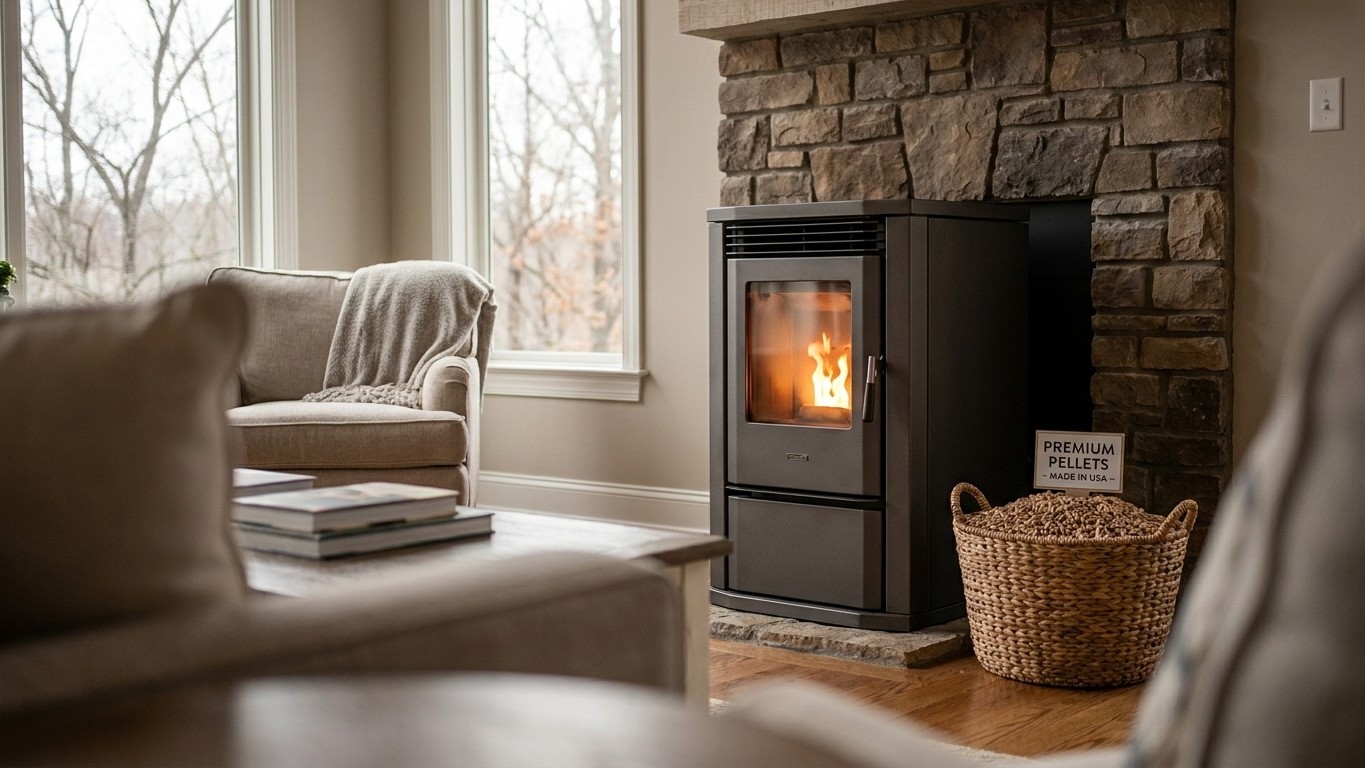

A Huntsville-area winter runs about 2,831 heating degree days, a number that puts North Alabama closer to “supplement” territory than “primary heat source” territory. For most households here, a pellet stove earns its keep in December and January cold snaps rather than carrying the whole season. What changes that answer is your house, your climate zone within the state, and how you actually run the stove day to day.
How hard the winter works here

The reference number for this part of the state comes from Huntsville Intl AP, and it reads about 2,831 heating degree days a year on the standard 65 F base, according to NOAA’s 1991-2020 Climate Normals. That figure is the whole story in shorthand: it adds up, for every day of the year, how far the average temperature sat below 65 F, and it’s the number that scales directly to fuel burned for a given house. Double the degree days, roughly double the pellets for the same square footage and the same thermostat setting.
A long season, not a brutal one
Degree days measure depth. Months measure length, and those two things don’t always agree. In the Huntsville area, heating demand starts in October, the first month whose normal mean temperature (63.9 F) dips below the 65 F line, and it doesn’t fully let go until May, when the mean climbs back above that threshold. That’s about seven months of some heating demand, but the load is front-loaded and back-loaded lightly: January carries 692 of those degree days on its own, more than double what November or March contribute. September barely registers at 8. So this is a season that opens gently, spikes hard for six to eight weeks around the new year, and tapers off slowly through spring.
Why this is comfort heat for most homes
Compare 2,831 heating degree days to a northern climate running 7,000 or 8,000, and the difference in what a stove is asked to do becomes obvious. Here, a pellet stove is far more likely to be a zone heater, something that takes the edge off a living room on the coldest nights while the central system handles the rest of the house, than a whole-home replacement for a furnace. That’s not a knock on the appliance. It just means the rest of this page should be read with that role in mind rather than the assumption that the stove is doing all the work.
One more caution worth repeating: this number belongs to Huntsville. A homeowner in the Tennessee Valley hills or up toward the Sand Mountain area runs colder than this station suggests, while the Gulf Coast counties run milder. If you’re at the far edge of the state, treat 2,831 as a starting point, not your own backyard.
How many tons a winter takes here
No source publishes a tons-per-winter figure for Alabama, and any number that claims otherwise is guessing. What you can do instead is build the estimate yourself, because the math is simple once you know the units. A standard bag holds 40 pounds of pellets. Fifty of those bags make a ton. From there, consumption tracks the heat your house actually needs, which is exactly what the degree-day figure above is measuring for the region as a whole. Your house isn’t the region, though, and that’s where the real variation lives.
- How well the house holds heat: a tight, well-insulated home built in the last fifteen years can burn a fraction of what an older, drafty farmhouse burns for the same square footage and the same thermostat setting.
- Whether the stove is the only heat or a supplement: a stove running alongside a central furnace or heat pump, which is the more common Alabama setup, works far fewer hours than one asked to carry the whole house.
- The setting it runs at: a stove left on a low or medium feed rate overnight burns differently than one run wide open to heat a large open floor plan.
The only number worth trusting: your own first winter
Two houses on the same street, same square footage, can land a ton apart in what they burn. That’s not a reason to give up on planning, it’s a reason to measure rather than guess. Count the bags you actually burn through your first winter, from the October start of heating demand through the May tail-off described above, and you have a real baseline for your house, your stove, and your habits. That one measured season is worth more than any estimate a website can hand you, including this one. For the national math behind bag counts, hopper sizes, and typical burn rates, the national page on how many pellets a winter takes walks through the full chain.
Buying and storing them in this climate
Buying ahead of the cold
Heating demand in this part of Alabama starts building in October, which means the smart buying window closes before that month opens. Wait until a cold snap actually arrives and you’re competing with everyone else who waited too, right when regional demand spikes and shelves thin out fastest. Pellets, like a lot of seasonal goods, tend to run cheapest in the off months, spring and summer, when nobody else is thinking about heat. Buying then, and storing through the warm months, is the logistics move that actually saves money rather than the brand or the bag size.
Storing pellets in Alabama’s humidity
Pellets are nothing more than compressed sawdust held together by the wood’s own natural lignin, no glue involved. That means moisture is the enemy, and it doesn’t take a flood to do damage. Humidity alone will swell and crumble a pellet back toward sawdust, which jams feed systems and burns dirty. North Alabama’s summers run humid for months at a stretch, and a garage or shed floor here can sweat condensation even when it isn’t raining outside. Storing bags directly on a concrete floor, or in a space with poor airflow through the humid season, is asking for trouble by spring. Raised pallets, a dry interior space, and bags kept sealed until use handle that risk. For the full storage rundown and the quality markers worth checking on a bag, the national storage guide and the pellet quality page cover ground this page won’t repeat. On price, compare everything per ton rather than per bag; it’s the only unit that lets you compare one supplier’s pallet against another’s fairly.
What a winter outage means here
What the backup really is
A pellet stove isn’t a wood stove with a different fuel. It needs electricity to run the auger that feeds pellets into the firebox and the blower that pushes heat into the room. Cut the power and the stove goes cold no matter how full the hopper sits. That single fact separates it from a wood-burning insert in a way that matters more the colder the climate, and matters less in a place running 2,831 heating degree days than it would somewhere colder. Here, an ice storm that knocks out power for a night is mostly an evening without the stove’s warmth, not the life-safety emergency it can become in a harder northern winter, though a multi-day outage during a January cold snap is a different situation entirely.
What most Alabama households fall back on tells you something too. State data shows 45% of homes heat mainly with a furnace and 39% with a central heat pump, while 64% of homes use electricity as their heating fuel and 28% use natural gas; propane shows up at 5%, and the survey doesn’t report enough homes running boilers or fuel oil to publish a figure for either. The overlap worth noticing: furnaces and heat pumps both typically need electricity to run their blowers, so a grid outage doesn’t just take out the pellet stove, it often takes out the backup system too. That’s a reason to know your own equipment cold rather than assume gas or propane means immunity. Check the wattage draw on your stove’s own label before assuming any particular generator or battery will cover it, and the national page on pellet stoves and power outages walks through sizing that decision properly.