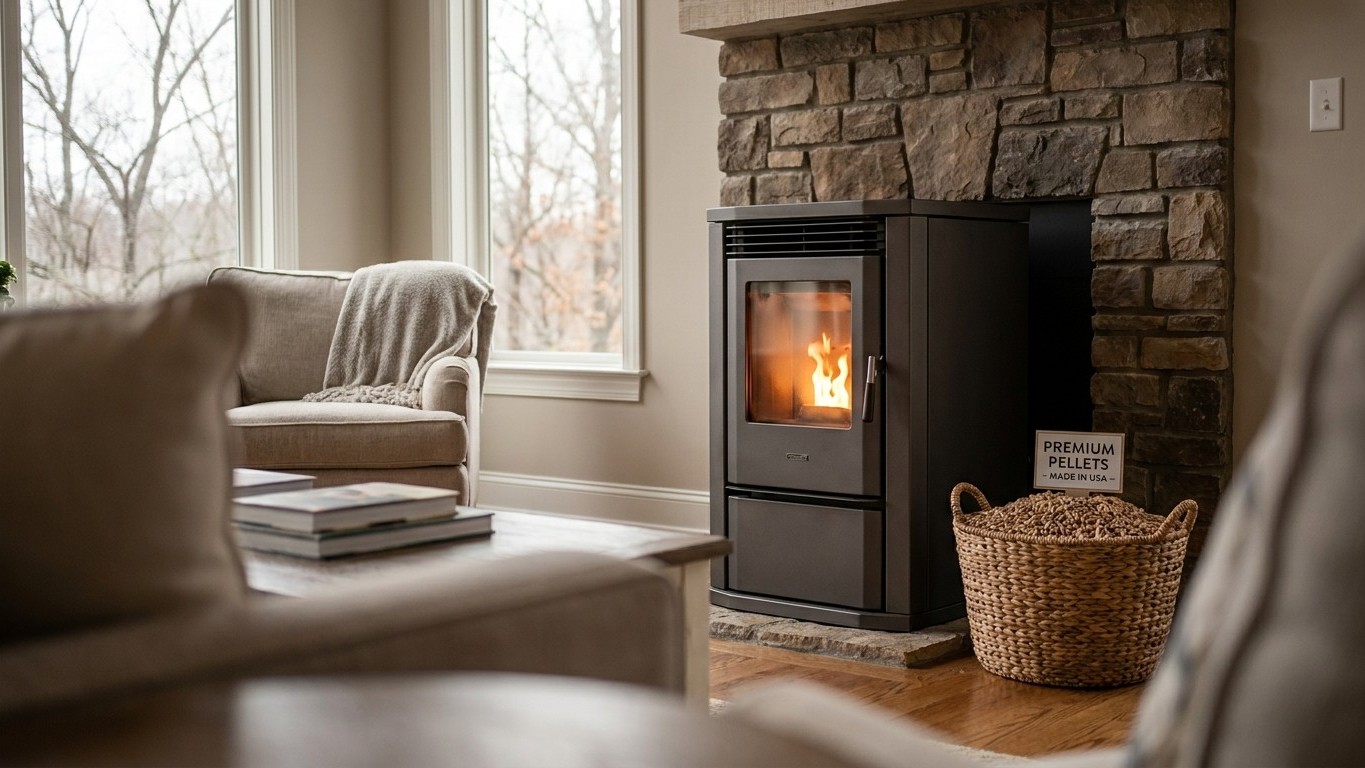

A furnace stays the backbone of home heating in Iowa, and the numbers explain why: this is a state where the mercury spends eight months below the point at which a house needs supplemental heat. A pellet stove here works hard, but it works inside a climate that punishes any gap in planning, from how many tons you order to what happens the day the power drops.
How hard the winter works here

Des Moines Intl AP logs about 6,178 heating degree days a year, base 65 F, according to NOAA’s 1991-2020 Climate Normals. That single number carries the whole story. Heating degree days add up, day by day, how far the average temperature falls below 65 F, and a house in a 6,178-degree-day climate burns roughly double the fuel of one sitting at 3,000. This is not a mild-winter state. It sits well above the national middle, closer to the northern tier than to the Midwest average.
The season also runs long, not just cold. Heating demand starts in October, the first month where the normal mean temperature (53.2 F) drops under that 65 F baseline, and it does not let go until June, when the mean finally climbs back above it. That is eight months of the year where a house in central Iowa needs some form of heat, even if only overnight. January carries the heaviest load, at 1,322 degree days on its own, more than a fifth of the annual total packed into thirty-one days. December and February follow close behind, each above 1,000.
Length and depth are two different things, and Iowa has both. A place can average a mild winter stretched over many months, or a brutal one that’s mercifully short. Des Moines gets neither kindness: a long season and a hard one, stacked together. That combination is exactly what makes a pellet stove worth treating as a real heating appliance here rather than a fireplace substitute for cozy evenings. In a climate like this, the stove is doing load-bearing work for a good chunk of the year, not just adding ambiance on a chilly Saturday.
One caution worth repeating: this figure comes from one weather station, Des Moines Intl AP, sitting near the middle of the state. Iowa runs colder in its northern counties and milder along its southern border, and the difference over a few hundred miles is real. A reader in Mason City or Estherville should expect a heavier degree-day total than Des Moines reports; a reader near the Missouri line should expect a lighter one. Check a station closer to your own county before you plan a season’s worth of fuel around a number logged at the airport in Des Moines.
How many tons a winter takes here
No agency publishes a tons-per-winter figure for Iowa, and anyone who quotes one is guessing. What you can do instead is build your own estimate from the same math every pellet burner eventually learns. A bag weighs 40 pounds. Fifty bags make a ton. From there, consumption tracks the heat your house actually needs, which is exactly what the degree-day figure above measures. A house that needs more heat burns more bags, in a straight line.
Three things move that line more than anything else:
- How well the house holds heat. Insulation, air sealing, and window quality decide how much of the heat you make actually stays inside. Two identical stoves in two houses of the same size can burn at very different rates depending on this alone.
- Whether the stove is the only heat or a supplement. A stove running as the sole heat source for a whole house works far harder, and burns through far more fuel, than one supplementing a furnace on the coldest nights or heating a single room.
- The setting it runs at. A stove dialed to a low, steady burn sips fuel compared with one run wide open to fight a January cold snap, and most owners run somewhere in between depending on the week.
Given how much those three variables can swing the total, even in the same town, the same house, on the same street, the only number worth trusting is the one you measure yourself. Count the bags you burn through your first full winter, from the October start of the heating season through the tail end in spring, and that count becomes your baseline. Every winter after that, you’re adjusting from a real figure instead of guessing from a state average that was never built to describe your house anyway. One measured season beats every published estimate, because it’s the only number that actually came from your walls, your stove, and your habits.
For the full national breakdown of how bag size, stove size, and climate zone combine into a season’s total, see our guide on how many pellets a winter takes.
Buying and storing them in this climate
Timing the purchase
Iowa’s heating season starts in October, so the window to buy ahead closes before then, not during it. Pellets are cheapest in the off-season, generally late spring through summer, when dealers are moving last year’s stock and demand is low. Wait until a cold snap hits in November or December and you’re competing with every other household in the state for shelf space, often at a worse price and sometimes with nothing left to buy at all. Given that heating demand here climbs steadily from October through January, ordering by late summer gives a real cushion before the season’s heaviest months arrive.
Storing them once you have them
Wood pellets are compressed sawdust held together by pressure and natural lignin, with no glue in the mix. That means moisture is the enemy, full stop. Damp air swells the pellets, and once they swell, they crumble back into sawdust and lose the density that makes them burn cleanly and evenly. Iowa summers run humid, and that humidity doesn’t disappear the moment pellets are indoors. A basement, garage, or shed that traps moisture, or a concrete floor that sweats condensation on warm, muggy days, will quietly ruin a pallet of pellets over a few months even if the bags look untouched from the outside.
Keep bags off bare concrete, on pallets or shelving, in the driest space available, and keep them sealed until you’re ready to burn them. Skip brand names and price quotes when you’re shopping. The only number worth comparing between sellers is the price per ton, since bag counts, weights, and bundle deals vary enough to make anything else a poor comparison. For the full rundown on moisture protection and how to judge pellet quality before you buy, see our guides on storing pellets properly and how to judge pellet quality.
What a winter outage means here
A pellet stove is not a wood stove, and the difference matters most on the coldest night of the year. Wood burns on its own once it’s lit. A pellet stove needs electricity to run the auger that feeds fuel into the firebox and the fan that pushes heat into the room. Cut the power, and the stove goes dark within minutes, regardless of how full the hopper sits.
In a climate logging 6,178 heating degree days a year, that’s not a minor inconvenience. A January outage in a house depending on a pellet stove as its main heat source is a real emergency, not just a lost evening of ambiance, especially with January alone averaging 1,322 degree days on its own. A summer or shoulder-season outage barely registers by comparison, since the house isn’t fighting to hold heat in the first place.
What most Iowa households fall back on tells you something too. RECS 2020 data shows 83% of Iowa homes heat mainly with a furnace, and 71% run on natural gas specifically, with propane covering another 13% and electricity 16%. Central heat pumps sit at just 4%, and steam or hot-water boilers at 7%. Fuel oil and kerosene didn’t return a reliable figure in the survey for this state, which means the data doesn’t support claiming any meaningful share of Iowa homes rely on it, not that nobody does. For most households, the backup during an outage isn’t another heating appliance at all. It’s whatever keeps the furnace’s blower and ignition running, since even a gas furnace needs electricity to operate despite burning gas for heat.
Sizing a generator or a battery to cover that gap depends entirely on the appliance you own, its startup draw, and how long you expect to be without utility power, and that’s not something to guess at from a state-level article. Check the label on your specific stove or furnace for its power draw, and see our national guide on what to do about a pellet stove during a power outage for how to plan around it properly.