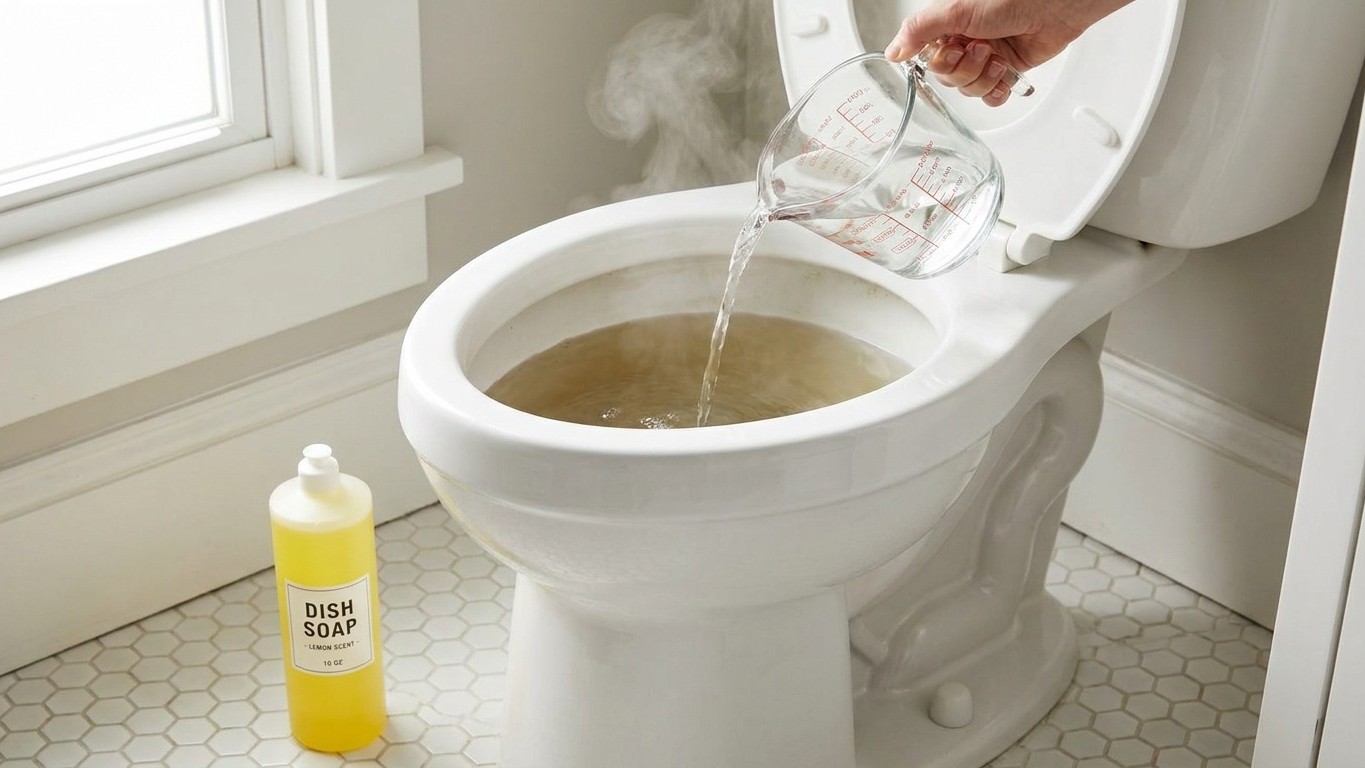

Grab a bucket of hot water and a squirt of dish soap before you touch the plunger. Pour it slowly into the bowl, wait ten minutes, and if the water level starts dropping on its own, you likely have a paper-and-waste clog that’s already breaking down. If the level stays put or rises, you’re dealing with something a plunger can’t dissolve, and the next few checks matter more than the tool itself.
What is actually happening

A toilet clears itself through a siphon. When you flush, water rushes from the tank into the bowl fast enough to fill the trap, the curved passage built into the base of every toilet, and that surge of water creates a pull that drags the bowl’s contents down and out into the drain line. The trap is shaped that way on purpose: it holds a few inches of standing water at all times to block sewer gas from coming back up into your bathroom. When something interrupts the siphon, that’s when you get a clog.
Toilet paper is designed to fail apart in water. The fibers are held together loosely enough that a few minutes of soaking and the agitation of a flush breaks the sheet into small clumps, which pass through the trap without much resistance. That’s why a clog caused by too much paper often clears on its own, or with nothing more than time and warm water loosening things further.
An object behaves differently. A cotton swab, a toy, a wipe marketed as “flushable” but not actually built to disintegrate, a bar of soap that slipped off the tank lid, these don’t break down. They lodge in the curve of the trap and hold their shape no matter how much water passes over them. Push a plunger against that kind of blockage and you’re not clearing it, you’re compressing it further into the trap or, worse, forcing it past the trap into the branch drain where it’s much harder to reach.
This is the part worth understanding before you do anything: a plunger works by using water pressure to push and pull an obstruction, and it’s genuinely effective against soft, water-permeable material. It’s far less effective, and sometimes counterproductive, against a solid object that has no give. Knowing which one you’re facing changes what the next step should be, and it’s the difference between a five-minute fix and a bill for pulling the toilet off the floor.
What to check, in order
Work through these before reaching for anything else. Each one costs nothing and tells you something specific about what you’re dealing with.
- Look at the water level in the bowl. If it’s high and barely moving, you have a full or near-full blockage in the trap. If it’s low or draining slowly, the blockage is partial and likely paper or waste, which softens with time.
- Think back to what went into the bowl. A recent flush that included a wipe, a small toy, or anything that doesn’t dissolve tells you this is an object clog, not a paper clog, and changes your approach entirely.
- Check whether other fixtures in the house are affected. Run water in a nearby sink or tub. If it drains fine, the clog is isolated to the toilet’s own trap or branch line. If the tub backs up or gurgles when the toilet is flushed, the problem is further down the shared drain line, not inside the toilet itself.
- Lift the tank lid and check the flapper. A flapper that doesn’t seal fully or lift completely can weaken the flush itself, meaning even a normal amount of paper doesn’t get the water volume it needs to clear the trap. A weak flush can look exactly like a clog when the real issue is upstream in the tank.
- Try the hot water and dish soap combination. Pour slowly to avoid overflow, let it sit, and watch the level. Soap breaks surface tension and helps water work into paper clumps; if the level drops over ten to fifteen minutes, you’ve confirmed a soft blockage that’s clearing itself.
- If none of that moves the water, a flexible drain snake fed gently into the trap can locate and hook an object clog without the force of a plunger stroke pushing it deeper. Resistance that doesn’t give as you rotate the snake usually means you’ve found the object rather than passed it.
What it costs to leave it
A toilet clog that clears is a one-time inconvenience. A toilet that runs constantly or leaks silently after you’ve fixed the immediate blockage is a different problem, and it’s the one that actually costs money over time. The U.S. EPA WaterSense program notes that “an old or worn flapper can cause your toilet to flush on its own or silently leak thousands of gallons a year.” That’s the mechanism worth checking once the clog itself is gone, because a flapper that doesn’t seat properly after you’ve been working on the tank can leave a leak running behind the scenes.
Zoom out and the scale gets harder to picture from a single household’s perspective. EPA WaterSense figures put it plainly: “Household leaks can waste nearly 1 trillion gallons of water annually nationwide,” and “the average household’s leaks can account for more than 9,300 gallons of water wasted every year.” Add to that the finding that “nine percent of homes have leaks that waste 50 gallons or more per day”, and you start to see why a running toilet is one of the most common culprits utility companies point to when a water bill jumps without an obvious explanation.
None of those national numbers tell you what your own toilet is doing, though. They’re aggregates built to show scale across millions of homes, not a diagnosis for the one in your bathroom. The only number that matters for your situation is what your own water meter shows before and after you fix the flapper or clear the clog. If you haven’t checked, this site’s guide to spotting a hidden leak walks through reading your meter correctly, which is the only measurement that actually belongs to you.
The financial upside of catching this early is real, if modest: WaterSense estimates that “fixing easily corrected household water leaks can save homeowners about 10 percent on their water bills.” For a toilet specifically, that usually means either replacing a flapper that’s stopped sealing or confirming a fill valve is shutting off completely once the tank reaches its normal level.
When to stop and call a plumber
Most toilet clogs are a bathroom-only problem you can solve with the checks above. A few situations change that, and they’re worth naming clearly rather than glossing over.
If water backs up into a tub or shower drain when you flush the toilet, the blockage sits in a shared line, not inside the toilet’s own trap, and that’s a job for a plumber with access to a main line snake. If a drain snake meets solid resistance that won’t clear and won’t let go, forcing it further risks cracking old cast iron or damaging PVC fittings you can’t see or reach. And if a clog recurs within days of clearing it, that’s often a sign of a partial blockage further down the line rather than a fresh, isolated event, which again points to professional equipment rather than repeated plunging.
More broadly, some situations call for stopping before you start. Anything behind a wall, meaning you’d need to open drywall or access a pipe run to reach it, is outside the scope of a bathroom fix. Any issue involving the main water supply line to the house, rather than a single fixture, carries risk of flooding if handled incorrectly. A gas water heater with a suspected leak or malfunction should never be treated as a DIY project, given the combination of water, gas, and pressure involved. And any leak, toilet-related or otherwise, that has already soaked into flooring, a subfloor, or a wall cavity needs a plumber and possibly a water damage assessment, since wet structure left unaddressed leads to mold within days, not weeks.
Before any of that, know where your home’s water shuts off. This site’s guide to finding and using your shut-off valve covers the step that matters most when a clog turns into an overflow: stopping the water before it spreads, not after.
Common questions
Why does a toilet clog after I’ve already plunged it once?
A first plunge often loosens paper enough to let water pass slowly, giving the impression the clog cleared. If a solid object is still lodged in the trap, though, it will re-catch material on the next flush. That pattern of repeated, quick clogs is a signal to check for an object rather than plunge again.
Is it safe to keep flushing a slow-draining toilet to force it through?
No. Repeated flushing on a slow drain adds water faster than the partial blockage can clear, raising the risk of an overflow. Let the bowl settle between attempts and check the water level before flushing again.
Does hard water affect how often a toilet clogs?
Hard water can leave mineral buildup inside the trap and the jets that direct water during a flush, narrowing the passage over time and weakening the siphon effect. That’s a separate, slower-developing issue from a one-time clog, but it can make future clogs more likely in homes with hard water.
Can a weak flush cause clogs even when nothing unusual went into the toilet?
Yes. If the tank isn’t filling to its normal level, or the flapper isn’t opening fully, the flush won’t generate enough water volume to complete the siphon, and ordinary amounts of paper can back up as a result. Checking the tank is worth doing before assuming the clog is about what went into the bowl.