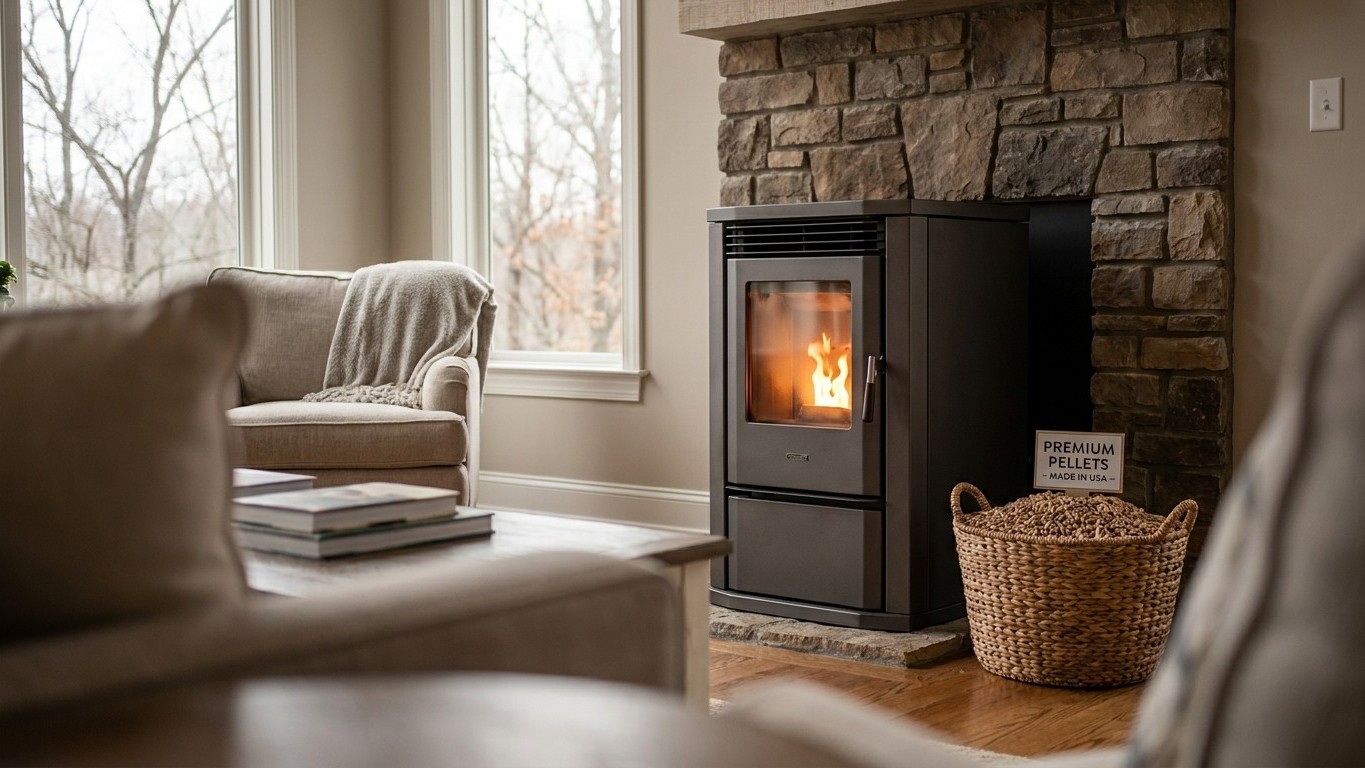

Albuquerque Intl AP, the reference weather station for central New Mexico, logs about 3,996 heating degree days a year against a 65 F base, alongside roughly 1,438 cooling degree days. That single number decides almost everything about Heating With Pellets here: how many tons a stove burns through, whether it can carry a house alone or only take the edge off a furnace, and how many months the hopper has to keep feeding a fire. Everything below works from that figure and from the months it spans.
How hard the winter works here

Heating degree days work like a running tally. For every day of the year, NOAA adds up how far the day’s mean temperature fell below 65 F, then sums it across twelve months. A day at 35 F contributes 30 degree days; a day at 60 F contributes 5. Add those daily gaps for a full year at Albuquerque Intl AP and you land near 3,996. That number is not an abstraction: double the degree days at two locations and you can expect, roughly, double the fuel burned to hold the same house at the same indoor temperature.
Compared with a genuinely cold climate, where annual totals can run past 7,000 or 8,000, Albuquerque’s near-4,000 sits in the middle range. That places a pellet stove here as a serious heat source, not a token gesture, but it also means a New Mexico winter is nowhere near the fuel demand of a Rocky Mountain valley or the upper Midwest.
A long season, not necessarily a brutal one
The monthly breakdown at the same station tells a second story that the annual total hides. Heating demand starts in October, the first month whose normal mean temperature (58.4 F) drops below the 65 F baseline, and it does not let up until May, when the mean climbs back above that line. That is about seven months of heating demand, spread unevenly: December is the peak at 870 degree days, followed by January at 856, while October and April sit far lower at 220 and 255.
| Month | Heating degree days |
|---|---|
| October | 220 |
| November | 579 |
| December | 870 |
| January | 856 |
| February | 645 |
| March | 481 |
| April | 255 |
A season that long, even at moderate intensity, still adds up. This is a state where a stove earns its keep across most of the calendar rather than in one short, sharp cold snap. That said, these figures come from one station in the Rio Grande Valley. A household in the northern mountains, around Taos or Angel Fire, runs colder and longer than Albuquerque’s numbers show, while the southern bootheel runs milder. Anyone outside the immediate Albuquerque area should treat this as a starting reference, not a personal forecast.
How many tons a winter takes here
No published source hands out a tons-per-winter figure for New Mexico, and treating any such number as gospel would be misleading anyway: two houses on the same street can burn twice as much fuel as each other depending on insulation, house size, and how the stove gets used. What you can do is build the estimate yourself, using the same chain that turns degree days into pounds.
A standard bag of wood pellets weighs 40 pounds. Fifty bags make a ton. Consumption tracks the heat the house actually loses, which is exactly what the degree-day figure above measures: more degree days over the season means more pounds burned to replace that lost heat, all else being equal. That is the whole mechanism, and it is also why the same house model burns differently in Albuquerque than it would in Denver or Duluth.
Three variables swing that estimate more than anything else:
- How well the house holds heat: attic insulation, window quality, and air sealing can change fuel needs by a large margin between two homes of identical square footage.
- Whether the stove is the sole heat source or a supplement to a furnace: in a state where furnace heat and natural gas dominate, many stoves run only in the coldest stretch or in one zone of the house, which cuts total pellet use sharply.
- The setting the stove runs at: a unit left on a low or medium heat setting for most of the season burns a fraction of what the same stove uses on high.
Given those swings, the most honest number is not a published average, it is the one you generate yourself. Count the bags burned through a first full winter, from the October start of heating demand through the tail end in April or May, and that count becomes a personal baseline more reliable than any regional estimate. One measured season beats every guess built from someone else’s house. For the national mechanics behind this calculation, including how climate zone and stove size interact, see the guide on how many pellets a winter takes.
Buying and storing them in this climate
Timing the purchase matters as much as picking a brand. With heating demand starting in October at Albuquerque and building fast through November into a December peak, the window to buy ahead is late summer into early fall, before that ramp-up. Wait until a cold snap hits and dealers across the region sell out fast, prices firm up, and drivers stuck without fuel end up paying premium rates for whatever is left. Pellets bought in the off-season, by contrast, tend to be both more available and cheaper per ton, which is the only figure worth comparing between sellers.
Storage is where New Mexico’s climate cuts a different way than it does in a wetter state. Wood pellets are compressed sawdust held together by the wood’s own lignin, with no added glue, which means they depend entirely on staying dry to hold their shape. Too little humidity is rarely the danger here; it’s the isolated moisture pockets that matter. A garage floor that sweats after a summer monsoon storm, a shed roof with a slow leak, or pellets stacked directly against a concrete slab can all pull in enough dampness to swell and crumble bags from the bottom up, even in a state known for dry air overall.
The fix is straightforward and doesn’t require a climate-controlled space: keep bags off the floor on a pallet or shelving, leave air space around the stack rather than jamming it against an exterior wall, and check the bottom bags periodically for softening or a change in weight. A pellet that’s absorbed moisture won’t burn cleanly and can jam an auger, which turns a storage mistake into a mechanical repair. The national pages on storage and pellet quality cover the sourcing and moisture-content details that apply regardless of state.
What a winter outage means here
A wood stove burns without any outside help. A pellet stove does not: it needs mains electricity to run the auger that feeds fuel into the burn pot and the fan that pushes heat into the room. Cut the power and the fire goes out on its own within minutes, regardless of how many tons of pellets sit in the hopper. That single fact is the real difference between the two appliances, and it matters more in a state with real winter demand than in one where a stove is purely decorative.
Cross that dependency with the degree-day figure from earlier. In December or January, when the season is pushing 850-plus degree days a month, an extended outage during a cold snap is a genuine heating emergency, not an inconvenience. In October or April, with degree days down near 220 or below, the same outage means a chilly evening and not much more. The risk scales with the calendar, not with the appliance itself.
New Mexico households aren’t relying on pellet stoves as their primary defense against that scenario. State data shows furnaces as the main heating equipment in about two-thirds of homes, with natural gas the dominant fuel at roughly three-quarters of households and electricity as the main heat source in about 13 percent. A hot-water or steam boiler shows up in a smaller share, around 7 percent. Fuel oil and kerosene don’t register at all in the state figures, and the estimates for heat pumps and propane were too thin to publish reliably, which is different from saying nobody uses them. For most New Mexico homes, a furnace running on gas is the backup a pellet stove supplements, not the other way around.
None of that changes the electrical dependency of the stove itself. Rather than guessing at a generator size or battery capacity, check the wattage rating printed on the appliance’s own label, since that draw varies by model and by whether the blower runs on high or low. The national page on power cuts and pellet stoves walks through backup options in more detail.