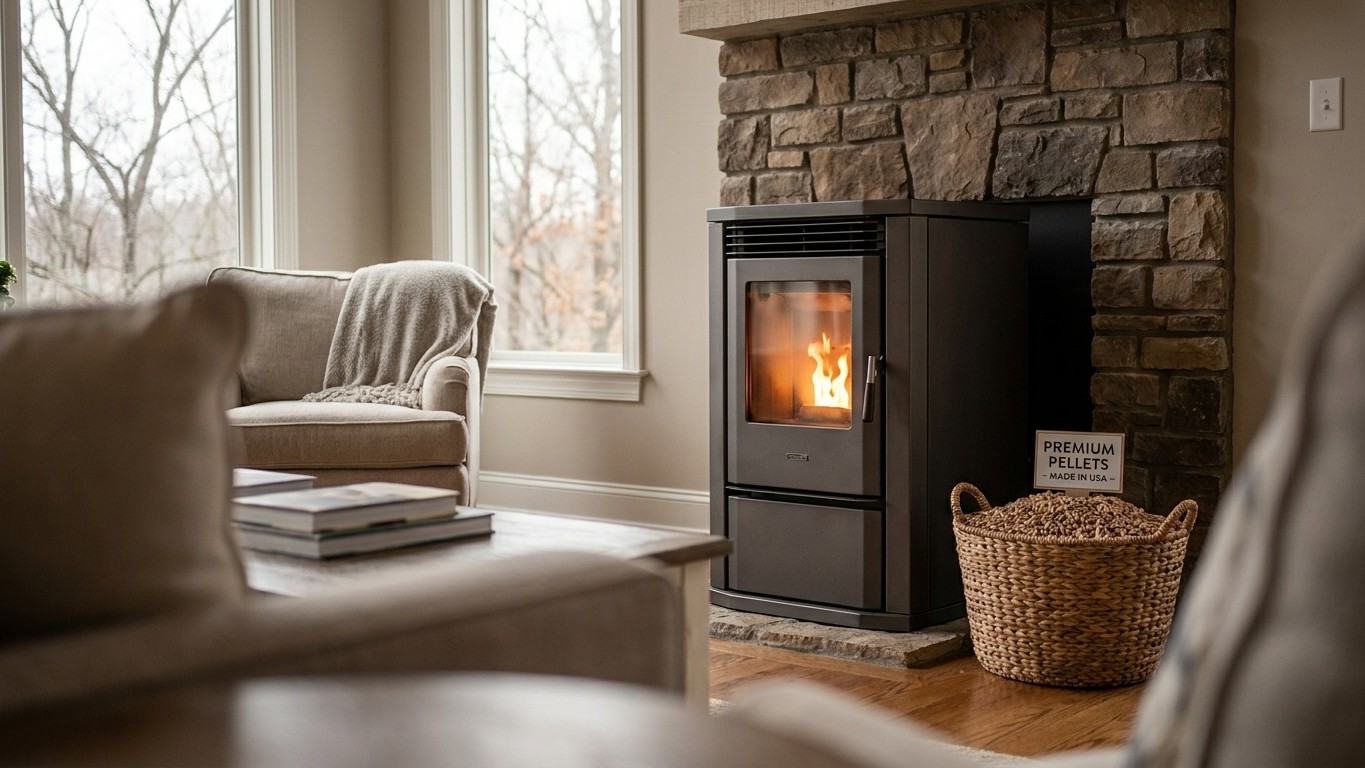

A North Carolina winter rarely knocks a house flat, but it does show up on the pellet bill. Most of the state sits in that in-between zone: cold enough for a stove to matter for months at a stretch, mild enough that it’s usually backup heat rather than the only thing standing between you and a cold house. How many tons that adds up to depends less on the state line and more on the specific winter, the specific house, and how the stove gets used.
How hard the winter works here

Charlotte Douglas AP, the National Weather Service reference station for the Piedmont, logs about 3,058 heating degree days a year on the current 1991-2020 climate normal, alongside about 1,769 cooling degree days. That heating number is the one that actually prices out a winter: it adds up, day by day, how far the average temperature falls short of 65 F, and it’s the same math NOAA uses everywhere, so it lets you compare Charlotte honestly against a place like Minneapolis (north of 7,500) or Miami (well under 1,000). At 3,058, Charlotte lands below the national average, in the same rough neighborhood as Atlanta or Nashville. That’s a mild-to-moderate winter by U.S. standards, not a brutal one.
What it isn’t is short. The heating season here runs about seven months, starting in October, once the monthly average temperature at Charlotte Douglas drops below that 65 F baseline, and stretching until May, when the average climbs back above it. January carries the heaviest load, at roughly 712 degree days for the month alone, more than double what October or April sees. December and February aren’t far behind. That’s the distinction worth sitting with: a mild winter and a short one are not the same thing. Charlotte’s winter is mild in depth but long in duration, which means a pellet stove here gets asked to do a little work over a lot of weeks, rather than a lot of work over a few brutal ones.
Given a degree-day figure in this range, a pellet stove in most of North Carolina works best as a serious supplement, something that carries the living space through the bulk of the season and takes real weight off a furnace or heat pump, rather than a stand-alone heating system built to handle every January morning on its own. That matches how the state actually heats, more on that below. But Charlotte Douglas is one station in the Piedmont. A house in the mountains around Boone or Asheville sits at meaningfully higher elevation and colder average temperatures, and a stove there is doing heavier lifting. A house near the coast, around Wilmington, sees a milder number still. Anyone outside the Piedmont should treat 3,058 as a starting point, not their own backyard.
How many tons a winter takes here
Nobody publishes a reliable “tons per winter in North Carolina” figure, and for good reason: two houses on the same street, both burning pellets all winter, can land a full ton apart. What you can do is work the math yourself, using the same degree-day logic that shaped the section above. A bag of pellets weighs 40 pounds. Fifty bags make a ton. How many bags a given house burns tracks how much heat it actually needs to replace, which is exactly what those 3,058 annual degree days measure at the Charlotte reference point, adjusted up or down for your own elevation and exposure.
Three things move that number more than anything else:
- How well the house holds heat. A tight, well-insulated 1990s build in the Piedmont burns markedly less than a drafty older farmhouse with single-pane windows, even sitting on the same street.
- Whether the stove is the only heat source or a supplement. Most North Carolina households run a furnace or heat pump as their primary system and lean on the stove for the coldest stretches and the main living areas, which cuts consumption well below what a stove running as sole heat would need.
- The setting it runs at. A stove left on a low, steady burn to take the edge off a room sips pellets compared with one run wide open to heat a whole floor.
The honest way to know your number is to measure it. Buy a manageable amount at the start of the season, track how many bags you actually feed through by the time the stove goes quiet in spring, and use that as your baseline for the following year. One measured winter, in your own house, with your own habits, beats any estimate built from a state average. For the general mechanics of that math, and how households elsewhere use it, the national page on how many pellets a winter takes walks through the same chain in more detail.
Buying and storing them in this climate
Since the North Carolina heating season starts in October on average, the window to buy ahead is late summer, Before the First real cold snap. That timing matters for two reasons. Pellets are typically cheapest in the off-season, well before demand picks up, and a regional cold snap in November or December can strip shelves fast, especially at big-box retailers that don’t restock mid-winter the way a dedicated hearth dealer might. Buying in August or September, rather than waiting for the first cold morning, avoids both problems.
Storage is where North Carolina’s own climate becomes the real issue, more than the cold itself. Pellets are compressed sawdust, held together by the wood’s own lignin with no glue added, which means they’re built to fall apart the moment they take on real moisture. North Carolina summers run humid across most of the state, and a garage or shed that isn’t sealed well can hold enough ambient humidity to soften a bag over the course of a summer, even without a leak. Coastal counties add wetter winters on top of that. And a concrete garage floor that sweats, which happens anywhere warm humid air meets cooler concrete, can wick moisture up into bags stacked directly on it.
None of that requires a special fix beyond the basics: keep bags off the floor, keep them away from a damp exterior wall, and don’t buy more than you can store somewhere genuinely dry through a North Carolina summer. The national storage guide covers the specifics of pallets, wraps, and shelf life, and the pellet quality page explains what a bag that’s absorbed moisture looks and burns like before you load it into the stove. On pricing, compare by the ton, not by the bag, since that’s the only figure that lines up dealer to dealer.
What a winter outage means here
A pellet stove needs electricity to work at all. An auger has to feed pellets into the burn pot, and a fan has to move air through the firebox and out the exhaust; cut the power and the stove goes cold no matter how full the hopper is. That’s the line between a pellet stove and a true wood stove, and it matters more the harder the winter bites. In a place logging 7,000-plus degree days, a multi-day outage in January is a real emergency. In North Carolina, with its 3,058 and its generally mild depth of cold, a lost evening without the stove is an inconvenience more than a crisis for most homes, though a longer outage during a January cold snap, when the degree-day load actually peaks, is a different story.
What people actually fall back on here lines up with how the state already heats. Furnaces are the main heating equipment in about half of North Carolina homes, and central heat pumps run a close second at 38%, with natural gas as a heating fuel in 29% of households and electricity used for heating in 62%. Propane shows up in a small share, around 4%. In practical terms, most homes losing power lose their heat pump or furnace right along with the pellet stove, since those systems run on electricity too, whether they’re pulling gas or running an electric heat pump compressor. A propane furnace, in the smaller share of homes that have one, may be the one system still working on battery-backed ignition during an outage.
Nobody should size a generator or a battery bank off a general guide like this one. That decision depends on the specific stove’s wattage draw, which is printed on the appliance’s own rating label, not on a state average. The national guide to pellet stoves and power outages walks through backup options in more detail once you know your own stove’s numbers.