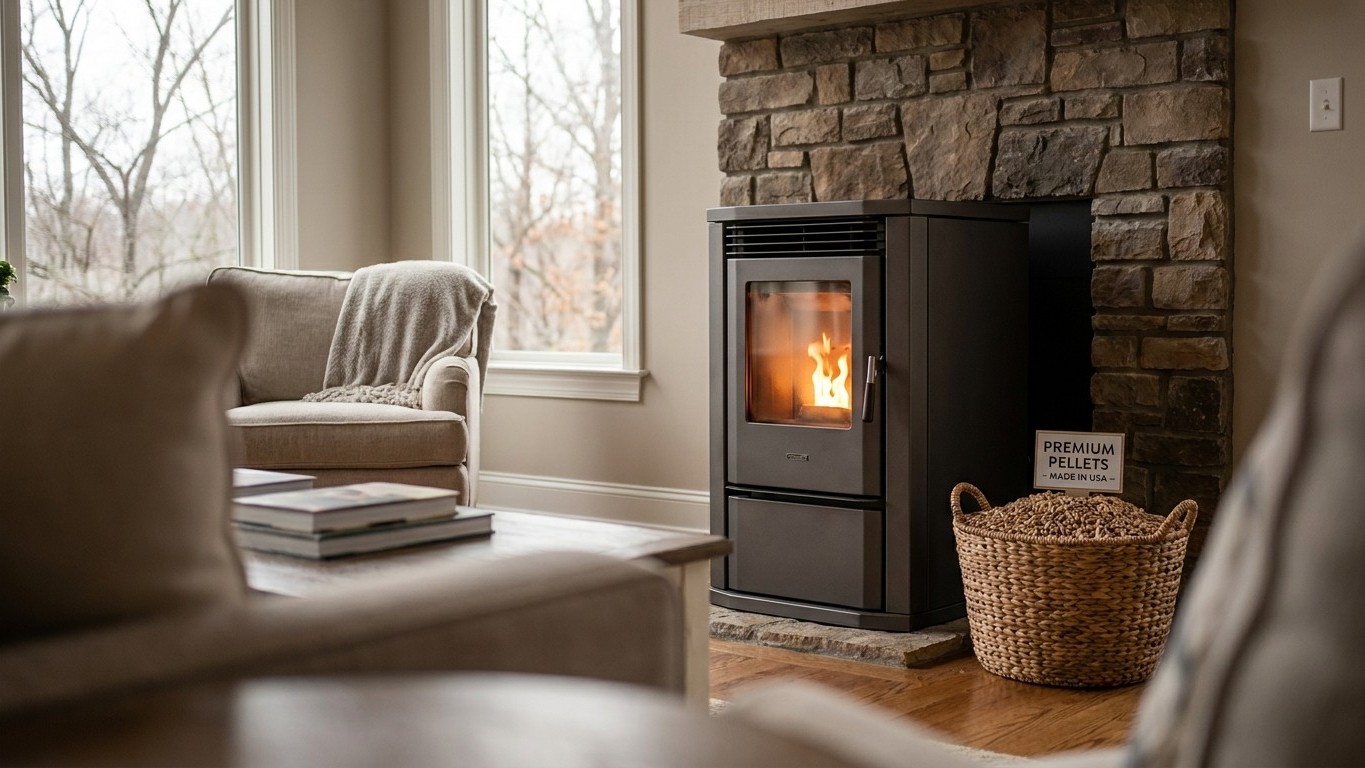

A winter in British Columbia’s Lower Mainland runs long rather than brutal, and that changes how you think about pellets. At the Vancouver reference station, heating demand stretches across roughly 11 months of the year, but the degree-day total behind it is moderate by Canadian standards. That combination, mild depth with a long calendar, decides whether a pellet stove carries your house through winter or simply keeps a room warm on the coldest evenings.
How hard the winter works here

Vancouver Int’l A records about 2,818 heating degree days a year below 18°C, based on Environment and Climate Change Canada’s 1981-2010 Climate Normals. That single number is the whole calculation behind a pellet stove’s workload: it tells you how much heat a house needs to hold 18°C against the outside air over the course of a full year, and it scales roughly straight-line with fuel use. Double the degree days, double the pellets for the same house. Half the degree days, half the pellets.
By Canadian standards, 2,818 is on the mild side. Coastal marine air keeps the depth of the cold shallow compared to the Prairies or the BC Interior. But depth and length are two different measurements, and this is where a lot of people misjudge their own heating bill. The monthly breakdown shows demand starting in September, the first month whose normal mean temperature (14.9°C) drops below the 18°C base, then building through fall, peaking in December at 447 degree-days, holding through January (430) and February (370), and not falling back above the 18°C threshold until August. That’s close to 11 months of some heating demand, even if the coldest stretch is short and rarely severe.
What that means in practice: a pellet stove in a Vancouver-area home is more often comfort and supplemental heat than a full heating system built to survive a hard freeze. It’s the appliance that takes the chill off a damp November evening, holds a living room warm through a wet January weekend, and lets a homeowner turn the furnace down rather than replace it. For most of the year the demand is light. December and January carry the real load, and even then, it’s a moderate load next to what a stove in Winnipeg or Prince George is asked to do.
That last comparison matters. British Columbia is a large province, and Vancouver Int’l A describes the coast, not the whole territory. Prince George, Kamloops, the Kootenays, and the northern interior see colder winters and a longer, harder heating season than the figure above. If you’re reading this from anywhere outside the Lower Mainland or southern Vancouver Island, treat this station’s numbers as a starting point and check the normals for a city closer to you before you plan around them.
How many tons a winter takes here
No published source hands you a tons-per-winter figure for British Columbia, and treating one as gospel would be misleading anyway: two houses on the same street can differ by a factor of two depending on insulation, age, and how the stove gets used. What you can do is work the chain honestly, using the degree-day figure above as the demand side of the equation.
Start with the units. A standard bag of wood pellets weighs 40 pounds. Fifty bags make a ton. From there, consumption tracks the heat your specific house needs to replace, which is exactly what heating degree days measure: more degree days below 18°C, more fuel burned to hold the line. A home near Vancouver Int’l A, with its relatively moderate 2,818 annual degree days, needs meaningfully less fuel over a season than an identical house sitting in a colder interior valley with a higher total.
Three variables move the number for your specific address, more than any provincial average ever could:
- How well the house holds heat — insulation, air sealing, window quality, and even how exposed the house is to wind off the water or up a valley.
- Whether the stove is the only heat or a supplement — running it as the main source through December and January burns far more than using it to top off a furnace or heat pump on cold nights.
- The setting it runs at — a stove held on a low or medium setting through most of the season uses noticeably less than one run wide open to heat a large, drafty space.
Given how much these three factors swing the answer, the most reliable number you’ll ever get is your own. Count the bags you burn through your first full winter, from the September start of the heating season through the following spring, and use that as your baseline going forward. One measured season on your own thermostat beats every estimate on this page, including this one. For the fuller breakdown of how the math works nationally, see the companion page on how many pellets a winter takes.
Buying and storing them in this climate
Timing the purchase
Heating demand at the Vancouver reference station starts building in September, so buying ahead means having your fuel in the garage or shed before that month, not after. Once the first cold snap of late fall hits, retail shelves in the region tend to empty fast, and pellets bought in a hurry in November or December often cost more than the same bags bought in July or August, when demand is at its lowest point of the year. Buying in the off-season isn’t just about avoiding a scramble. It’s usually the cheaper way to stock a winter’s supply.
Storing against a wet coastal climate
Wood pellets are compressed sawdust, held together by the natural lignin in the wood rather than any added glue. That construction is what makes them burn cleanly and consistently, and it’s also their weak point: any sustained damp swells the wood fibers and the pellets crumble back toward sawdust, losing their shape and much of their heat value.
That matters more on the BC coast than in a drier climate, because winters here run wet, not just cool. A garage floor that sweats with condensation, a shed with a leaky roof seam, or bags stacked directly against a concrete slab are all common ways a season’s supply gets ruined before it’s ever burned. Pallets or boards under the stack, a tarp or plastic sheeting as a moisture barrier, and storage off an exterior wall all help. For the full storage rules and how to judge pellet quality before you buy, the national pages on pellet storage and pellet quality cover the details that apply everywhere, not just here.
One rule worth repeating locally: compare prices per ton, never per bag. Bag sizes and per-bag pricing can make two very different deals look similar at a glance, and per ton is the only figure that actually lines up across suppliers.
What a winter outage means here
A pellet stove isn’t a wood stove with a different fuel. It’s an electrically dependent appliance: an auger motor feeds pellets into the firebox, and a fan pushes combustion air in and heated air out. Cut the power, and the stove stops working, full stop, regardless of how many tons are sitting in the shed.
Cross that dependency with the degree-day figure from earlier and the stakes come into focus. In a harder, colder BC winter, deep in the Interior or the north, a power outage during a stove-reliant cold snap is a genuine heating emergency. Near Vancouver Int’l A, where the annual degree-day total is comparatively moderate and the coldest stretches are short, an outage is more often an inconvenient, chilly evening than a survival situation. Depth of cold changes the consequence, not just the discomfort.
What do most BC households actually fall back on if the pellet stove goes dark? Statistics Canada’s 2023 survey of primary heating systems in the province shows forced-air furnaces as the leading system at 36%, electric baseboard heaters at 28%, heat pumps at 10%, and boilers with hot-water or steam radiators at 9%; heating stoves aren’t broken out as a separate reported figure in that data, meaning the estimate was judged too unreliable to publish, not that the category is empty. The catch worth sitting with: a forced-air furnace’s blower needs electricity to move warm air, and electric baseboards and heat pumps need power outright. A widespread outage doesn’t just take down the pellet stove. It takes down most of what British Columbia actually heats with.
Don’t guess at a generator size or a battery bank capacity from a general guide like this one. Check the wattage draw printed on your specific stove’s rating label, and read the national page on what a power outage means for a pellet stove for how to plan around that number.