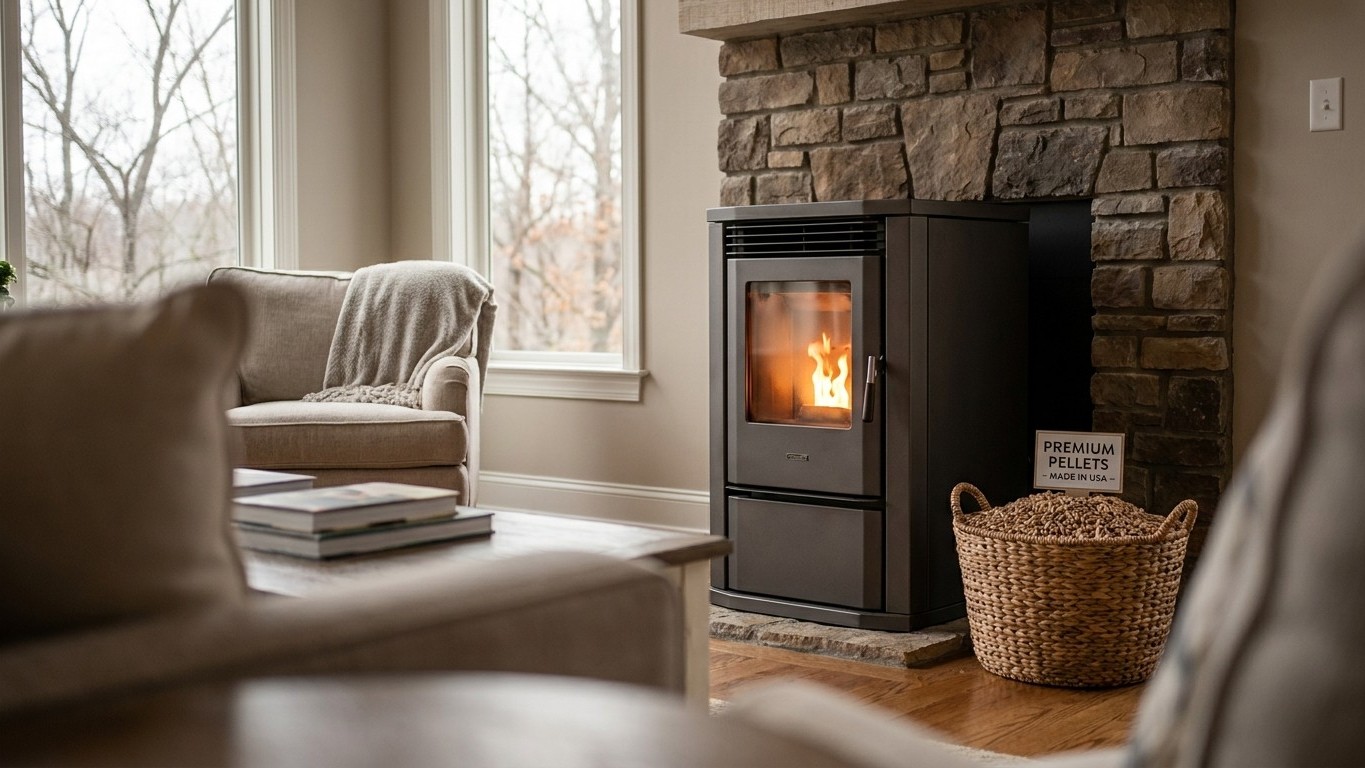

A Columbus-area home logs roughly 5,233 heating degree days a year, and heating demand there stretches across eight months, October through May, peaking hard in January. That means a pellet stove in Ohio isn’t a weekend accessory. It’s asked to carry real, sustained heat load for most of the year, and the tons of fuel it burns depend on how well the house holds that heat and how the stove gets used inside it.
How hard the winter works here

Start with the number that actually prices out a winter: 5,233 heating degree days a year at Columbus Port Columbus Intl AP, the NOAA reference station for central Ohio, under the 1991-2020 climate normals. Degree days aren’t a temperature, they’re an accumulation, adding up how far below 65°F the average day sits, every day, all year. A house that racks up 5,233 of them burns roughly twice the fuel of a house sitting at 2,600, all else equal. That’s the number that separates “the stove takes the edge off” from “the stove is doing real work.”
Pair that figure with the season’s length, because depth and length are not the same story. Columbus’s heating season effectively opens in October, the first month whose normal mean temperature (55.2°F) drops under the 65°F threshold NOAA itself uses to count degree days. It runs through January’s peak of 1,099 degree days in that month alone, and doesn’t fully let go until the mean climbs back above 65°F in June. Call it eight months of some heating demand, with the brutal stretch concentrated in December through February, when 947, 1,099, and 910 degree days pile up in successive months.
What that combination means in practice: this isn’t a short, sharp cold snap climate, and it isn’t a mild climate that happens to have one hard month either. It’s long and moderately hard at the same time, which is a harder combination on a fuel budget than either alone. A stove sized and stocked for a two-month cold snap will come up short here, because the hopper has to keep feeding it from fall into late spring, not just through the worst weeks.
One thing to flag before going further: Columbus is one station, not the whole state. Ohio runs from the Lake Erie shoreline in the north to the Ohio River valley in the south, and a household in Ashtabula County is working a noticeably colder normal than one in Cincinnati. Anyone at the far edges of the state should treat the Columbus figure as a starting point, not their own number, and can pull their nearest station’s normals from NOAA’s Climate Normals dataset if they want a closer match.
How many tons a winter takes here
No dataset publishes “a winter in Ohio takes X tons.” Anyone who tells you that is guessing, and two houses on the same street can genuinely differ by a factor of two. What does exist is a chain you can work through yourself, using the degree-day figure above as the load your house is actually fighting.
Start with the units. A standard bag of pellets weighs 40 pounds, and a ton is fifty bags. From there, consumption tracks the heat the house needs to replace, which is exactly what those 5,233 annual degree days are measuring: more degree days, more fuel burned to hold the same indoor temperature. That’s the physics. The tonnage on top of it depends on three things specific to your house and how you run the stove.
- How well the house holds heat — insulation, air sealing, window quality, and even how open the floor plan is around the stove all change how much of that heat sticks around instead of leaking out.
- Whether the stove is the only heat source or a supplement — a stove carrying the whole house through a Columbus winter burns far more than one that’s just taking the load off a furnace on the coldest days.
- The setting it runs at — a stove left on a low, steady burn sips fuel differently than one cycling on high through the January stretch, and burn rate is one of the few variables the homeowner directly controls.
Given all that, the honest answer is to stop looking for someone else’s number and build your own. Buy a modest, round quantity for the first winter, count exactly how many bags actually get burned by the time the mean temperature climbs back above 65°F in June, and use that count as your baseline going forward. It will be specific to your house, your stove, and how you run it, which no published estimate can be. For the mechanics behind that math, the site’s page on how many pellets a winter takes walks through the calculation in more detail.
Buying and storing them in this climate
Timing matters here because the heating season starts in October, not December. Buying ahead means buying before that window opens, ideally over the summer months when demand is flattest and pellets tend to run cheapest. Wait until the first real cold snap and you’re competing with every other household in central Ohio for whatever’s left on the shelf, often at a worse price and sometimes with nothing left at all.
Storage is the other half of the equation, and it’s where climate specifics actually matter. Pellets are compressed sawdust, held together by the wood’s own lignin rather than any added glue, which means moisture is the enemy. Humid air swells the pellets, and once they’ve absorbed enough, they crumble back toward sawdust and lose their burn quality. Ohio’s summers run humid, and a garage or basement that sweats condensation on its walls and floor in July and August is not a neutral place to stack a season’s supply. Off the ground, away from exterior walls that sweat, and in a space with some air movement is the baseline to aim for, whatever specific setup a given home allows.
None of this depends on brand or dealer, and no price belongs in this kind of comparison because prices shift by season and by supplier. What does compare across sellers is the per-ton figure, since bag counts and bag sizes can otherwise make two offers look different when they’re not. For the fuller rundown on moisture damage and how to judge pellet quality before buying, the site’s storage guide and quality guide cover the national-level detail that applies here just as much as anywhere else.
What a winter outage means here
A pellet stove is not a wood stove with a different fuel. It’s an electrical appliance that happens to burn wood pellets: a hopper auger feeds the fuel, a fan pushes combustion air through, and another moves heat into the room. Cut the power and the whole mechanism stops, regardless of how full the hopper is. That’s the single biggest functional difference from a wood-burning stove, and it matters more the colder the climate sitting outside the window.
Set against Columbus’s 5,233 annual degree days, that distinction has real weight in the depth of winter. An outage in January, sitting inside that month’s 1,099 degree days, is a heating emergency for a household actually depending on the stove, not just an inconvenience. The same outage in a shoulder month like October or April, with 323 and closer to 100 degree days respectively, is closer to an evening without the stove running, uncomfortable but not urgent.
What a given household falls back on during that outage is worth being honest about, because it varies by what’s already installed. Ohio’s residential mix, per the U.S. Energy Information Administration’s 2020 Residential Energy Consumption Survey, runs 77% furnaces as the main heating equipment, with natural gas the dominant fuel at 64% and electricity at 23%. Central heat pumps and steam or hot-water boilers each sit around 5%, and propane covers about 7%. A furnace running on natural gas doesn’t need grid power to make heat the way electric resistance heat does, but most furnace blowers still need electricity to circulate that heat through the house, so a power outage compromises even a gas furnace’s ability to move warm air, just less severely than it compromises a pellet stove.
What size generator or battery bank actually covers a pellet stove through an outage isn’t something to guess at here. That number lives on the appliance’s own label, specifically its running wattage, and the site’s page on power outages and pellet stoves covers how to size backup power against that figure rather than against a rule of thumb that won’t match every stove.