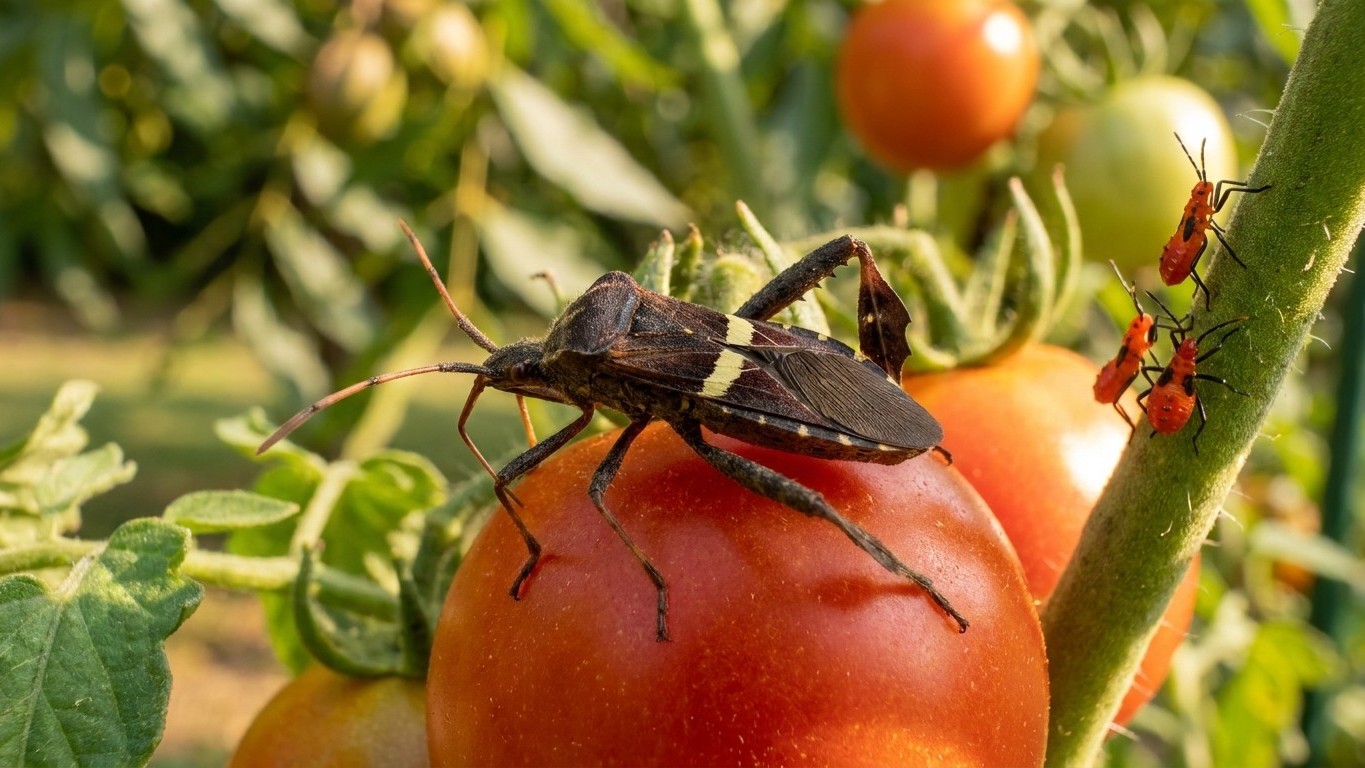

Leaffooted bugs show up in Oklahoma gardens in mid-to-late summer, once tomatoes, peppers, pecans and other fruiting crops are setting and filling out. They stay active through early fall, feeding on developing fruit and seed pods until cold weather finally shuts them down. Row covers and hand-picking early in the season do more than any spray applied later.
The weeks to watch
Oklahoma State University Extension’s home vegetable insect fact sheet (EPP-7313) doesn’t publish a specific calendar window for leaffooted bug the way it does for a handful of other garden pests. What it does offer is a general pattern worth borrowing: pest pressure in Oklahoma gardens tends to be relative to plant stage rather than tied to a fixed date. The sheet notes, for instance, that corn earworm and squash bug numbers build up as the season goes on, so early plantings often dodge the worst of it, while thrips hit hardest right at the cotyledon and first-true-leaf stage. Leaffooted bug follows a similar logic, tracking the fruiting stage of its host plants rather than a spot on the calendar.
Early season
Adults overwintering in leaf litter, wood piles, and under bark start moving in spring as temperatures climb, but they don’t do much damage yet because there’s little ripening fruit to feed on. This is the quiet window.
Mid and late summer
Once tomatoes, peppers, black-eyed peas, and pecans start producing, adults and nymphs move in and populations build through several overlapping generations. This is when most Oklahoma gardeners actually notice the damage, and it continues until frost knocks the plants back.
Reading the calendar from your last frost
Leaffooted bugs don’t respond to a date on the wall. They respond to warming soil and the growth stage of nearby host plants, which means an early or late spring shifts everything downstream. The one date most Oklahoma gardeners actually plan around is the last spring frost, and for the reference station used in NOAA’s 1991-2020 climate normals, that falls between March 28 and April 10.
- Start from your local last-frost window (March 28 to April 10 at the reference airport station, though suburban and rural gardens often see frost one to two weeks later, and more at elevation, so check your own county before setting a date).
- Count forward roughly six to eight weeks from transplanting before fruit is developed enough to attract feeding leaffooted bugs, since that’s the stage they’re after, not the seedling itself.
That arithmetic gives a range, not a single day. If your county’s frost date runs later than the reference station’s, push both the transplant date and the expected damage window back by the same margin. Covers should go on before adults start moving into the garden and come off only once flowers need pollinators, since leaffooted bugs feed on fruit, not foliage, at that stage.
What it attacks, and what the damage looks like
Most gardeners spot the symptom long before they spot the insect. Fruit develops sunken, discolored blotches or corky-looking dimples where feeding punctures pierced the skin. Pods and seeds can look shriveled or deformed even when the outside of the plant looks fine. Pecans hit hard enough show blackened, aborted nuts. The damage comes from the piercing-sucking mouthparts of both nymphs and adults, which inject digestive enzymes into developing fruit and seeds and then withdraw the liquefied contents, so the harm is done well before any wilting or discoloration becomes obvious on the surface.
Because both immature and adult stages feed the same way, treatment timing matters less by life stage and more by how early the population is caught. Crops most commonly affected in Oklahoma include:
- Tomatoes
- Peppers
- Black-eyed peas and other cowpeas
- Pecans
- Okra
Once the punctures happen, the cosmetic and sometimes structural damage to that fruit is permanent. Later feeding on the same plant can still be limited, but the fruit already hit won’t recover its appearance or, in cases of severe pecan damage, its viability.
How Oklahoma sits in this pest’s range
Leaffooted bugs are established broadly across the southern and central United States, and Oklahoma’s climate, hot summers, mild falls, and a long fruiting season for warm-season crops, sits comfortably within the range where this insect thrives. The OSU Extension fact sheet used for this page doesn’t include a state-by-state range map or a severity ranking, and no other Oklahoma-specific source in this research names a neighboring state’s data as the basis for local guidance. That means the honest answer here is that Oklahoma’s own extension literature treats leaffooted bug as a routine garden pest across the state’s vegetable- and pecan-growing regions, without singling it out with the kind of dedicated timing data given to squash bug or corn earworm.
What that absence tells a gardener matters more than it might seem. Where a pest gets its own detailed calendar in extension publications, it usually means concentrated economic damage on a major crop. Leaffooted bug’s more generic treatment suggests it’s a real but secondary concern in most Oklahoma gardens, worth watching on tomatoes, peppers, and pecans, but not the first pest most county extension offices lead with when the growing season starts.
What actually works against it
Cheap, physical measures work better against leaffooted bug than most home remedies, mainly because the insect is large, slow-moving, and easy to see once you know what you’re looking for.
- Clear overwintering sites in fall. Adults spend winter in leaf litter, brush piles, and under loose bark near the garden. Removing that debris in late fall reduces the number of adults available to move in come spring, before any damage starts.
- Hand-pick adults and nymphs in early morning. Leaffooted bugs are sluggish in cool morning temperatures, which is the easiest window to knock them into a bucket of soapy water. This works only while populations are still low; once numbers build in mid-summer, hand-picking can’t keep pace.
- Use row covers before fruit sets. A physical barrier keeps adults from reaching flowers and young fruit in the first place. Covers have to come off once pollination is needed, which is also roughly when the insect’s feeding period begins, so timing the removal matters.
- Rotate host crops and interplant. Moving tomatoes, peppers, and cowpeas to a different bed each year, and breaking up large single-crop blocks, makes it harder for a population that built up nearby last season to find the same host again immediately.
- Trap crops. Some gardeners plant sunflowers or sorghum at the garden’s edge to draw adults away from the main crop. Reports on how well this works are mixed, and Oklahoma extension sources don’t confirm it as a reliable strategy on its own.
None of these measures do much once nymphs have already fed and fruit shows the corky scarring. At that point the damage to that particular fruit is done, and the goal shifts to protecting what hasn’t been hit yet rather than reversing anything already marked.
Common questions
Do leaffooted bugs bite people or pets?
No. They feed exclusively on plant tissue with piercing-sucking mouthparts built for fruit and seeds, and they don’t target animals or humans. Handling one can produce a mild odor from defensive glands, similar to a stink bug, but not a bite.
Can leaffooted bug damage be confused with squash bug damage?
It’s easy to mix them up early on since both are large, shield- or leaf-shaped insects found on garden vegetables. Squash bugs concentrate on squash and pumpkin foliage and cause wilting vines, while leaffooted bugs go after fruit and seeds directly, on a wider range of hosts including tomato, pepper, and pecan.
Does covering pecan trees work the way it does for garden vegetables?
Not practically. Row covers work on small garden beds but aren’t feasible on mature pecan trees. For pecans, removing nearby overwintering debris and monitoring nut clusters for the telltale black, aborted nuts in late summer is the more realistic approach home growers actually use.