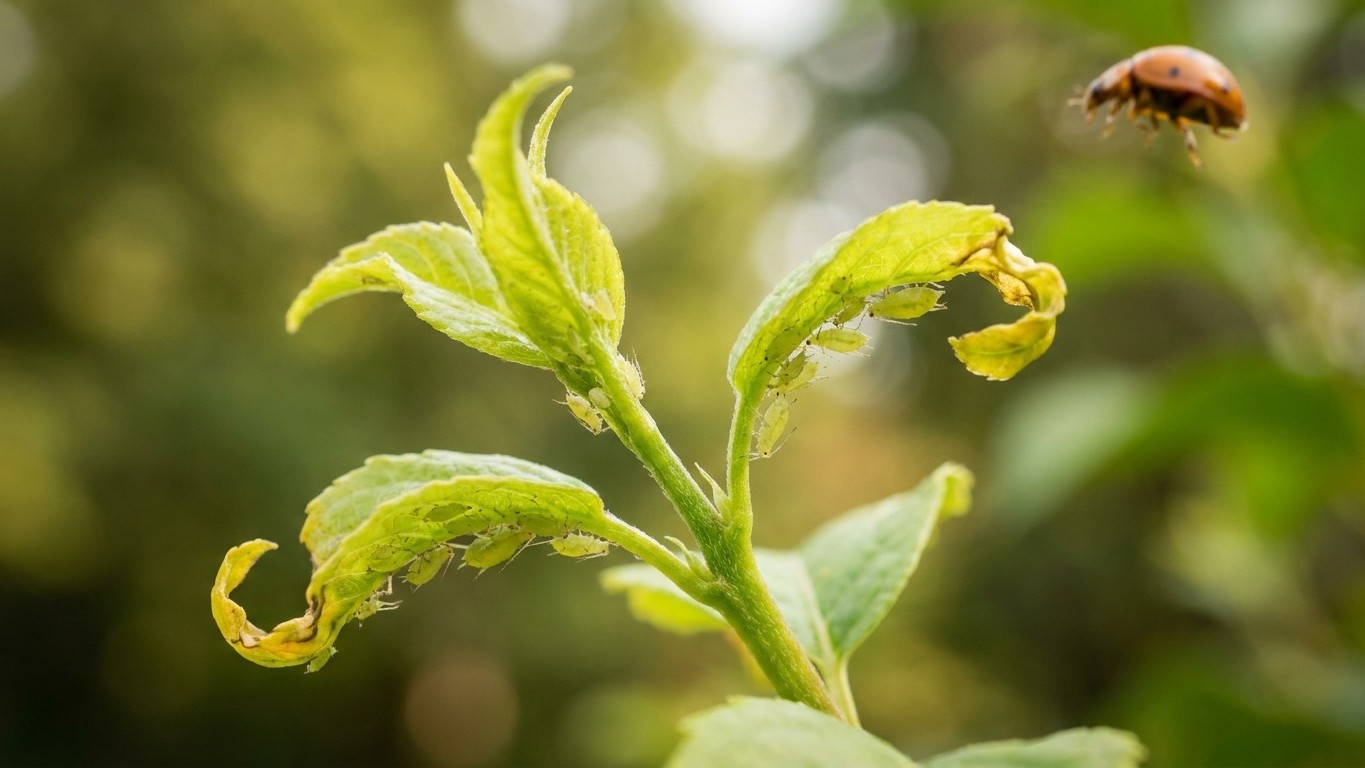

Aphids build up in West Virginia gardens anytime from April through August, but WVU Extension’s pest calendar singles out June as the month they hit hardest, right alongside cabbage worms and Japanese beetles. Row covers over young transplants, a strong hose spray to knock colonies off, and letting ladybugs and lacewings move in stop most home-garden outbreaks before they need anything stronger.
The weeks to watch
Aphids can turn up on West Virginia plants any time between April and August, but WVU Extension’s seasonal pest management guide places the heaviest pressure in June, grouping aphids with cabbage worms and Japanese beetles as the month’s main problem insects.
Early colonies
The first small clusters usually settle on tender new growth as soon as it appears in spring, drawn to the soft tissue at leaf tips and stem ends. These early colonies are easy to miss because a handful of aphids on the underside of one leaf doesn’t look like much of a threat yet.
The June buildup
Aphids reproduce without mating for most of the growing season, and in warm weather a new generation can mature in about a week. That’s the mechanism behind June’s spike: a few overlooked aphids in May don’t stay a few aphids for long. Each female can produce dozens of live young, and those young start reproducing themselves within days, so numbers climb fast once the weather cooperates.
Late-season decline
The pest calendar’s window runs through August, but pressure usually tapers as the season wears on. Predator populations catch up, plants toughen past the tender-growth stage aphids prefer, and hot, dry stretches slow reproduction. None of that means aphids disappear by midsummer, just that June tends to be the peak a WV gardener should plan around.
Reading the calendar from your last frost
Aphids respond to soil and air temperature, not to a date on the wall, so an early or late spring shifts everything that follows. For the Charleston area, NOAA’s 1991-2020 climate normals put the last spring frost somewhere between April 9 and April 23, a range built from freeze-probability data at that station, not a single guaranteed day.
- Start from your own last frost date, using the April 9 to April 23 window as a normal for the Charleston area, not a promise.
- Count forward roughly six to ten weeks to reach June, when WVU Extension marks aphid pressure as heaviest, and use that stretch to plan when covers go on and when they need to come off.
That gap matters for timing. Transplants set out right after frost spend their most vulnerable early weeks heading straight into aphid buildup season, which is exactly when a lightweight row cover earns its keep. Charleston sits in a river valley, and NOAA’s data notes that higher elevations elsewhere in the state freeze noticeably earlier come fall, a reminder that a single station’s numbers don’t stretch evenly across West Virginia’s terrain.
What it attacks, and what the damage looks like
Curled, yellowing leaves and a sticky film on foliage usually show up before a gardener spots the insect responsible. That sticky residue is honeydew, aphid waste that often grows a black sooty mold on top of it, and it’s frequently the first clue something’s feeding on a plant, well before the tiny insects themselves are noticed clustered on stem tips or leaf undersides. New growth that looks stunted or twisted is another early sign, since aphids favor the softest, most actively growing tissue.
Both nymphs and adults do the damage, piercing plant tissue with needle-like mouthparts and drawing out sap, and because nymphs mature so quickly, a colony is often mostly immature insects during an active outbreak. That matters for treatment: knocking off or removing a colony hits every feeding stage at once, since none of them are hidden inside the plant.
Common host crops in a West Virginia garden include:
- Beans and peas
- Tomatoes and peppers
- Cabbage, broccoli and other brassicas
- Lettuce and other leafy greens
- Cucumbers and squash
- Roses and other flowering ornamentals
How West Virginia sits in this pest’s range
Aphids are about as widespread as a garden pest gets, present wherever their host plants grow across nearly every U.S. state. That kind of range means the real difference between West Virginia and its neighbors isn’t whether aphids show up, it’s when. A wide-ranging pest like this shifts its timing with local temperature and elevation rather than skipping regions entirely.
WVU Extension publishes its own seasonal pest calendar covering aphids directly, placing them in June alongside cabbage worms and Japanese beetles, so there’s no need to borrow a window from a neighboring state’s guidance here. That’s worth noting because plenty of pest pages end up leaning on a bordering state’s extension data when their own state hasn’t published specifics. West Virginia’s mountainous terrain does mean timing can vary within the state itself, since a garden at higher elevation warms later in spring and cools earlier in fall than one in a river valley like Charleston’s, even though both sit under the same statewide guidance.
What actually works against it
- Time plantings around the buildup. Setting out sturdy transplants rather than delicate seedlings right as aphid pressure climbs in late spring means less exposed tender growth during the weeks aphids reproduce fastest.
- Spray them off with water. A strong jet from a hose physically dislodges aphids, and their soft bodies and limited mobility mean many don’t make it back onto the plant.
- Check leaves weekly and crush colonies by hand. Aphids cluster on the undersides of leaves and at stem tips, and catching a small colony early stops it before the weekly reproduction cycle turns it into hundreds.
- Cover young plants with row covers. A physical barrier blocks winged aphids from landing on and colonizing transplants in the first place; it stops working the moment aphids are already established underneath it.
- Encourage natural predators. Planting flowers that draw ladybugs, lacewings and parasitic wasps gives aphid populations a natural check, since both the adults and larvae of several of these insects feed on aphids directly.
- Try reflective or metallic mulch. Some gardeners use it on the idea that the reflected light disorients winged aphids searching for a place to land; trials on how well it actually reduces infestations don’t reach a consistent conclusion.
- Clear garden debris after harvest. Removing old plant material limits overwintering sites, though this step manages next season’s population rather than the one currently on your plants.
None of these measures matter much once ants have moved in to protect and “farm” a colony for its honeydew, since the ants will actively fight off predators trying to control the aphids. At that point, a soap-based spray applied directly to the colony is generally the next step, rather than any of the physical or cultural methods above.
Common questions
Do aphids in West Virginia only appear in June?
No. WVU Extension’s calendar lists aphids under June because that’s when pressure peaks, but the broader pest season runs from April through August, and warm spells can bring colonies earlier or keep them active later.
Can row covers be left on all summer to prevent aphids?
Not for fruiting crops that need pollinators, since covers also block bees and other pollinating insects. They work best on young transplants during the vulnerable early weeks, then need to come off once plants flower or the covered space gets too crowded.
Does a light aphid infestation actually hurt a plant, or is it mostly cosmetic?
Small colonies often cause more cosmetic curling than real damage, but left unchecked through a June buildup, heavy feeding can stunt growth, reduce yield, and leave sooty mold on the honeydew residue that further blocks light from reaching the leaf surface.