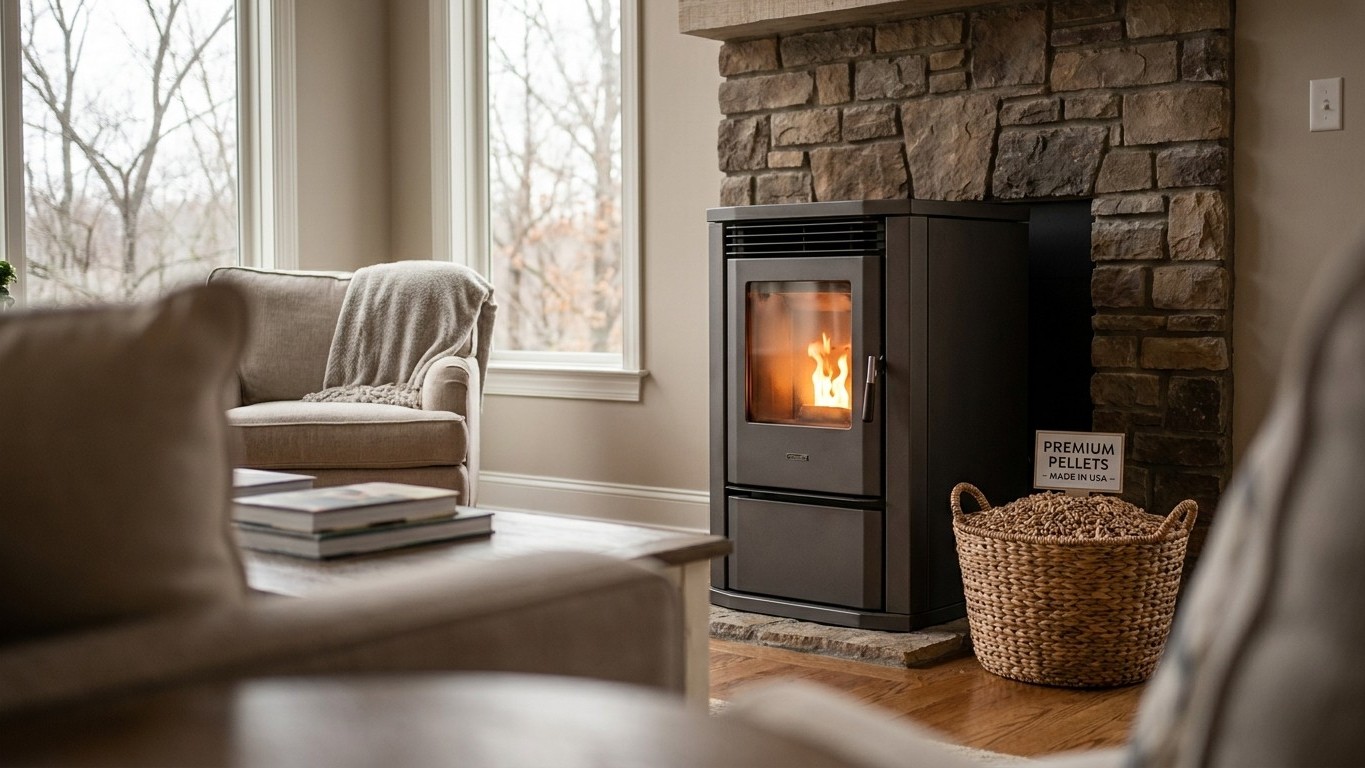

In Charleston and most of South Carolina, a pellet stove is a comfort upgrade, not a substitute for the furnace or heat pump already doing the real work. The state’s heating degree days run low compared to most of the country, which means a stove here earns its keep on cold snaps and shoulder-season evenings rather than through a long, grinding winter. Understand that distinction first, because it changes every other decision that follows: how many bags to buy, where to store them, and what happens when the power goes out.
How hard the winter works here

Charleston International Airport, the National Weather Service reference station for the Lowcountry, averages about 1,844 heating degree days a year (base 65 F), against 2,434 cooling degree days over the same period. That’s a lopsided climate: the air conditioner does more annual work than the furnace, and it isn’t close. For comparison, a lot of the Midwest and Northeast run three to four times that heating-degree-day total. Fewer degree days means less fuel needed to hold a house at a given temperature, whatever the fuel.
But low doesn’t mean short. The heating season here starts in November, the first month whose normal mean temperature (58.3 F) drops below the 65 F base NOAA uses to count degree days. It peaks in January, with 483 degree days that month alone, and the mean climbes back above 65 F only in April. So call it about five months of heating demand, running November through March, with January carrying more than a quarter of the annual load by itself. A mild winter and a short one are not the same thing, and Charleston’s is the first without being the second.
What that means practically: a pellet stove in this climate is best understood as a zone heater. It can carry a living room or an open-plan first floor through the coldest stretch of January without much help, and it can knock the chill off a November evening before the central system would otherwise kick in. Asking it to replace a furnace or heat pump for five months, though, is asking more of it than the climate requires or than most owners actually want, given how mild most of that season runs.
One more note before moving to consumption: Charleston is a coastal station. Upstate South Carolina, up toward Greenville and the Blue Ridge foothills, runs measurably colder and will log more heating degree days than the coast does. If your address is well north or west of Charleston, treat this figure as a floor, not a ceiling, and expect your own season to run a bit harder and a bit longer than the numbers above suggest.
How many tons a winter takes here
Nobody publishes a per-state or per-city tons-per-winter figure, and anyone who hands you one is guessing. What you can do is work the math yourself, because the chain is simple. A standard bag of wood pellets weighs 40 pounds. Fifty bags make a ton. From there, consumption tracks the heat your house actually needs to lose to the outside, which is exactly what the degree-day figure above measures. A house that needs to shed less heat burns fewer bags for the same comfort, full stop.
Three things move that number more than anything else, and they can shift it by a factor of two or more between two houses on the same street:
- How well the house holds heat. Attic insulation, window quality, and air sealing determine how fast the warmth you make leaks back outside. A drafty older home in Columbia will burn noticeably more pellets than a tight, newer build a mile away.
- Whether the stove is the only heat or a supplement. Given South Carolina’s mild degree-day profile and the fact that most homes here already run a furnace or heat pump (more on that below), a stove used to take the edge off a room, rather than to heat the whole house, will burn far fewer bags per season.
- The setting it runs at. A stove left on a low or medium feed rate through a mild evening uses a fraction of what the same appliance burns on high through a January cold snap.
Because of that spread, the only estimate worth trusting is the one you generate yourself. Buy a modest stack for the first winter, no more than you’d feel comfortable storing anyway, and count what’s left in March. That single measured season, in your house, with your habits, beats any published range or dealer’s rule of thumb, because it accounts for your insulation, your thermostat habits, and how much the stove is actually asked to do. For the national math on bag counts and consumption ranges by house size and use pattern, see the how many pellets a winter takes guide.
Buying and storing them in this climate
Given a heating season that starts in November, the window to buy ahead runs through late summer and early fall, Before the First real cold snap sends everyone in the Lowcountry and Midlands to the same stack of pallets at once. Pellets are typically cheapest in the off-season, spring through late summer, and regional demand spikes are real: a hard cold snap anywhere in the Southeast can strip local retailers bare within days, because most dealers don’t carry deep reserve stock for a fuel that, in this state, plenty of buyers treat as optional. Buying in August or September for a November start avoids that scramble entirely.
Storage matters more here than the mild winter numbers might suggest, because South Carolina’s climate cuts the other way in summer. Wood pellets are compressed sawdust held together by the wood’s own lignin, with no added glue or binder. That means moisture is the enemy, not cold. A humid Lowcountry summer, or a garage slab that sweats condensation on muggy August nights, can swell and crumble pellets stored in anything less than a sealed, elevated setup. Bags stacked directly on a concrete floor, or left in a shed that traps humidity, can go from solid fuel to sawdust before the heating season even starts.
The fix is straightforward: keep bags off the floor on a pallet or shelving, keep them under cover, and favor an interior storage space over an unconditioned outbuilding if the state’s humid months are a concern where you live. None of that changes by region within South Carolina, so the detailed storage rules, and how to judge pellet quality by ash content and moisture before you buy, are covered in full on the national pellet storage and pellet quality pages. What’s worth repeating here is the one comparison that actually means something at the point of purchase: compare price per ton, not per bag, since bag sizes and pallet counts vary enough between sellers to make per-bag pricing misleading.
What a winter outage means here
A pellet stove needs electricity to run, full stop. An auger motor feeds fuel into the burn pot on a timer, and a fan pushes combustion air in and heated air out; cut the power and the fire dies within minutes, regardless of how many tons are stacked in the garage. That’s the one hard difference between a pellet stove and a traditional wood stove, which will keep burning through a blackout with nothing but a match and a draft. It’s a fact every pellet-stove owner needs to sit with before the first storm, not after.
Cross that constraint with Charleston’s mild degree-day profile and the stakes look different than they would in a harder climate. In a place logging three or four thousand annual heating degree days, a multi-day winter outage without backup heat is a genuine emergency, especially for households with young kids or older residents. In South Carolina’s roughly 1,844-degree-day climate, a power cut during the heating season is, for most homes, an uncomfortable evening rather than a crisis, because the outdoor temperatures the stove would otherwise be fighting are rarely severe enough to make the house dangerously cold within hours.
That said, the fallback still matters, and the state’s actual heating mix tells you what most households are leaning on already. Federal survey data for South Carolina shows 46% of homes using a furnace as their main heating equipment and 41% using a central heat pump, with electricity as the dominant heating fuel overall at 64% and natural gas at 28%. Propane sits at 5%. In practical terms, most South Carolina households already have a furnace or heat pump as primary heat, with the pellet stove layered on top for comfort and cost savings, so a stove outage rarely leaves a household with no heat at all, just without its preferred source for the evening.
What size generator or battery backup makes sense for your specific stove isn’t something to guess at from a state average. Check the appliance’s electrical draw on its data label, and see the national power-cut and backup power guide for how to size a solution against that number rather than against a rule of thumb that wasn’t written for your unit.