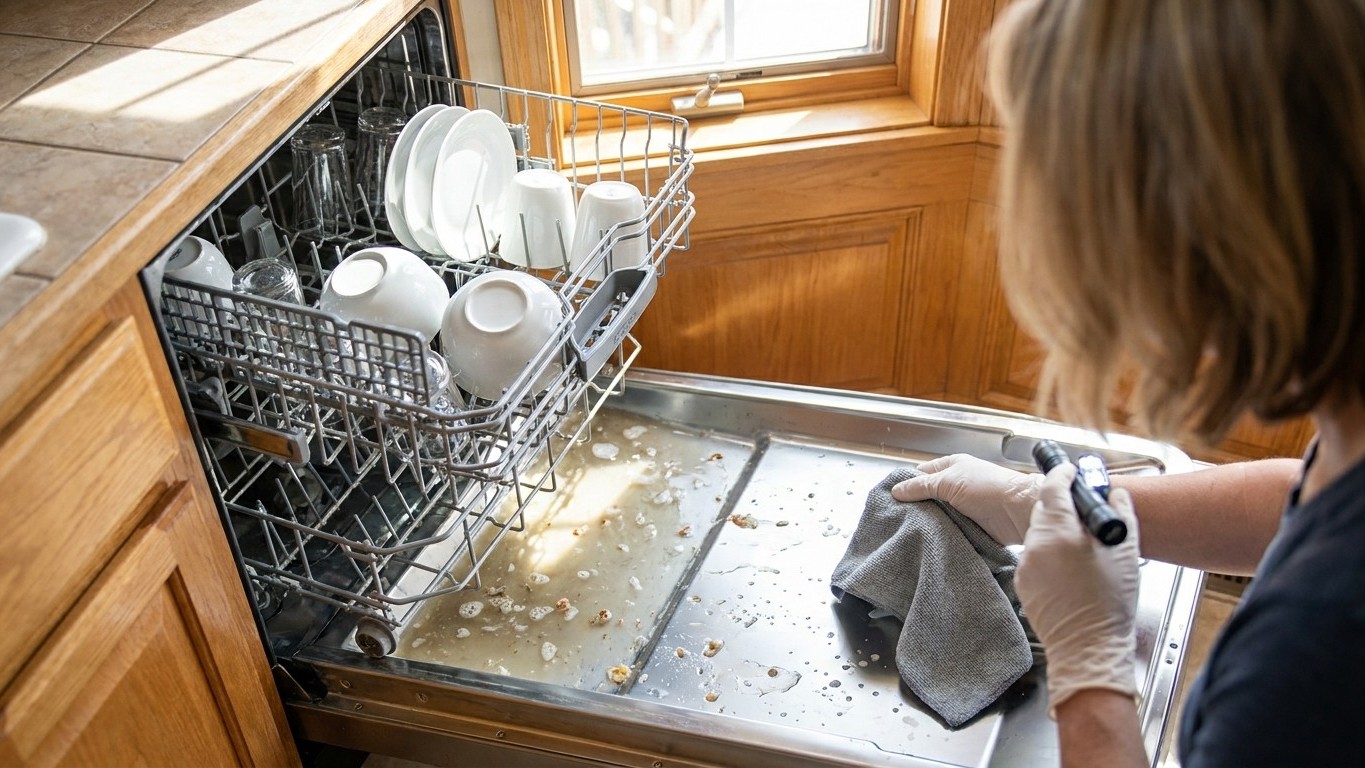

Water pooled in the bottom of a dishwasher after a full cycle almost always means the drain path is blocked somewhere between the tub and the sewer line, not that the machine itself has failed. In most cases the culprit is a clogged filter, a kinked or looped drain hose, or a garbage disposal knockout plug that was never removed during installation. A repair call isn’t usually needed. Fifteen minutes with a flashlight and a towel will tell you which of the three it is.
What is actually happening

A dishwasher doesn’t have its own pump connection to the sewer. It relies on a chain of parts that live partly inside the cabinet and partly under the sink, and any one of them can stop water from leaving the tub even when the appliance itself is working perfectly.
Start with the air gap, if the installation has one. It’s the small chrome or plastic cylinder you sometimes see poking up next to the faucet on the countertop. Its job is to prevent dirty water from siphoning back into the dishwasher from the sink drain, but it does this by forcing all the drain water through a narrow passage that can fill with debris over time. A blocked air gap backs water up right where you’d expect: the tub floor.
Next comes the drain hose itself, the corrugated tube that runs from the dishwasher pump to either the air gap, the sink drain, or the garbage disposal. This hose is supposed to rise in a loop, usually secured high under the counter, before it drops down to its connection point. That high loop stops sink water from flowing backward into the dishwasher when the disposal or sink is running. If the hose has slipped, sagged, or been installed without that loop, gravity works against the pump, and water sits rather than drains cleanly.
The disposal connection
Finally there’s the garbage disposal itself, when the dishwasher drains through it rather than through a separate air gap. Every new disposal ships with a knockout plug sealing off the dishwasher inlet port, because not every household connects a dishwasher to it. If that plug was never punched out during installation, or during a disposal replacement, the drain hose is connected to a dead end. This is one of the most common causes of a dishwasher that has never drained properly since the day it was installed, and it’s also one of the easiest to miss because everything looks connected from the outside.
Understanding which of these three points is actually blocking flow matters more than any generic fix, because the repair for a clogged filter (rinse it) is completely different from the repair for a missing knockout plug (remove it) or a sagging hose (re-secure the loop). Once you know the mechanism, the checks below go fast.
What to check, in order
Work through these from cheapest and most likely to more involved. Each step tells you something even if it isn’t the fix, so don’t skip ahead.
- The bottom filter and screen. Most residential dishwashers have a removable filter assembly at the bottom of the tub, usually a twist-and-lift cylinder or a flat mesh cover. Pull it out and rinse it under the faucet. Food particles, glass shards, and grease film collect here fast, especially in households that don’t pre-rinse dishes. If the filter comes out coated in gunk, you’ve likely found your answer.
- The drain hose path. Open the cabinet under the sink and trace the corrugated hose from the dishwasher to its connection point. Look for a kink, a sag below the high loop, or a section pinched by something else stored under the sink. A hose that dips low anywhere along its run can trap water and air, stalling drainage even with a clean filter.
- The garbage disposal knockout plug. If the dishwasher drains into a disposal, and the disposal was installed or replaced after the dishwasher, check whether the internal knockout plug was ever removed. This requires disconnecting the hose at the disposal inlet and looking inside with a flashlight. A plug still in place means water has nowhere to go, no matter how clean everything else is.
- The air gap, if present. Twist off the cap on the countertop air gap and check the small tube inside for buildup. A quick rinse or a pipe cleaner run through it usually clears it.
- The pump and impeller area. If the first four checks come back clean and water still sits in the tub, look at the sump area at the bottom of the tub for a lodged object, a broken glass fragment or a bottle cap, wedged against the pump inlet. This is less common than the other four causes but worth a visual check before assuming a mechanical failure.
If none of these five checks turns up an obvious blockage, the pump motor or a check valve inside the unit may be the actual failure point, and that’s a job better suited to an appliance repair technician than a plumber, since it involves the machine’s internal parts rather than the drain path.
What it costs to leave it
Standing water in a dishwasher tub isn’t usually a big single leak. It’s closer to the slow, easy-to-ignore kind of waste the EPA WaterSense program tracks across the country. Nationally, the agency notes that “household leaks can waste nearly 1 trillion gallons of water annually nationwide,” and that “the average household’s leaks can account for more than 9,300 gallons of water wasted every year.” Those are aggregate figures across millions of homes, not a forecast for any single kitchen, but they explain why plumbers treat small, chronic problems as worth fixing rather than living with.
The EPA also reports that “nine percent of homes have leaks that waste 50 gallons or more per day,” a scale that applies more to running toilets and dripping faucets than to a dishwasher drain issue, but it’s a useful reminder that small fixtures rarely announce themselves loudly. A dishwasher that fails to drain fully isn’t leaking 50 gallons a day. It’s typically re-circulating a cup or two of standing water each cycle, water that either sits and grows odor-causing bacteria or gets pumped out inefficiently on the next run, forcing the appliance to work harder than it should.
Where this becomes a real cost is in what a blocked drain path can hide. A hose disconnected at the disposal, or a cracked air gap fitting, can slowly wet the cabinet floor under the sink without ever showing up as a puddle on the kitchen tile. That’s the same quiet pattern behind the agency’s broader point: “fixing easily corrected household water leaks can save homeowners about 10 percent on their water bills,” a number that reflects the whole house, not one appliance, but it’s the reason a five-minute filter check is worth doing before the smell, the warped cabinet floor, or the water bill makes the case for you.
None of these national figures tell you what your own dishwasher is wasting. Your water meter is the only instrument that measures your actual loss, and this site’s guide to spotting a hidden leak walks through how to read it correctly if you suspect the problem is bigger than a clogged filter.
When to stop and call a plumber
Everything covered above sits inside the cabinet, under the sink, or inside the dishwasher’s own tub, places a homeowner can reasonably inspect with a flashlight and a screwdriver. But there’s a clear line past which the job stops being a DIY afternoon and starts being a licensed plumber’s work.
Call a professional the moment a problem lives behind a wall rather than in front of it. If water is draining slowly throughout the kitchen, not just from the dishwasher, or if you notice dampness on a wall or ceiling below the kitchen, the blockage or leak may be in the branch drain line itself, not in anything visible under the sink.
The main water supply line is another firm boundary. If shutting off the dishwasher’s water doesn’t stop water from appearing, or if you’re seeing pressure changes elsewhere in the house at the same time, that’s main-line territory, and main-line work involves fittings and shutoffs that, handled wrong, can flood a kitchen fast.
Anything touching a gas water heater is a stop point on its own, regardless of how minor it looks. Gas connections and water lines share tight physical space around most water heaters, and a homeowner poking around a suspected leak near one risks disturbing a gas fitting without realizing it.
Last, any leak that has already wetted structure, meaning a cabinet floor that’s swollen, a subfloor that feels soft underfoot, or drywall that’s stained or bubbling, needs a plumber and likely a moisture assessment before repairs go any further. Standing water sitting quietly for weeks does more damage below the surface than the puddle itself ever suggests, and by the time wood or drywall shows visible signs, the fix is rarely just the original drain problem anymore.
Common questions
Is a small amount of water at the bottom of a dishwasher normal?
A shallow layer, maybe a cup or less, covering only the area right around the filter, is normal on many models and helps keep the pump seal from drying out between cycles. Standing water that covers the whole tub floor, or that’s visible before you even start a cycle, is not.
Can I run the dishwasher again to try to clear a drain clog?
It’s unlikely to help if the blockage is in the filter, hose, or disposal connection, and running a cycle with standing water already present can push dirty water back onto dishes. Check the filter and hose first.
Does a new garbage disposal always affect dishwasher drainage?
Only if the installer forgets to remove the internal knockout plug meant for the dishwasher connection. It’s a common oversight, especially on disposal swaps done without checking the existing dishwasher hookup.
How often should the dishwasher filter be cleaned?
Most manufacturers suggest checking it monthly in average-use households, more often if dishes aren’t rinsed before loading or if the home has hard water that leaves mineral buildup.