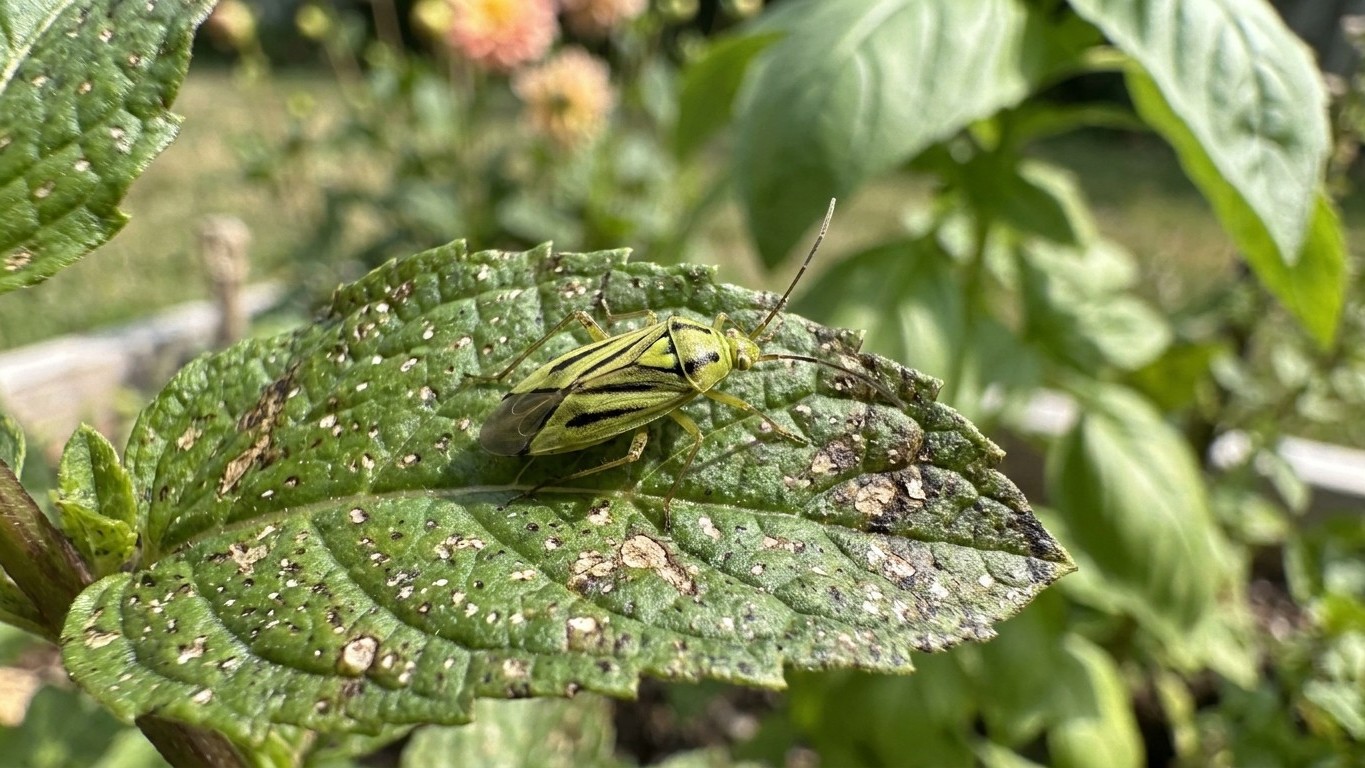

Fourlined plant bug damage shows up in New York gardens in a tight window, mid-May through late June, when the pest’s single yearly generation of nymphs hatches and starts feeding on mint, basil, dahlias, and dozens of other soft-stemmed plants. The insect itself, Poecilocapsus lineatus, causes cosmetic leaf spotting rather than plant death, and the most reliable fix isn’t a spray at all. It’s cutting out old flower and shrub stems before the eggs inside them hatch next spring.
That timing detail matters more than most gardeners realize. Miss the early nymph stage and you’re stuck watching stippled, blackened leaves for weeks with no good chemical option left. Catch it early and a few targeted actions can knock the population down before it ever becomes a problem worth worrying about.
What the Fourlined Plant Bug Looks Like

Adults are hard to miss once you know what you’re looking for. They run about a third of an inch long, greenish-yellow, with four bold black stripes running lengthwise down the wing covers. That striping is where the common name comes from, and it’s the single fastest way to rule out look-alikes like tarnished plant bugs or lygus bugs, which lack the crisp lines.
Nymphs look nothing like the adults they’ll become. Fresh out of the egg, they’re bright red-orange, almost alarming against green foliage, and they darken toward black with red markings as they mature through five growth stages. Gardeners in the Hudson Valley and Finger Lakes region often report the nymphs first, mistaking the vivid color for a beneficial insect or even a tiny ladybird larva. It isn’t. Those red nymphs are the stage doing the most feeding damage, since they’re active and hungry for roughly four to six weeks before molting into winged adults.
The damage signature is distinctive too. Feeding punctures leave small, sunken, dark spots on leaves that can look almost like a fungal leaf spot disease at a glance. Heavy feeding on a single leaf can leave it looking bleached or tattered, but the plant underneath is rarely in real danger. This is largely an aesthetic pest, not a plant-killer, which changes how aggressively it’s worth treating.
When It Shows Up in New York
New York’s fourlined plant bug population runs on a single generation per year, unlike pests that cycle through two or three broods in a season. Eggs overwinter tucked inside the pith of woody and semi-woody plant stems, laid there by adult females the previous summer in slits they cut with their mouthparts. Those eggs sit through the coldest months, well insulated inside stem tissue, and wait for soil and air temperatures to climb.
Statewide, that means nymphs typically emerge from early to mid-May in the Hudson Valley, Long Island, and the Capital Region, with slightly later emergence, often late May into early June, in cooler zones like the Adirondacks and the Southern Tier. Warmer microclimates in New York City’s boroughs can see activity start a week or two ahead of the rest of the state.
Nymphs feed heavily for about a month, molting through their growth stages, before becoming winged adults by mid-to-late June. Adults keep feeding and mate through July, laying the eggs that will overwinter and restart the cycle. By August, adult activity drops off sharply, and by early fall the insect is essentially gone from the garden until the following spring. That means the practical window for any kind of intervention, whether it’s a spray or simple removal, runs roughly six to eight weeks, from first nymph sighting in May through the end of June.
Plants at Risk Across the State
The fourlined plant bug isn’t picky. Extension entomologists have documented it feeding on more than 250 plant species, which puts it in a different category from pests that stick to one or two hosts. In New York gardens, the plants that show damage most consistently include mint, basil, sage, and other culinary herbs, along with dahlias, chrysanthemums, sunflowers, and forsythia shrubs. Currant bushes and viburnum are common shrub hosts too, and gardeners growing heirloom perennials often notice the sunken leaf spots on catmint, bee balm, and rudbeckia first.
Herb gardens tend to get hit hardest, and there’s a reason for that beyond taste preference. Soft, tender new growth is easier for nymphs to pierce, and herb beds with dense mint or basil plantings offer exactly that kind of continuous tender foliage all season. A backyard herb patch in Westchester or on Long Island can look noticeably worse for wear by mid-June even while the rest of the yard shows barely any sign of the insect.
Ornamental shrubs like forsythia and viburnum matter for a different reason: they’re where the eggs spend the winter. A shrub that hosted feeding adults in July is very likely holding next year’s egg supply in its stem tissue right now, which is exactly why pruning strategy plays such a large role in long-term control.
What Actually Stops It
Cultural control beats chemical control here, and it’s not close. Because every egg for next year’s population sits inside a stem cut from last year’s growth, removing and destroying old stems before nymphs hatch cuts directly into the source. Fall or late-winter pruning of perennials and shrubs that hosted heavy feeding the previous summer, followed by disposing of the cut stems rather than composting them nearby, removes a meaningful share of the overwintering eggs before they ever get a chance to hatch.
This single step is the reason some New York gardeners see the pest fade to a non-issue within two or three seasons, while others who skip stem cleanup keep fighting the same infestation year after year on the same dahlias or the same mint patch.
When Spraying Actually Helps
If nymphs are already active and cultural control alone isn’t enough, timing a spray to the nymph stage gives the best return. Nymphs are softer-bodied and more vulnerable to contact insecticides than the winged adults that follow. Insecticidal soap and horticultural oil, applied directly to nymphs on the underside of leaves, work reasonably well without leaving lasting residue that harms pollinators visiting nearby flowers. Neem oil-based products offer a similar contact effect and break down quickly in sunlight, which limits their window of impact but also limits collateral damage to beneficial insects.
Broad-spectrum pyrethrin sprays knock down nymphs fast, but they’re indiscriminate, killing ladybugs, lacewings, and other predators that would otherwise help keep the fourlined plant bug and other pests in check the rest of the season. Given that this insect rarely does more than cosmetic damage, reaching for the strongest chemical option is usually overkill for what amounts to a leaf-spot problem, not a plant survival problem.
Once adults show up and start flying, spraying loses most of its value. Winged adults move readily between plants and even between yards, so knocking down the population on one dahlia bed does little if the neighbor’s forsythia hedge is still hosting a healthy crowd of adults a few weeks from laying next year’s eggs.
Living With Minor Damage
Because the feeding damage is almost entirely cosmetic, a fair number of New York gardeners choose to do nothing beyond basic monitoring, especially on ornamentals grown for foliage mass rather than pristine leaves. A dahlia with a few dozen small black leaf spots still blooms fine. A mint patch with some tattered leaves at the edges is still perfectly usable for the kitchen once the peak nymph period passes in June.
Where the calculus changes is with plants grown for show, like exhibition dahlias or prize-winning chrysanthemums, where every leaf matters for competition or sale. In those cases, the combination of fall stem removal plus a couple of well-timed insecticidal soap applications during the May-June nymph window covers most of what’s needed without resorting to harsher chemistry.
One detail that surprises a lot of gardeners: research on natural predators of the fourlined plant bug has turned up very little. Unlike aphids or Japanese beetle grubs, which have a decent lineup of predatory insects and parasitic wasps working against them, this pest doesn’t have many natural enemies documented in the Northeast. That absence of built-in biological control is part of why the pruning strategy carries so much weight. There’s no cavalry of beneficial insects coming to thin out the population on its own, so what a gardener removes by hand each fall is largely what determines next spring’s numbers.