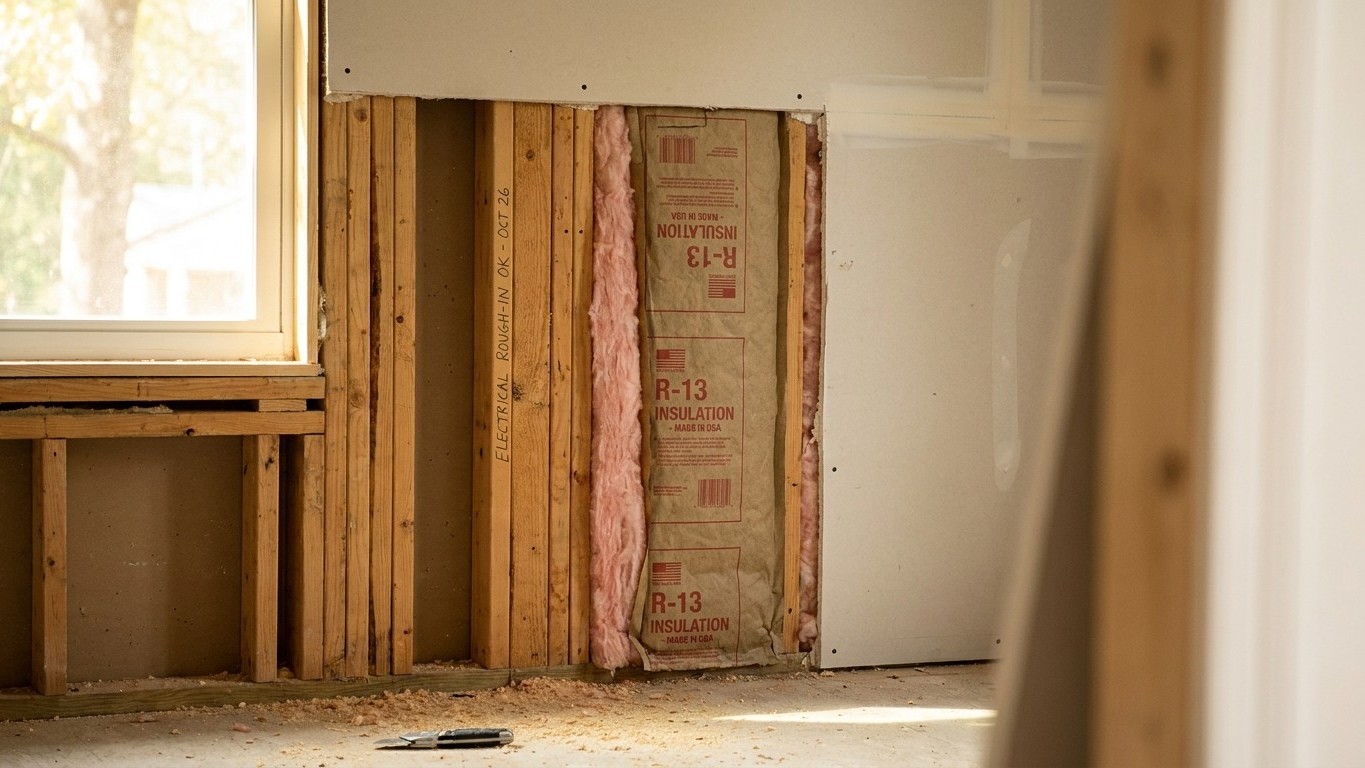

Yes. Every one of Alaska’s 27 counties sits in IECC climate zone 5C, 6A, 7, or 8, and none of those reach the zone 1, 2, or 3 exception written into the 2021 International Residential Code. That’s the rare case where a state this size gets one answer instead of a patchwork: a frame wall here needs an interior vapor retarder of the class its jurisdiction’s adopted code assigns.
What the code asks for in Alaska

Section R702.7 of the 2021 International Residential Code states it plainly: a vapor retarder of the class given by Table R702.7(2) “shall be provided on the interior side of frame walls.” The code then lists four situations where that requirement drops away, and one of them is geographic: “A vapor retarder shall not be required in Climate Zones 1, 2 and 3.”
Alaska never touches those three zones. Of the state’s 27 counties, 11 sit in zone 7, 8 sit in zone 8, 5 sit in zone 6A, and 3 sit in zone 5C. Every single one of those four zones is colder than the cutoff where the exception starts to apply. So unlike a state that straddles the zone 3/zone 4 line, where a builder two counties apart can face opposite obligations, Alaska doesn’t split on this particular question. The interior vapor retarder requirement holds statewide, from the panhandle boroughs in zone 5C up through the interior and arctic counties in zone 8.
What does shift by zone is which class the local table calls for on a given wall assembly, and that’s a detail set by the code edition each borough or municipality has actually adopted, not by the model code alone. A required vapor retarder is not a banned material list either; the exceptions in R702.7 remove an obligation in specific circumstances, they don’t forbid installing one where it isn’t strictly demanded.
None of this is a substitute for a call to the local building department. The permeance class that satisfies R702.7 for a stud wall in a coastal borough at 5C may differ from what’s expected on an interior-zone build at 8, and the adopted edition can lag the current model code by years. A wall assembled with the wrong vapor control doesn’t announce the mistake. It sits fine for a decade, then the sheathing or the framing is found rotted from the inside, long after the drywall went up.
Why the answer is the opposite in a warm climate
The reason Alaska’s answer is so uniform, and so different from a Gulf Coast state’s, comes down to which direction the moisture is traveling. In a cold climate, the warm, humid air lives inside the house all winter. An interior vapor retarder stops that indoor moisture from pushing through the wall cavity and hitting a cold sheathing surface where it would condense. That’s the entire logic behind R702.7’s default rule, and it’s why zones 5 through 8, Alaska’s whole map, keep the requirement.
Flip the climate and the physics flips with it. In a warm, humid zone, the damp air is outside for most of the year, working its way in through the wall. If that same impermeable Class I sheet sits on the interior side of the insulation, it becomes the coldest, least permeable surface the vapor can reach, and the water has nowhere to go but to condense right there. The U.S. Department of Energy’s Building America program describes exactly this outcome: “If the wall contains a vapor retarder on the interior side of the insulation, the water vapor will condense on this cool, impermeable surface,” and the result is “ruined insulation, mold, and structural rot of framing members.”
That single sentence is why the code doesn’t hand out one rule nationwide. It isn’t a bureaucratic quirk or an inconsistency between regions; it’s the code following the water. In Alaska, the moisture drive is overwhelmingly inward-to-outward through most of the year, so the interior retarder does its job as designed. In zones 1 through 3, the drive reverses often enough that the same material becomes the mechanism of the damage. Two houses built to the same wall assembly, three thousand miles apart, need opposite vapor strategies because the humid air is coming from opposite sides of the wall.
This is also why “not required” in the warm zones was never written as “forbidden.” The exception in R702.7 removes an obligation for zones 1 through 3; it doesn’t outlaw a vapor retarder there. It simply stops mandating the type of retarder that, per the DOE’s own findings, tends to trap moisture rather than block it in that climate.
The three classes, and why the word matters
The 2021 IRC doesn’t leave “vapor retarder” as a vague term. It sorts materials into three classes by permeance, and the class, not the mere presence of a retarder, is what the argument between a builder in Anchorage and a builder in Miami is actually about.
| Class | Example materials | Permeance range |
|---|---|---|
| Class I | Sheet polyethylene, nonperforated aluminum foil | 0.1 perm or less |
| Class II | Kraft-faced fiberglass batts, vapor retarder paint | Above 0.1 up to 1.0 perm |
| Class III | Latex or enamel paint | Above 1.0 up to 10.0 perm |
Sheet polyethylene is a Class I product, the tightest of the three, and it’s what most people picture when they hear “vapor barrier.” But calling it a vapor barrier without naming the class hides the real question: which class does Table R702.7(2) call for on this wall, in this zone, with this cladding? A Class I sheet that’s the right choice on an interior wall in zone 8 could be the wrong choice on a different assembly in the same house.
Here’s the detail most homeowners miss entirely: ordinary latex paint qualifies as a Class III vapor retarder. Anyone who’s painted an interior wall with a standard latex finish already has a vapor retarder in place, whether they knew it or not. It’s the loosest of the three classes, permeance-wise, but it still counts under the code’s definitions.
One more distinction worth keeping straight: a vapor retarder and an air barrier are not the same assembly, even though they’re sometimes the same physical sheet. A vapor retarder slows water vapor diffusing through a material. An air barrier stops bulk air, and the moisture it’s carrying, from moving through gaps and seams. Confusing the two is common and it matters, but that’s a separate topic from the class question here.
Where the rule stops
R702.7 doesn’t apply everywhere in a house, even in a state where zone alone doesn’t remove the obligation. The code lists conditions under which the interior vapor retarder requirement doesn’t apply:
- Basement walls
- The below-grade portion of any wall
- Construction where accumulation, condensation, or freezing of moisture will not damage the materials
The basement exception is the one most Alaska homeowners actually run into, because it isn’t intuitive. A poured concrete basement wall holds moisture from the soil and releases it slowly, sometimes for years after the pour. That assembly needs to be able to dry toward the interior. Wrap the inside face with a sheet vapor retarder and the wall loses its main path to shed the moisture it’s already holding, which is the opposite problem from the one the above-grade rule is solving.
Below-grade portions of an otherwise above-grade wall get the same treatment for the same reason: contact with damp soil changes the moisture math enough that the interior retarder rule doesn’t transfer. For the specifics of how that assembly should be handled in a basement, this site’s basement wall guide covers the detail beyond what applies here.
The third exception, for construction where moisture accumulation won’t damage the materials, is intentionally broad and depends on the specific assembly, which is one more reason this isn’t a page that can tell a reader what to install in their own wall. It’s a case-by-case call the local building department makes against the code edition it has adopted.
Who actually decides, in Alaska
Nothing on this page substitutes for the local building department. The 2021 IRC is a model code, and states, then boroughs and municipalities, adopt it on their own schedule, sometimes with local amendments, sometimes years behind the edition currently published. Whether a given Alaska jurisdiction is enforcing the 2021 IRC, an earlier edition, or a modified version of either is a fact only that jurisdiction’s building department can confirm.
That gap matters more here than in most places, because Alaska’s heating demand is severe by any national comparison. Anchorage runs about 9,979 heating degree days a year against roughly 8 cooling degree days, a ratio that says almost the entire climate load on a house is winter heat retention, not summer cooling. That’s not a temperature reading; degree days measure how much heating demand accumulates over the year, day by day, against a 65 F baseline. A house carrying that kind of heating load has real consequences riding on whether its wall assembly manages vapor correctly, because the interior stays warm and humid against cold sheathing for most of the calendar.
None of that changes the basic fact that this page can’t answer for one specific wall. It can say the rule, say that the rule depends on zone and on the local adopted code, and point toward the office that can confirm both. A wall built with the wrong vapor control in a climate this cold won’t show a problem in year one. It shows up years later, in framing that’s already rotted, discovered only when someone opens the wall for an unrelated repair.