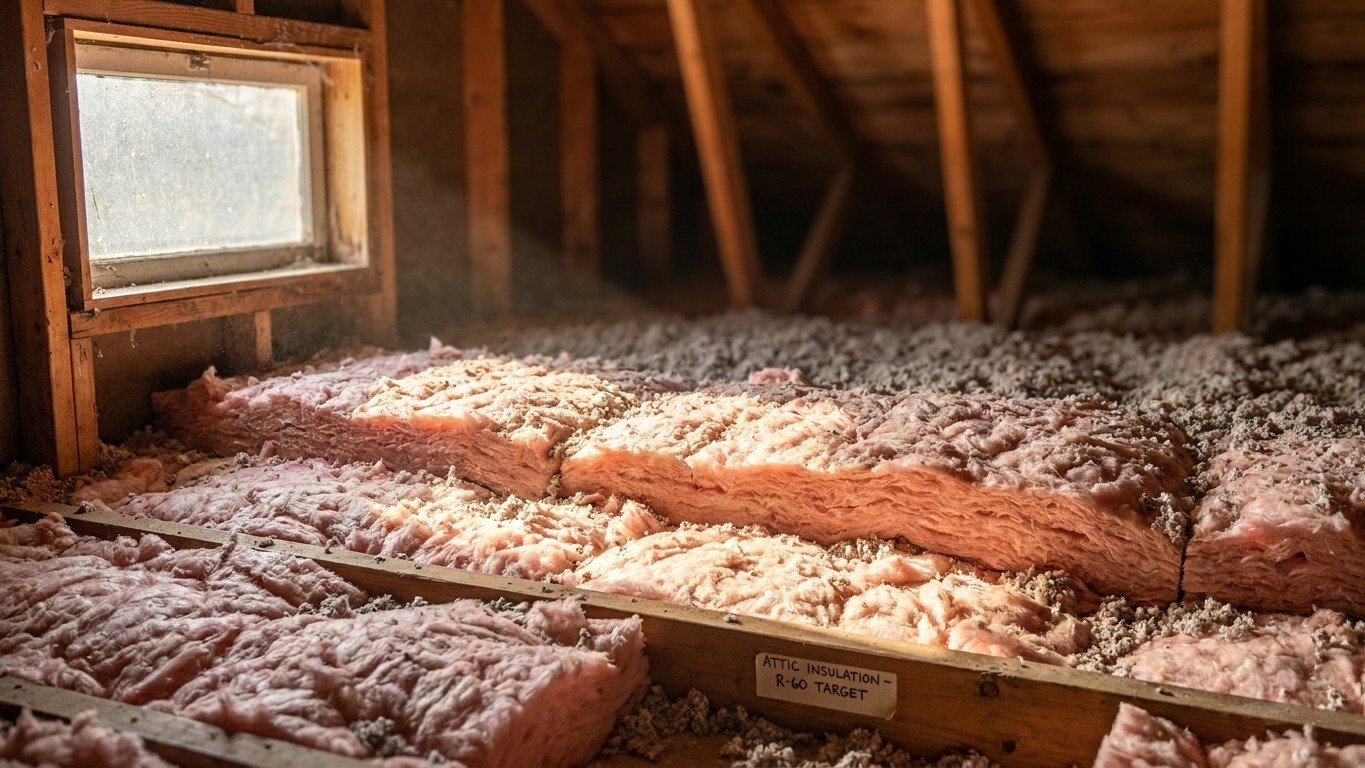

Alaska spans four IECC climate zones across its 27 counties, so there’s no single R-value that fits the whole state. A house in the Interior and a house in the Southeast panhandle are not buying the same insulation package. The right level depends on which zone a county sits in, How Much Insulation the attic already carries, and whether the job covers the attic alone or the floor too.
Which climate zone Alaska is in

Alaska is not a one-zone state, and treating it as one is where a lot of insulation advice goes wrong. According to the 2021 International Energy Conservation Code (IECC), Table R301.1, the state’s 27 counties fall into four separate zones. There is no single answer here, only a spread.
| Climate zone | Number of counties |
|---|---|
| Zone 7 | 11 counties |
| Zone 8 | 8 counties |
| Zone 6A | 5 counties |
| Zone 5C | 3 counties |
That’s 11 counties of 27 in zone 7, 8 counties of 27 in zone 8, 5 counties of 27 in zone 6A, and 3 counties of 27 in zone 5C. Notice that’s a county count, not a population share. A county with one small town and a county with a regional hub can each count as “one county” on this table, so don’t read “11 counties” as “most Alaskans.” It just means eleven separate jurisdictions carry that designation.
A climate zone is a shorthand the building code uses to bundle counties with similar heating and cooling demands, so builders and inspectors aren’t reinventing insulation standards county by county. The number is the main signal, and it runs from 1 (hot, like South Florida) up to 8 (subarctic and arctic, the harshest zones the code recognizes). The letter that sometimes follows the number describes moisture, not temperature: A means moist, B means dry, C means marine. Zones 7 and 8 don’t carry a letter at all, since at that level of cold the moisture distinction stops mattering for insulation purposes.
That letter is not decorative. The ENERGY STAR insulation table groups some zones together specifically because their moisture regime and severity land in the same insulation bracket, while keeping others separate. A 6A county and a 5C county in Alaska end up sharing a row in that table, while a 7 or 8 county gets its own. This is exactly why the zone number and letter matter more than most homeowners assume: they decide which row applies before you ever pick up a bag of insulation.
If you want to know which zone your own county falls into, the county-level table in the 2021 IECC (linked below) or the ENERGY STAR zone map will tell you directly. This page can’t assign you a zone. It can only lay out what the four zones present in Alaska mean for the insulation levels that follow.
The insulation levels that apply here
ENERGY STAR publishes recommended insulation levels for retrofitting existing wood-framed homes, based on the 2021 IECC. The table below is not new-construction code. It’s guidance for upgrading a house that’s already standing, which is the situation most Alaska homeowners are actually in.
One thing trips people up here: each zone lists three numbers, and it looks like three attic values. It isn’t. The first two columns are both attic figures, split by starting condition, uninsulated attic versus an attic that already has 3 to 4 inches in place. The third column is a completely different assembly: the floor.
| Zone | Attic if UNINSULATED | Attic if already has 3-4 inches | Floor |
|---|---|---|---|
| Zone 1 | R30 | R25 | R13 |
| Zone 2 | R49 | R38 | R13 |
| Zone 3 | R49 | R38 | R19 |
| Zones 4A and 4B | R60 | R49 | R19 |
| Zones 6, 5 and 4C | R60 | R49 | R30 |
| Zones 7 and 8 | R60 | R49 | R38 |
For Alaska, two rows matter, and no others. The 11 zone 7 counties and 8 zone 8 counties, 19 counties in total, fall under “Zones 7 and 8”: R60 for an uninsulated attic, R49 if there’s already 3 to 4 inches up there, and R38 for the floor. The 5 zone 6A counties and 3 zone 5C counties, 8 counties combined, fall under “Zones 6, 5 and 4C”: the same R60/R49 attic numbers, but a lighter R30 floor.
The attic target barely moves between these two Alaska scenarios, R60 either way for an uninsulated attic. The floor is where the real difference shows up, R38 versus R30, a meaningful jump when a floor sits over an unheated crawlspace or open air in a harsh winter. A homeowner in a zone 7 or 8 county buying floor insulation off a zone 5C recommendation would be under-buying for their actual climate.
None of these figures should be interpolated or averaged. There’s no “Alaska number” halfway between R30 and R38 for the floor: that’s the exact mistake this table exists to prevent. And none of these R-values convert cleanly to inches. Depth depends on the material, whether it’s fiberglass batts, blown cellulose, or spray foam, and that figure is printed on the product’s own packaging, not derived from the R-value alone.
Sealing comes before insulating
ENERGY STAR treats air sealing and insulation as two steps of a single project, and its own guidance puts attic air sealing first, ahead of adding any insulation at all. That ordering isn’t arbitrary.
Insulation slows heat moving through a material. It does nothing to stop air moving around it. Lay a fresh layer of insulation over a gap, a can light housing, a plumbing chase, or an unsealed attic hatch, and you haven’t closed that leak. You’ve buried it, making it harder to find and fix later while the warm air keeps escaping right past the material meant to stop it.
The recommended order of work runs in a specific sequence:
- Seal the attic first, closing air leaks at penetrations, hatches, and top plates
- Add attic insulation once the sealing is done
- Seal and insulate the rim joist
- Address the floor over a crawlspace or unconditioned space
- Only then move to wall assemblies
Skipping straight to the insulation step, especially in a state carrying the heating demand Alaska does, means paying for material that can’t fully do its job. The published savings estimates for insulation work assume sealing happened first; there’s no separate percentage that applies to sealing on its own, since ENERGY STAR’s modeling bundles the two together as one project rather than crediting each step in isolation.
The mechanics of each step, how to find attic leaks, how to seal a rim joist properly, how to handle a crawlspace floor, are covered in the national insulation guides elsewhere on this site rather than repeated here. What matters at the state level is the order, and the fact that skipping ahead to insulation undercuts everything that follows it.
What the winter here actually asks for
Heating degree days measure demand, not temperature. The figure adds up, for every day of the year, how far the average temperature fell below 65°F, then totals it. At Anchorage Intl AP, the 1991-2020 NOAA normal comes to about 9,979 heating degree days a year, against roughly 8 cooling degree days. That’s a heating season that dominates the year almost entirely, with essentially no cooling load to speak of. Double the heating degree days of another location and you’re looking at roughly double the fuel burned to heat a comparable house.
That demand has to be met by something, and Alaska’s heating mix is unusually split. Per the U.S. Energy Information Administration’s Residential Energy Consumption Survey (RECS) 2020 state data, 37% of Alaska homes heat primarily with a furnace, and 36% with a steam or hot-water boiler, nearly an even split between forced-air and hydronic systems. Central heat pump data was not reported (the estimate was suppressed for reliability), and the same applies to propane as a heating fuel. Natural gas fuels 57% of homes, electricity 13%, and fuel oil or kerosene 24%. “Not reported” here doesn’t mean zero use, it means the survey sample was too thin to publish a reliable number, which is a different claim entirely.
That near-even furnace-boiler split changes what insulation work should prioritize. A furnace-heated home typically pushes warm air through ductwork, and if that ductwork runs through an unconditioned attic, as it often does, the ducts themselves leak heat regardless of how well the attic floor is insulated above them. A boiler-and-radiator system skips that particular loss point entirely, since it doesn’t move air through ducts at all.
Given the degree-day load and this fuel mix, local priorities line up roughly like this:
- Seal and insulate the attic to the zone-appropriate level covered above
- For homes on forced-air furnaces, check duct location and sealing in unconditioned spaces before assuming attic insulation alone solves the loss
- Insulate the floor to the level that matches the county’s zone, not a blended guess
- Address the rim joist, a common cold-air entry point in a climate with this much heating demand
The duct guides elsewhere on this site cover how to inspect and seal ductwork running through unconditioned attics, which matters more here than in a state where forced-air ducts stay inside conditioned space.
What the work is worth
ENERGY STAR’s own methodology page states it plainly: “EPA estimates that homeowners can save an average of 15% on heating and cooling costs (or an average of 11% on total energy costs) by air sealing their homes and adding insulation in attics, floors over crawl spaces, and accessible basement rim joists.” Both numbers matter, and so does what each is measured against, 15% of the heating and cooling portion of a bill, 11% of the whole energy bill.
These are averages built from energy modeling of a “typical” existing U.S. home, not a guarantee for any specific house in Anchorage, Fairbanks, or Juneau. A home with a heating demand as extreme as Alaska’s, over 9,900 heating degree days at the Anchorage reference station, may see different real-world results than the national average this figure is built on.
The estimate also names exactly where the modeled work happened: attics, floors over crawl spaces, and accessible basement rim joists. It does not extend to walls, windows, or doors, even though those assemblies matter too. Don’t stretch this figure to cover work it never modeled.
It’s worth keeping this number separate from two others that sound similar but aren’t the same claim. ENERGY STAR’s programme landing page mentions “up to a 10% savings on your annual energy bills” for similar work, phrased as an upper bound on a different denominator. And the U.S. Department of Energy’s often-cited 10% figure refers to a thermostat setback of 7 to 10°F held for eight hours a day, which has nothing to do with insulation at all. Three real numbers, three different claims, and only the 15%/11% pairing above describes what sealing and insulating the attic, floor, and rim joist actually delivers.