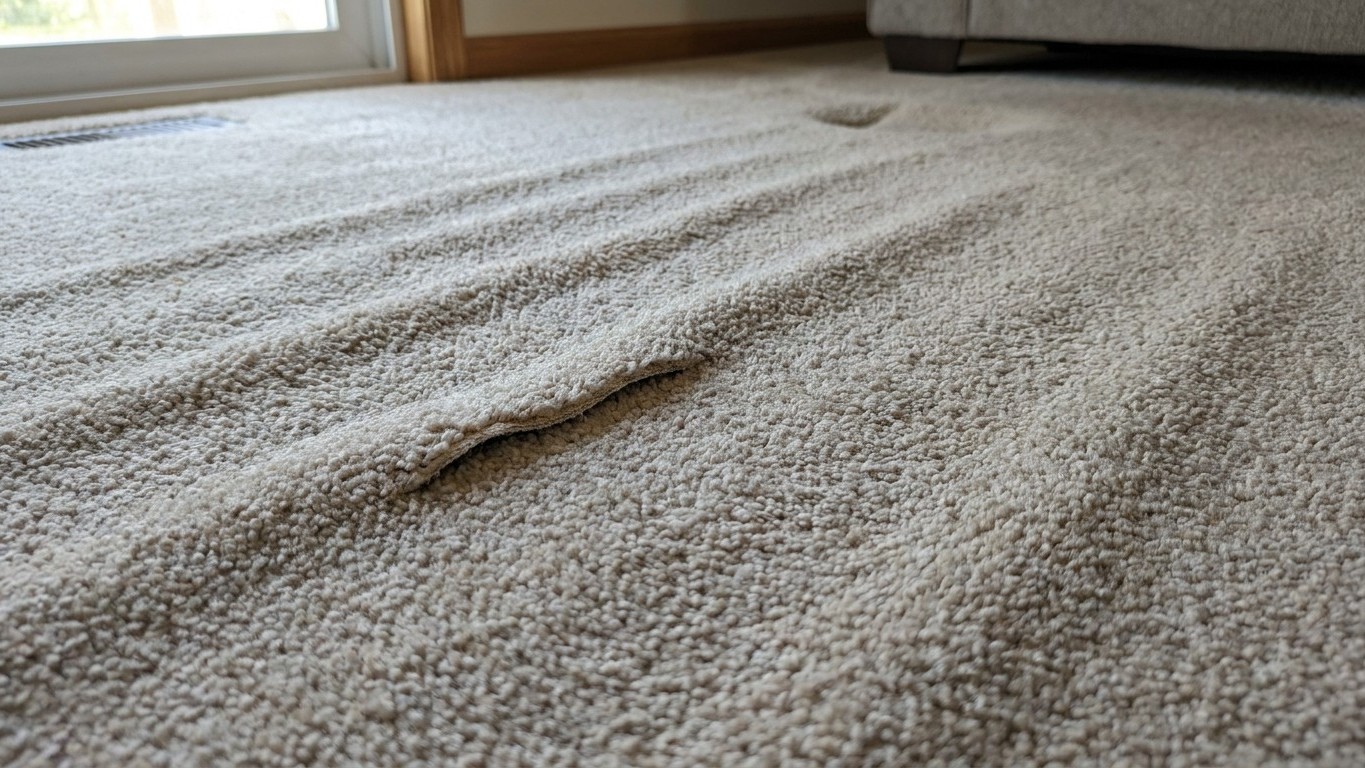

Rippled carpet almost always means the fabric has lost its stretch, not that it has failed. A professional re-stretch pulls it taut again over the same padding and tack strips, and the carpet lies flat within a couple of hours. The exception is a wave that keeps coming back within days: that points to moisture or damage underneath, not slack tension.
What is actually happening
Fitted carpet is not laid loose. It is stretched across the room with a mechanical device (a “power stretcher”) and hooked onto tack strips nailed around the perimeter, usually with a knee kicker used to work it into corners and against doorways. That tension is what keeps a wall-to-wall installation smooth for years. Ripples show up when that tension relaxes, and three things cause it to relax: heat, humidity, and sustained weight.
Heat and humidity work on the backing material itself. Most residential carpet backing is woven or bonded from synthetic fibers that expand slightly when the air gets warm and damp, then contract again when conditions dry out. Do that enough times across a few seasons, especially in a room without air conditioning or with a space heater running against one wall, and the backing stretches a hair more each cycle. It does not spring back on its own. The stretch is one-directional: it accumulates.
Heavy furniture does something similar but by force rather than climate. A couch, a piano, a filing cabinet sitting in one spot for years presses the pile down and drags the backing slightly toward the load. Move the furniture and the flattened area often shows a faint ripple line around its old footprint, a rough map of the pressure it was carrying. Rooms with radiant floor heat under the carpet see accelerated relaxation for the same reason ordinary heat does, just concentrated and more frequent.
None of this means the carpet is worn out or that the installation was done poorly. Slack backing is a mechanical issue with a mechanical fix: a technician re-tensions the carpet with a power stretcher, re-hooks it onto the tack strips, and trims any excess at the walls. Nothing is replaced. Nothing under the carpet is touched. It is a maintenance job, similar in spirit to tightening a loose fence wire, and most installers treat it as routine rather than a repair.
What actually matters for the reader trying to figure out what is going on is timing. Slack carpet ripples gradually, over months or years, and tends to show up first in high-traffic paths and near doorways where the stretch gets tested the most. A ripple that appears suddenly, or that reappears in the same spot right after a re-stretch, is telling a different story, and that story starts under the carpet rather than in it.
The covering, or what is under it
The carpet itself is only the top layer. Underneath sits the pad, and under the pad sits the subfloor, either plywood or a concrete slab. A ripple can originate at any of those three levels, and the fix is completely different depending on which one is responsible. Confusing them is the single most common reason a “flooring problem” gets handled twice.
| What you observe | Likely layer | What it means |
|---|---|---|
| Broad, gentle waves across a large area, worse in high-traffic paths, developed slowly over seasons | Carpet backing (the covering) | Tension has relaxed. A re-stretch resolves it and nothing underneath is involved. |
| Ripple returns within days or weeks of a professional re-stretch, same location each time | Pad or subfloor | Something underneath is moving or degrading and pushing the carpet back out of shape. Re-stretching treats the symptom, not the cause. |
| Localized bump or soft, spongy feel underfoot in one specific spot, sometimes with a faint musty smell | Pad | The pad has broken down or absorbed moisture and lost its even thickness, creating a high point the carpet drapes over. |
| Ripple runs along a straight line, often near an exterior wall or under a window, and the subfloor feels uneven when pressed through the carpet | Subfloor | The plywood has swelled, cupped, or delaminated, usually from moisture reaching it from below or from a past leak. This is a subfloor problem wearing a carpet costume. |
| Discoloration or a hard, crusty texture felt through the carpet near the ripple, over a concrete slab | Slab | Moisture is moving through the concrete itself. The carpet and pad are reacting to what the slab is doing, not the other way around. |
The practical rule: a ripple that a re-stretch permanently fixes was a covering problem. A ripple that comes back is telling you the covering is only reporting on something happening below it, the same way a cupped hardwood board reports on subfloor moisture rather than causing it. Treating the visible symptom without checking what is underneath just means paying for the same fix twice, a point covered in more detail in the broader guide on reading what the floor surface is telling you.
What to check, in order
- Look at where the ripple sits. A wave that follows traffic patterns, doorways, or the edge of a rug that used to sit on top of the carpet suggests ordinary backing relaxation. A ripple that follows a wall, a window, or a plumbing line underneath the floor suggests a moisture source rather than simple wear. This rules nothing in on its own, but it tells you where to look next.
- Press on the area, not just look at it. Firm, even resistance under your palm across the ripple is consistent with a slack-tension problem. A soft, spongy, or uneven give suggests the pad has broken down or the subfloor underneath has been compromised. This step rules out a straightforward re-stretch if the give is noticeably different from the rest of the room.
- Pull back a corner if the carpet allows it. Along a wall or in a closet, carpet can often be lifted gently from the tack strip without damage. Look at the pad directly: is it flat and uniform, or compressed, discolored, or crumbling in the ripple’s location? This either confirms a pad issue or clears the pad and points further down, to the subfloor.
- Have a professional run a moisture test before any re-stretch on a recurring ripple. Flooring contractors and moisture-testing services use handheld meters and, for concrete slabs, longer in-slab tests to determine whether there is elevated moisture in the subfloor or slab. This is not a step to skip on a repeat ripple: it is the only way to confirm whether re-stretching will hold or whether it will just relax again in the same spot.
- Only after a moisture test comes back clear does a re-stretch make sense as the final step. If the subfloor and pad check out and the ripple is confined to the carpet backing, a re-stretch is a low-risk, non-invasive fix. If moisture shows up, re-stretching before addressing that source is wasted work, because the carpet will simply relax again as the same conditions recur.
Everything through the moisture test can be done without removing carpet from more than a small section, and without touching the subfloor. That is the boundary of what belongs in this checklist. The next step, if the subfloor itself turns out to be compromised, is where the job changes character entirely.
When this stops being a flooring job
Three findings mean the problem has moved out of flooring territory and the reader should stop troubleshooting and start calling someone else. The first is anything structural: joists that flex, sag, or feel soft when pressed on from below (in a basement or crawlspace), or a subfloor with a slope that was not there before. That is a structural engineer’s call, not a flooring contractor’s, because the question at that point is whether the framing under the house is sound.
The second is active water. If the moisture test comes back positive, or if there is visible standing water, a damp smell that persists, or staining that keeps reappearing after cleaning, the source needs to be found and stopped before any flooring work is worth doing. That is a plumber’s job if the water is coming from a pipe, drain, or fixture, and it may be a roofing or exterior-drainage issue if the water is entering from above or from grading around the foundation. Re-stretching or replacing carpet over an active leak is a repeat expense waiting to happen.
The third is anything that has been wet long enough to smell. A musty or earthy odor coming through carpet, especially combined with discoloration on the pad or subfloor, suggests moisture has been present for a while, long enough to start breaking down organic material. At that point the concern shifts from “will the carpet lie flat” to “is this safe and structurally sound,” and that is not a call a homeowner should make alone.
What a professional does differently in these cases is diagnostic reach: a structural engineer can assess load-bearing capacity in ways a moisture meter cannot, and a plumber can trace a leak back through walls and under slabs to its actual source rather than just its visible symptom. A flooring contractor’s job stops at the subfloor. Readers dealing with water intrusion from a roof, gutter, or exterior wall should look at the site’s roofing and drainage guides for how that water is getting in before any flooring work begins, and readers with a suspected leak from inside the house should treat the plumbing side of the problem as the priority, since no re-stretch or pad replacement will hold up against water that keeps coming back.