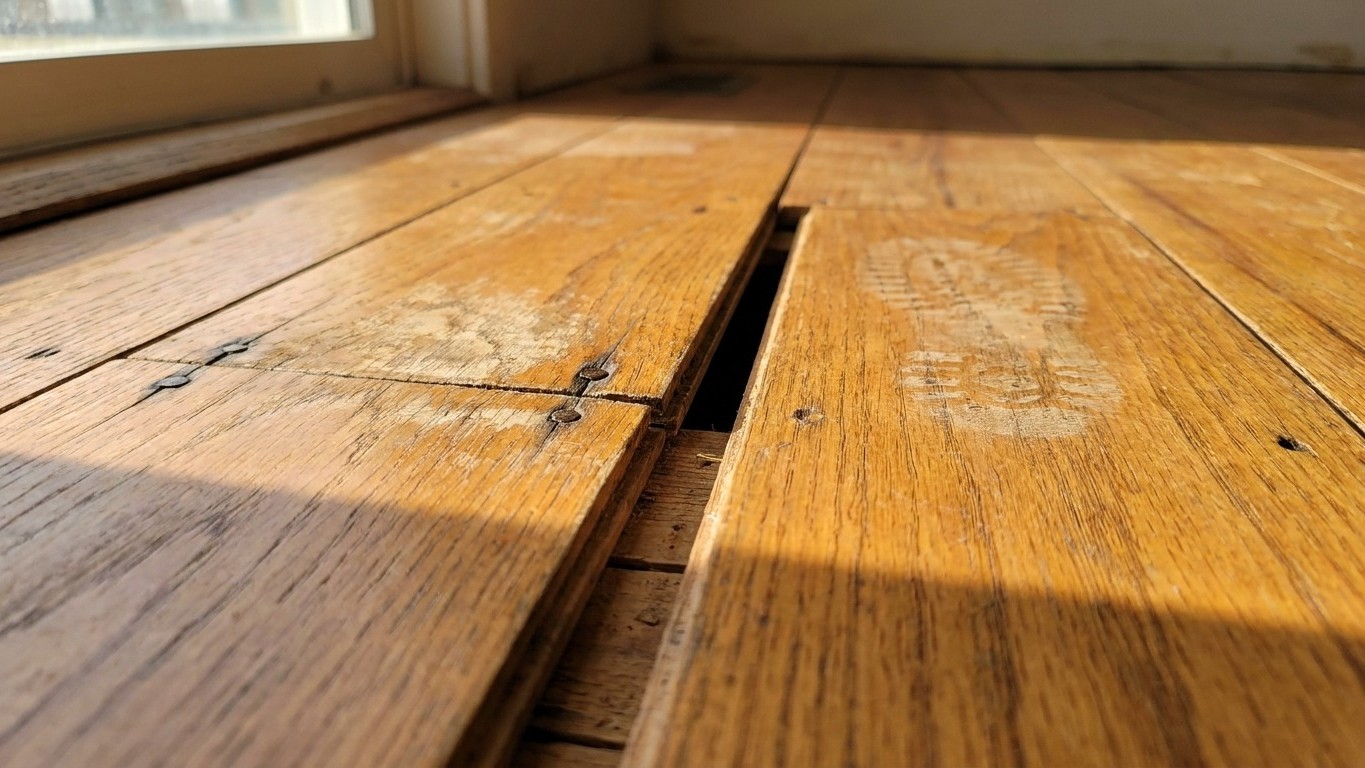

A squeaky floor is friction between two surfaces that used to sit still and now don’t. Wood shrinks, fasteners back out, subfloor panels separate from joists, and every step forces two parts to rub past each other. The fix depends entirely on which two parts those are and whether the noise starts at the surface or underneath it. Finding that spot is the actual job, before any tool comes out.
What is actually happening
A floor doesn’t squeak because it’s old. It squeaks because something that used to be held tight now has a little room to move, and that movement makes two surfaces scrape against each other with every step. The list of possible rubbing pairs is short: a board rubbing against the nail shank driven through it, one board’s edge rubbing its neighbor along a tongue-and-groove joint, or a subfloor panel rubbing against the top of a joist it’s supposed to sit flush against.
Nails hold wood by friction against the fibers around the shank, not by any kind of chemical bond. Wood expands and contracts with humidity all year, swelling in summer and shrinking back in winter, and each cycle compresses the fibers around a nail just a little more. After enough cycles, the hole is slightly bigger than the shank. The board can flex up and down a fraction of an inch under a footstep, and that flex drags wood fiber across metal. That scrape is the squeak. It’s mechanical, not a sign of decay by itself, but it does mean a connection that used to be tight no longer is.
The same logic applies at a larger scale to the subfloor itself. Plywood or OSB panels are fastened down to the joists below them, and those fasteners loosen the same way over years of foot traffic and seasonal movement. When a panel edge lifts even slightly off the joist it should be resting flush against, stepping near that edge rocks the panel and the edge rubs against the joist top, or against the neighboring panel. This kind of squeak tends to follow a straight line across a room, because it’s tracing the run of a joist underneath rather than a single loose board.
One question separates a simple fix from a more involved one: does the noise happen exactly where you step, or does it happen when you step somewhere nearby and the board flexes at a distance? A squeak that only sounds directly under your foot usually means a very local, isolated connection has loosened. A squeak that fires when you step a foot or two away means a wider section of subfloor is flexing as a unit, which points to a joist connection rather than a single fastener. That distinction decides where you look next, and it’s the reason walking the room slowly, before doing anything else, matters more than any tool.
The covering, or what is under it
Every squeak belongs to one of two layers: the flooring surface you can see and touch, or the subfloor and framing underneath it that you can’t see without access from below or from within the floor assembly itself. Confusing the two wastes effort. Tightening a board that’s actually rubbing against a loose joist connection buys you a quiet week and nothing more.
| What you observe | Where it happens | Which layer |
|---|---|---|
| Squeak at a board edge, only when you step directly on it | Tongue-and-groove joint rubbing under load | Covering, fixable from above |
| Squeak under carpet or resilient flooring, with no visible joint to blame | Padding has shifted, or the layer beneath is moving | Subfloor, not the covering itself |
| Squeak that follows a straight line across the room | Subfloor panel edge lifted off a joist run | Subfloor-to-joist connection |
| Squeak paired with cupped boards, staining, or a musty smell | Moisture has reached the subfloor or framing | Subfloor or joists, a moisture issue first |
| Squeak that changes with the season | Normal wood expansion and contraction | Covering, seasonal and usually harmless |
| Squeak plus a soft or bouncy feel underfoot | A joist has partially failed or is undersized for the span | Structural, below the subfloor entirely |
The practical test for which layer you’re dealing with is simple: can the fix happen while you’re standing in the room, or does it require getting underneath the floor to see the framing? Driving a fastener down through the covering and subfloor into a joist, or working a lubricant into a board joint, both happen from above. Sistering a joist, shimming a gap between subfloor and framing, or replacing a section of rotted subfloor all require access from below, whether that’s a basement, a crawlspace, or pulling up a section of flooring to expose the framing directly.
Moisture changes which layer you’re in even when the surface symptom looks identical to a dry squeak. A board that cups slightly and squeaks can be doing so purely from humidity swelling one edge more than the other, which is a covering issue that often settles down on its own as conditions even out. The same cupping paired with a musty smell or a stain on the underside of a nearby panel is a different problem entirely, one where the squeak is the least important symptom. That’s the point where a moisture meter earns its keep: a flooring contractor or home inspector uses one to compare a suspect area against a known-dry area in the same room, not to produce a single number that means something in isolation, but to see whether one spot is holding noticeably more moisture than the rest of the floor. A clear difference between the two readings is what tells you water is involved, not a squeak alone.
What to check, in order
Start cheap and non-invasive, and only move to the next step when the current one doesn’t answer the question.
- Walk the room slowly and mark every spot that squeaks with a piece of tape. This rules out guessing after the fact. It also shows immediately, which points toward a single loose fastener versus a subfloor-to-joist issue along a joist run.
- Note whether the squeak happens directly under your foot or when you step near it. A squeak that only fires under direct pressure usually rules out a wide subfloor problem and points to a local, isolated connection. A squeak that fires from a step nearby rules out a single loose nail and points to a board or panel flexing as part of a larger section.
- If you have access from below, in a basement or crawlspace, have someone walk the marked spots above while you watch the joists and subfloor from underneath. Look for movement, gaps between subfloor and joist, or daylight where there shouldn’t be any. This step rules out or confirms a subfloor separation without requiring anything to be lifted from above.
- Try a targeted fastener at one marked spot from above, if access from below isn’t possible. If driving a fastener down through the flooring and subfloor into the joist stops the noise, that confirms the subfloor-to-joist connection was the cause. If the squeak persists after fastening, the rubbing surface is elsewhere, most likely a board-to-board joint rather than the subfloor.
- Revisit the same marked spots after a real change in weather or indoor humidity. A squeak that comes and goes with the season rules in normal wood movement and rules out a fixed structural gap, which wouldn’t change with humidity at all.
- Where a stain, smell, or a history of a nearby leak raises suspicion, bring in a moisture meter comparison between the suspect spot and a dry area of the same floor. This is the last check before anything gets opened up. A clear gap between the two readings means the next step is finding the water source, not tightening a fastener.
Nothing on this list requires lifting a room. The moment a check points toward standing water, a smell, or a structural gap that doesn’t respond to a fastener, the job changes character, and that’s the boundary the next section covers.
When this stops being a flooring job
Three things end a squeak repair and start a different kind of job. The first is anything structural: a joist that flexes noticeably underfoot, a beam or support post that looks out of level, or a subfloor that feels genuinely soft rather than just noisy. The second is active water, meaning anything damp, dripping, or clearly still leaking rather than a stain left over from something that happened once and was fixed. The third is any smell of mustiness coming from under the floor, which usually means wood has stayed wet long enough for fungal growth to start, well beyond what a squeak fix addresses.
Each of these calls for a different professional, and they’re not interchangeable. A structural issue, a joist that bounces or a beam that’s failing, needs a structural engineer or a licensed contractor who can evaluate load capacity and specify a real fix, such as sistering a joist or adding support, something a flooring repair can’t substitute for. Active water needs a plumber first, especially if the source is a supply line, a drain, or a fixture nearby, because fastening down a squeaky board while the leak keeps running just delays the real damage. A flooring fitter’s job is the covering and the fasteners that hold it down, not tracing where water is coming from or judging whether a joist can still carry the load it was built for.
If the water turns out to be coming from above, a supply line, a fixture, or a roof leak working its way down through the framing, that’s a different problem with its own diagnosis path, and it’s worth checking the site’s plumbing and roofing guides rather than treating the floor as the source. A floor that stays quiet after a fastener fix but keeps showing new stains or smells hasn’t been repaired. It’s been muffled, and the underlying problem is still there, just harder to hear.