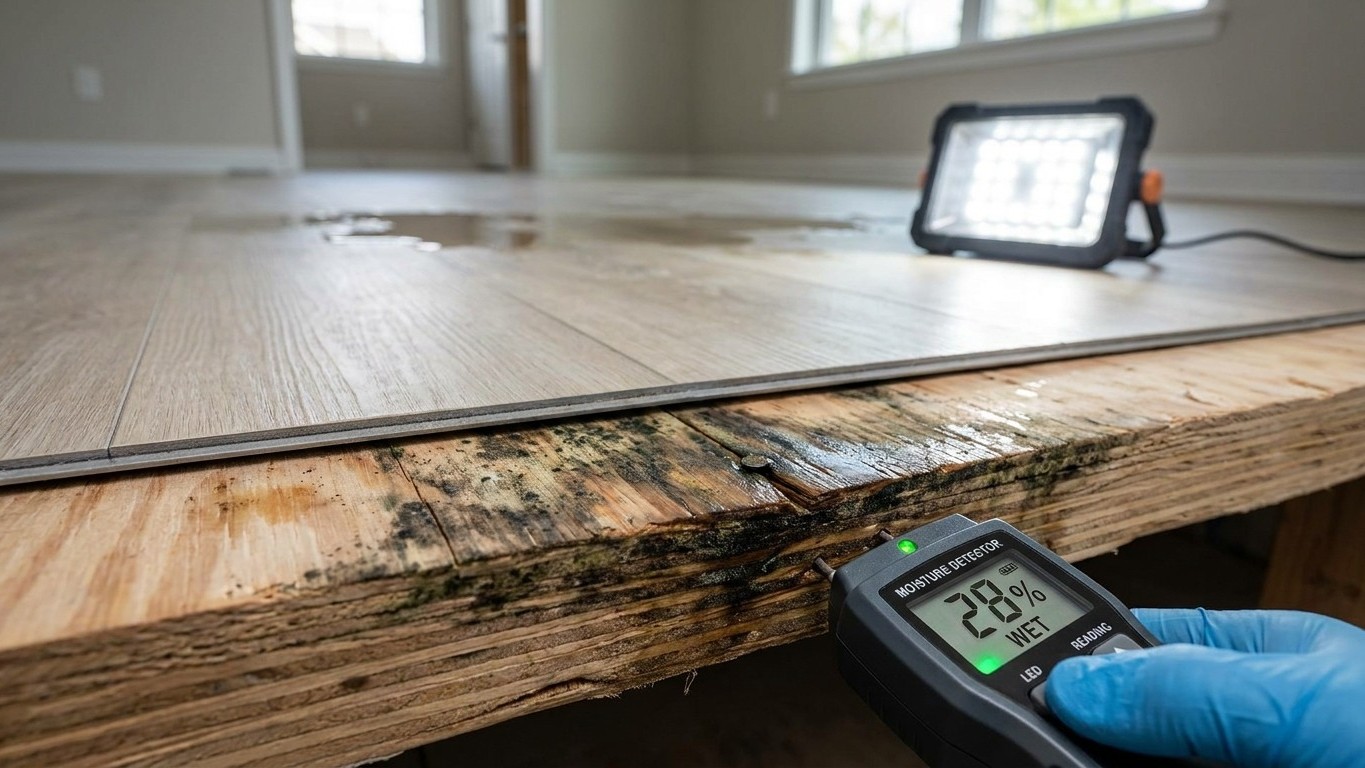

After a flood, hard, sealed surfaces often survive intact. Porous materials rarely do. But what actually decides the outcome isn’t what you see on top: it’s how fast the water was removed and how long the layer underneath stayed wet before anyone checked.
What is actually happening
The thing to understand about a flooded floor is that the covering and the subfloor dry at completely different speeds. Vinyl, tile, and even laminate can look and feel dry to the touch within a day or two. The plywood or OSB panel underneath, especially anywhere seams, fasteners, or old adhesive create a path for water to travel sideways, can stay wet for a week or more. A floor that looks fine from a standing position can be sitting on a subfloor that’s still saturated.
That gap between “looks dry” and “is dry” is where almost everything gets lost. A dry surface trapping moisture underneath doesn’t just risk warping; it creates the exact conditions mold needs. The Environmental Protection Agency notes that mold can begin growing on wet materials within 24 to 48 hours, which is faster than most homeowners get around to checking under a floor covering after the visible water is gone. EPA’s mold cleanup guidance is written for exactly this window: the period after standing water is removed but before anyone knows what’s happening below the surface.
This is also why the timeline matters more than the volume of water. A half-inch of standing water removed within hours does less damage than an inch of water left sitting overnight, because the damage isn’t really about how much water arrived. It’s about how long it had contact time with materials that absorb it and hold it. Wood-based subfloor panels swell, delaminate, and lose their fastener grip the longer they stay wet, regardless of what’s sitting on top of them.
Airflow changes this equation more than anything a homeowner buys. Open windows, running fans, and a dehumidifier pulling moisture out of the room air all speed up evaporation from the subfloor, but only if the covering above it isn’t sealing that moisture in. That’s the real reason some floor types get pulled up immediately after a flood even when they don’t look damaged: not because the material failed, but because leaving it down would trap water against wood that needs to breathe to dry. The decision about what stays and what comes up isn’t really about the covering’s condition at all. It’s about whether the covering is helping the subfloor dry or blocking it.
The covering, or what is under it
Once the standing water is gone, the job is sorting what’s actually damaged from what’s just wet. Those aren’t the same thing, and confusing them is how a floor gets replaced twice: once because it looked ruined, and again a few months later when the real source, moisture trapped below, finally shows up as a stain, a smell, or a soft spot.
| What you observe | What it tells you | Which layer |
|---|---|---|
| Solid hardwood boards curling upward at the edges (cupping), no staining | The top face absorbed water faster than the wood could release it. Often reversible once both sides dry evenly | Covering |
| Boards cupped with visible dark staining and gaps opening at seams | Water sat long enough to stain the panel underneath, not just the finish | Subfloor |
| Laminate flooring swollen, edges soft or crumbling | The core material has absorbed water and won’t return to its original shape. This layer is done | Covering |
| Vinyl plank or sheet lifting at seams, no swelling of the material itself | Adhesive failed or water traveled underneath. The plank itself may still be sound | Mostly covering, check adhesive layer |
| Tile intact and unmoved, but grout lines have darkened and tapping sounds hollow | Water is sitting in the setting bed between the tile and the subfloor | Subfloor |
| Carpet pad squishes or feels heavy underfoot after the carpet itself feels dry | Padding holds water like a sponge and rarely dries fully in place | Covering (pad specifically) |
| A musty smell that persists after every visible surface tests dry | Something below the surface is still wet even though the top looks fine | Subfloor |
Notice the pattern: the covering usually tells you what happened to it directly, cupping, swelling, lifting, and those symptoms often resolve once conditions improve. The subfloor speaks through secondary signs: staining, hollow sounds, smell. That’s the whole logic of separating the two. A cupped board with no odor and no staining is a drying problem you can often manage. The same cupped board with a musty smell underneath is a subfloor problem wearing a covering’s symptoms, and sanding or refinishing it without addressing what’s below just seals the moisture back in.
What to check, in order
None of the following requires lifting a room. Each one either confirms or rules out a possibility before you commit to anything more invasive, and each is cheaper and less disruptive than the one after it.
- Look and press. Walk the affected area and press firmly on the covering with your palm or a knuckle at several points, especially near walls and seams. Softness, give, or visible cupping rules in surface-level water absorption. Finding nothing here doesn’t confirm the subfloor is dry, it only means the covering isn’t showing obvious distress yet.
- Smell test, done after the surface reads dry. Once the covering feels and looks dry, close the room up for a few hours and then check the air. A musty or earthy smell that wasn’t there before rules in trapped moisture somewhere below the surface, even without any visible sign on top.
- Tap and sound test. Tap across the floor with a knuckle or the handle of a screwdriver, listening for a change from solid to hollow. This finds pockets of delamination or trapped air/moisture between layers without disturbing anything, and it can map the size of the affected area before you decide how much needs attention.
- Non-invasive moisture scan. This is a job for a flooring contractor or restoration professional using a pinless meter across the surface. The reading itself isn’t a fixed pass-or-fail number. It’s compared against a dry reference area elsewhere in the same house to see how much wetter the affected zone is by comparison. This step tells you where the wet pockets are before anything gets removed.
- Lifting a small, inconspicuous section. A corner, a closet, an area near a floor vent, somewhere lifting a few square feet won’t be visually obvious. This is the first genuinely invasive step, and it’s where this list stops: what you find here, a dry panel, a stained one, standing water still present, decides everything that follows.
When this stops being a flooring job
Three things end this page and hand the problem to someone else. The first is anything structural: joists, beams, or support posts that show sagging, soft spots, or visible rot when the subfloor is opened up. That’s a structural engineer’s call, not a flooring fitter’s, and no amount of drying time fixes a joist that’s already lost its strength.
The second is active water. If water is still arriving, from a slow plumbing leak, a failed seal around a fixture, or a roof or wall letting moisture in during rain, drying the floor is pointless until the source stops. That’s a plumber’s job when the water is coming from inside the house, and a different trade entirely when it’s coming from above or from the exterior envelope.
The third is smell that persists after everything visible tests dry, combined with any history of the area staying wet for more than a day or two. At that point the concern isn’t the floor anymore, it’s what’s grown underneath it during the time it was wet, and that calls for a restoration or remediation professional equipped to test and treat what a homeowner can’t see or safely handle.
A flooring fitter’s role only really starts once the subfloor is confirmed sound and dry. Their job is replacing or repairing what sits on top, not diagnosing what’s underneath or where the water came from in the first place. If the water traced back to a fixture, a supply line, or a slow drain, that’s a plumbing question. If it came in through a roof, flashing, or an exterior wall during weather, that points to the building’s envelope, not its floors. Getting the right trade on the right problem the first time is what keeps a flooded floor from becoming a flooded floor twice.