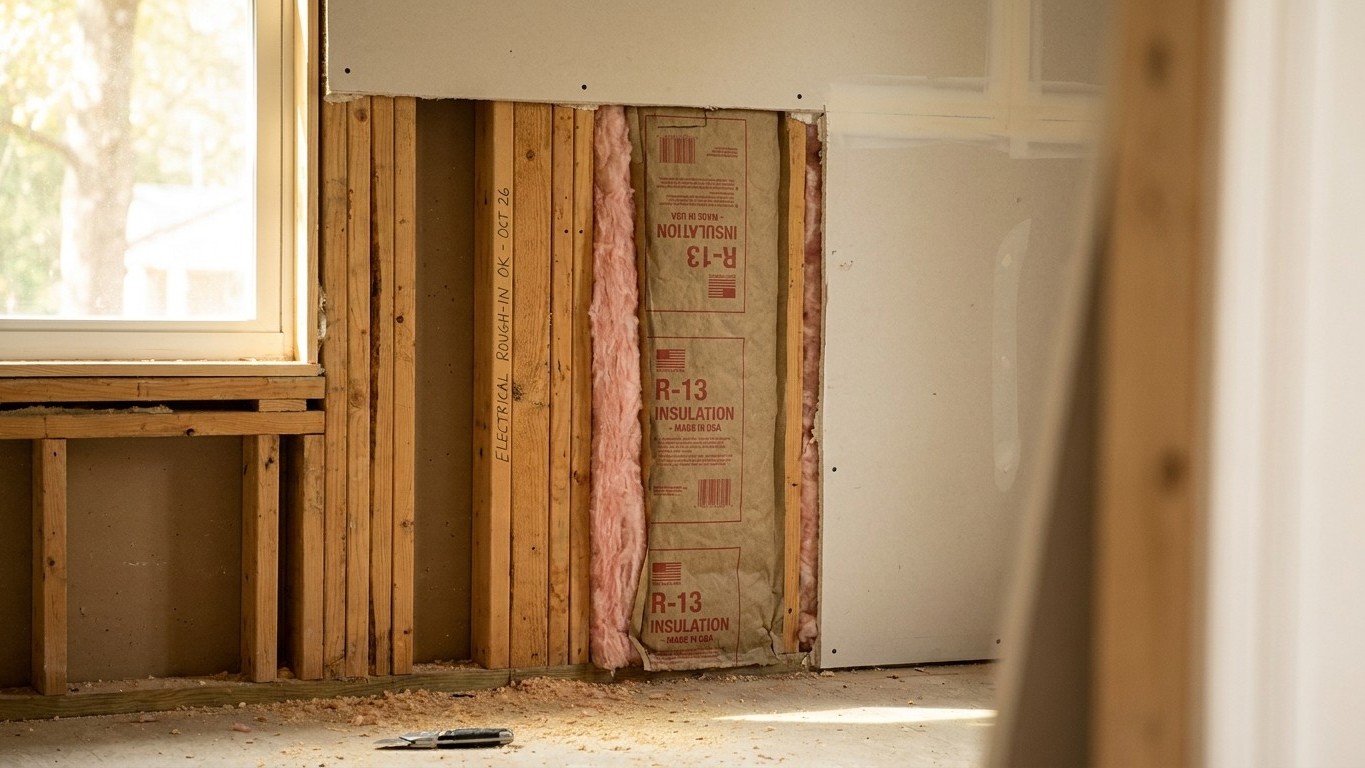

No. Under the 2021 International Residential Code, a vapor retarder is not required in Climate Zones 1, 2 and 3, and Mississippi’s 82 counties fall entirely within Zones 2A and 3A. That single fact settles the question for the whole state, which is unusual, because most states this size split across a hard code boundary. Mississippi doesn’t.
What the code asks for in Mississippi

The rule itself, before any exception, is Section R702.7 of the 2021 International Residential Code: a vapor retarder of the class listed in Table R702.7(2) “shall be provided on the interior side of frame walls.” That’s the default. Then the code carves out four exceptions, and the one that governs Mississippi reads plainly: “A vapor retarder shall not be required in Climate Zones 1, 2 and 3.”
Mississippi’s counties split between two of those exempt zones. Seventy-six counties sit in Zone 3A, and six counties sit in Zone 2A. Both numbers matter, but here’s the part that actually simplifies things for a state this size: because both 2A and 3A appear in the same exception clause, the interior vapor retarder requirement is waived across every one of the state’s 82 counties, not just most of them. That’s the opposite pattern from a state that straddles, say, Zone 3 and Zone 4, where one county requires the retarder and its neighbor doesn’t.
Waived is not the same as forbidden. Nothing in the code prohibits installing a vapor retarder in a Mississippi wall assembly. The exception simply removes the obligation. A builder or homeowner can still choose to install one, and in some assemblies, a properly permeable Class III product plays a legitimate role. What the exception does is stop the code from mandating an interior Class I sheet by default, because in this climate that default choice tends to work against the wall rather than for it (more on that mechanism below).
None of this tells any individual reader what to put in their own wall. The IRC is a model code. What actually governs a permit in Hattiesburg, Southaven, or a rural county between them is whichever edition of the code that local jurisdiction has adopted, sometimes with amendments that change the details. A wall assembly built with the wrong vapor control doesn’t announce the mistake at the final inspection. It shows up years later, as rot inside a stud cavity nobody’s opened yet.
Why the answer is the opposite in a warm climate
The logic that produces a required vapor retarder in Minnesota and an exempted one in Mississippi comes down to which direction the moisture is traveling, and that direction flips with climate.
In a cold-climate wall, the warm, humid air lives inside the house. Heating systems, cooking, showers, breathing occupants: all of it loads the indoor air with vapor. That vapor wants to migrate outward, through the wall assembly, toward the cold winter air. If it reaches the cold sheathing before something stops it, it condenses there, and the sheathing gets wet all winter. A Class I retarder placed on the interior side, close to the warm air, intercepts that vapor before it can travel far enough to hit a cold surface. That’s the entire logic behind the base rule in R702.7.
Flip the climate and the water starts traveling the other way. In Mississippi’s humid summers, the damp air sits outside, not inside. Air conditioning keeps interior air cooler and drier than the muggy air pressing against the exterior siding. Vapor now wants to migrate inward, from outside toward the cool interior. If a builder installs an impermeable Class I retarder on the interior side anyway, following cold-climate habit, that sheet becomes exactly the cool, impermeable surface the inbound vapor hits and condenses on. The U.S. Department of Energy’s Building America program describes the result without softening it: “the water vapor will condense on this cool, impermeable surface,” producing “ruined insulation, mold, and structural rot of framing members.”
That’s not a bureaucratic quirk buried in a code table. It’s the code tracking which way the water is actually moving in each climate, and refusing to mandate a material that would trap moisture on the wrong side of the wall.
The three classes, and why the word matters
Most of the confusion around this topic comes from treating “vapor barrier” as one product, when the code actually defines three classes by how much moisture they let through, measured in perms.
| Class | Example materials | Perm rating |
|---|---|---|
| Class I | Sheet polyethylene, nonperforated aluminum foil | 0.1 perm or less |
| Class II | Kraft-faced fiberglass batts, vapor retarder paint | above 0.1 up to 1.0 perm |
| Class III | Latex or enamel paint | above 1.0 up to 10.0 perm |
Polyethylene sheeting only qualifies as a Class I material; it isn’t automatically “the vapor barrier,” it’s the tightest of three tiers, and calling it a barrier without naming the class is exactly the shorthand that causes builders in different regions to talk past each other. A cold-climate contractor thinking “vapor retarder” usually means Class I. A warm-climate assembly, when it uses one at all, more often calls for something in the Class II or III range, permeable enough to let a wall dry in whichever direction it needs to.
Here’s a detail that surprises most homeowners: ordinary latex wall paint is a Class III vapor retarder. Anyone who’s painted an interior wall with a standard latex product already has a vapor retarder on that wall, whether they intended one or not.
One more distinction worth keeping straight: a vapor retarder and an air barrier are not the same thing, even though a single sheet of material sometimes does both jobs. A vapor retarder controls moisture diffusion through the material itself. An air barrier stops bulk air movement through gaps, seams, and penetrations. Confusing the two leads people to think a poly sheet with unsealed edges is doing more than it actually is.
Where the rule stops
Even in climates where R702.7 would otherwise apply, the code lists four situations where the interior vapor retarder requirement simply doesn’t reach:
- Basement walls
- The below-grade portion of any wall
- Construction where accumulation, condensation, or freezing of moisture will not damage the materials
- Climate Zones 1, 2, and 3, which is the exception that covers Mississippi
The basement exception is the one most homeowners actually run into, because so many houses have at least a partial basement or crawlspace foundation wall. A concrete or masonry basement wall holds moisture and releases it slowly, over years, through its own mass. That assembly needs to dry toward the interior when conditions call for it. Sealing an impermeable vapor retarder against the inside face of that wall traps moisture between the concrete and the sheet, with nowhere to go, which is close to the same failure the DOE describes for warm-climate above-grade walls, just against a different substrate. For the full mechanics of that situation, the basement wall guide on this site covers what changes once the wall goes below grade.
These exceptions are specific to the IRC as adopted in the United States. A reader working from a Canadian provincial code should not assume the same list applies; the National Building Code of Canada handles vapor control differently and doesn’t carry a climate-zone exception at all.
Who actually decides, in Mississippi
The IRC is a model code, and Mississippi’s local jurisdictions decide which edition to adopt, sometimes with local amendments that change specific sections. That means the version of R702.7 enforced on a given permit in a given county isn’t automatically the 2021 edition referenced here. It’s whatever edition that county or municipality has formally adopted, which can lag the model code by years. The only reliable answer for a specific project comes from the local building department, not from a national reference table.
Mississippi carries a moderate winter heating load by national standards: Jackson averages about 2,222 heating degree days a year against roughly 2,402 cooling degree days, based on the 1991-2020 NOAA climate normals. Degree days measure demand, not temperature, so that number reflects how much heating a typical building needs to run over a full year, added up day by day. The two figures sit close to each other, which fits a state with real but short winters and long, humid, cooling-dominated summers, exactly the profile that puts the whole state into the exempt zones rather than the required ones.
None of that changes the basic answer for any specific reader: the code sets the default, the climate zone determines whether the exception applies, and the local building department confirms which edition and which amendments actually govern the wall being built. A wall assembly built backward for its climate won’t fail at inspection. It fails quietly, inside the cavity, and the owner usually finds out only once the drywall comes off for an unrelated repair.