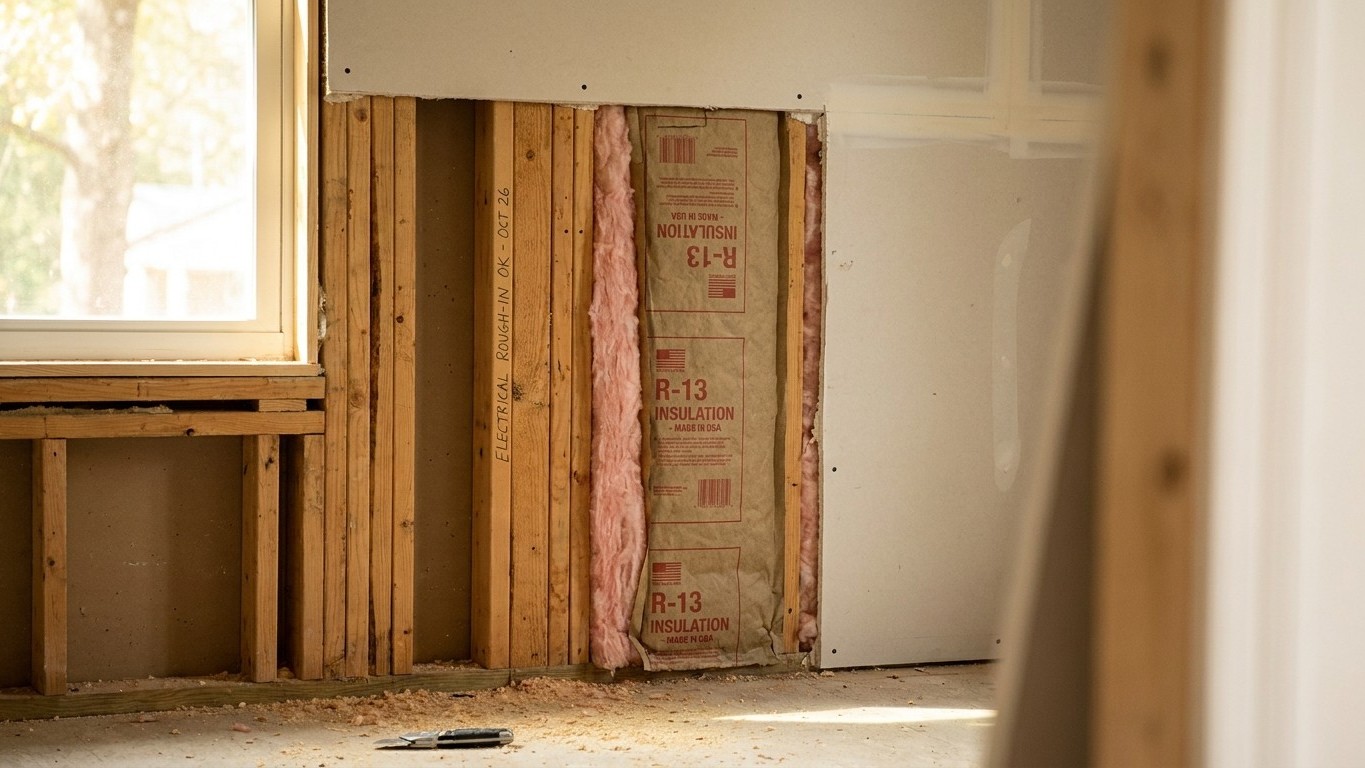

A wall in Missouri doesn’t have one answer. The state’s 87 counties in climate zone 4A and 26 counties in zone 5A fall under the 2021 IRC’s default rule requiring an interior vapor retarder on frame walls. Only two counties, both in zone 3A, sit inside the code’s exception. Which rule applies depends entirely on which side of a county line the wall stands.
What the code asks for in Missouri

The 2021 International Residential Code, Section R702.7, states the rule directly: a vapor retarder of the class set by Table R702.7(2) shall be provided on the interior side of frame walls. That’s the baseline most jurisdictions building on the IRC have adopted in some form. But Missouri isn’t one climate zone. It’s three, and the code’s own exception hinges on exactly that fact.
Table R301.1 of the 2021 IECC sorts the state’s 115 counties into three groups: 87 counties in zone 4A, 26 counties in zone 5A, and 2 counties in zone 3A. The IRC’s fourth exception to R702.7 reads plainly: “A vapor retarder shall not be required in Climate Zones 1, 2 and 3.” That exception doesn’t reach zone 4 or zone 5. So for the 87 counties sitting in 4A and the 26 sitting in 5A, the default requirement stands, an interior vapor retarder of whatever class the table calls for is expected on frame walls. For the two counties in zone 3A, the exception applies, and the code doesn’t require one.
That’s not license to skip vapor control everywhere in those two counties, and it isn’t a ban on installing one anywhere else. “Not required” removes an obligation. It doesn’t forbid anything. A builder in a 3A county can still choose vapor control appropriate to a given wall assembly; a builder in a 4A or 5A county has an actual code obligation to satisfy, tied to whichever class the Table R702.7(2) row specifies for that construction type.
The split means two houses built eighty miles apart, one in a 4A county and one in the sliver of 3A territory, can face genuinely different requirements and both be correctly built under the code. That’s an unusual situation for a state this size. The exception line typically falls cleanly along zone 3 versus zone 4 boundaries, and Missouri happens to have a small edge of zone 3A tucked into an otherwise cold-climate footprint.
None of this tells any individual reader what their own wall needs. The zone assigned to a county sets which row of the code table governs, but the code actually enforced on a given project is whichever edition the local jurisdiction has adopted, sometimes amended, sometimes years behind the current IRC cycle. A wall built with the wrong class of vapor control doesn’t fail an inspection on the spot. It fails slowly, inside the cavity, and nobody notices until a renovation or a leak opens the wall years later. The local building department is the only source that can confirm which zone applies to a specific address and which code edition currently governs there.
Why the answer is the opposite in a warm climate
The vapor retarder requirement doesn’t flip between zones for administrative reasons. It flips because the direction moisture travels through a wall flips too.
In a cold climate zone, like Missouri’s 5A counties, the moisture problem starts inside the house. Heated indoor air carries water vapor, and that vapor pushes outward through the wall assembly toward the cold sheathing and siding, where temperatures drop below the dew point during winter. An interior vapor retarder sits exactly where it needs to, intercepting that vapor before it reaches the cold surface and keeping the cavity dry through the heating season. That’s the assembly the IRC’s default rule was written to protect.
Flip the climate, and the same material becomes a liability instead of a defense. In a warm, humid climate, outdoor air is often more saturated with moisture than the conditioned indoor air, especially with air conditioning running through the summer months. Water vapor migrates inward instead, from the humid outside toward the cooler, drier interior. If a Class I vapor retarder sits on the interior side of the insulation in that scenario, it becomes the cool, impermeable surface the vapor reaches first. The U.S. Department of Energy’s Building America program describes what happens next in plain terms: “If the wall contains a vapor retarder on the interior side of the insulation, the water vapor will condense on this cool, impermeable surface,” resulting in “ruined insulation, mold, and structural rot of framing members.”
That mechanism is the reason the code writes different rules for different zones. It isn’t bureaucratic overcaution. It’s a direct response to which way the water is moving. The same sheet of polyethylene, installed the same way in two different climates, protects one wall and damages the other.
For Missouri’s two 3A counties, this is the practical logic behind the exception. Installing an interior vapor retarder there wouldn’t necessarily be pointless, but it carries real risk of trapping moisture on the wrong side of the assembly depending on the specific wall design and cooling load. For the 87 counties in 4A and 26 in 5A, the heating season dominates enough of the year that the cold-climate logic holds, and the default requirement applies.
The three classes, and why the word matters
Vapor retarders aren’t one product. The code sorts them by permeance into three classes, and the class, not the mere presence of a retarder, is what the code actually regulates.
| Class | Example materials | Perm rating |
|---|---|---|
| Class I | Sheet polyethylene, nonperforated aluminum foil | 0.1 perm or less |
| Class II | Kraft-faced fiberglass batts, vapor retarder paint | Above 0.1, up to 1.0 perm |
| Class III | Latex or enamel paint | Above 1.0, up to 10.0 perm |
Polyethylene sheeting is a Class I vapor retarder, but calling it “a vapor barrier” without noting that class obscures the actual disagreement between a builder working in a cold zone and one working in a warm-humid zone. That disagreement is never about whether to have vapor control at all. It’s about which class belongs in that specific assembly, facing that specific direction of moisture flow.
Most homeowners already have a Class III vapor retarder on their walls and don’t know it. Ordinary latex paint falls in that permeance range. It’s not a heavy-duty barrier by any stretch, but it does slow vapor movement enough to count under the code’s own definition, which is one reason interior finishes matter more to an assembly’s moisture performance than most people assume.
One distinction worth keeping straight: a vapor retarder is not an air barrier. They do different jobs. A vapor retarder slows the diffusion of water vapor through a material. An air barrier stops bulk air movement, which carries far more moisture, far faster, through gaps and cracks than diffusion ever will. Some products do both jobs at once, which is part of why the two get confused, but the code treats them as separate requirements.
Where the rule stops
Section R702.7’s default requirement doesn’t apply everywhere, even inside the counties where it otherwise governs. The code lists specific exceptions, separate from the climate-zone exception already discussed:
- Basement walls
- The below-grade portion of any wall
- Construction where accumulation, condensation, or freezing of moisture will not damage the materials
- Climate Zones 1, 2, and 3, as covered above
The basement exception is the one most homeowners actually run into. A concrete basement wall holds moisture from the surrounding soil and releases it slowly over years, not days. That assembly needs to be able to dry toward the interior, since drying outward through the concrete and soil isn’t a realistic path. An impermeable sheet on the interior side of a basement wall would trap that moisture against the concrete instead of letting it dissipate, which is the opposite of what the wall needs. This site’s basement wall guide covers that assembly in more detail for readers dealing specifically with below-grade construction.
The third exception, covering construction where moisture won’t damage the materials, is narrower than it sounds and depends heavily on the specific assembly, the cladding, and the local inspector’s interpretation. It’s not a general escape hatch from the rule.
Who actually decides, in Missouri
Everything above describes what the model code says. What actually governs a specific wall in a specific Missouri county is whatever code edition that jurisdiction has adopted, and that’s a decision made locally, not by the IRC itself. Model codes get adopted state by state, and often county by county or city by city within a state, sometimes with local amendments, sometimes on a delay of several years behind the current national cycle.
That gap matters more here than it might in a smaller, single-zone state. Missouri’s split across three zones, 3A, 4A, and 5A, means the correct answer for a given address depends on a fact, the county’s assigned zone, that only the local building department can confirm with certainty alongside the specific code edition in force.
The heating demand across the state gives some sense of why this question carries real weight here. At Kansas City, a reference station for the region, the area logs about 5,071 heating degree days a year against roughly 1,363 cooling degree days, a measure of how much heating demand accumulates across the year rather than a temperature reading itself. That lopsided ratio, heavily weighted toward heating, is consistent with a state where most counties sit in cold-climate zones 4A and 5A rather than the milder 3A pocket.
None of this tells an individual reader what to install in their own wall. The rule depends on the zone, the zone depends on the county, and the code actually enforced depends on what the local jurisdiction has adopted. A wall built with the wrong class of vapor control doesn’t fail visibly at the time of construction. It fails quietly, inside the cavity, and the owner usually finds out years later, when the damage is already done. The local building department remains the only reliable source for confirming both the applicable zone and the code edition in force for a specific address.