
Yes. Under the 2021 International Residential Code, a frame wall in Ohio needs an interior vapor retarder. The state sits entirely in IECC Climate Zones 5A and 4A, and the code’s exception for skipping a retarder applies only to Zones 1, 2 and 3. Neither Ohio zone qualifies, so the requirement holds statewide, even though the two zones don’t share the same winter.
What the code asks for in Ohio

Section R702.7 of the 2021 International Residential Code states that a vapor retarder of the class listed in Table R702.7(2) “shall be provided on the interior side of frame walls.” That’s the rule, full stop. It’s a mandate, not a suggestion, and it applies to the assembly at the point of construction, not something a homeowner can retrofit after drywall is up without opening the wall back up.
Ohio’s 88 counties fall into two IECC zones: 64 counties sit in Zone 5A, and 24 counties sit in Zone 4A. That’s a real split, and on plenty of code questions it would mean two different answers depending on which side of the county line a house sits. Not here. The code’s only zone-based exception, the line that reads “a vapor retarder shall not be required in Climate Zones 1, 2 and 3,” doesn’t touch either Ohio zone. Zone 4A isn’t Zone 3. Zone 5A certainly isn’t either. So whether a house sits in a 4A county near the Ohio River or a 5A county up near Lake Erie, the base requirement to install some class of interior vapor retarder on frame walls stands.
What does change between the two zones
The class of retarder required, drawn from Table R702.7(2), is what shifts with climate zone and wall assembly, not the yes-or-no question of whether one is needed. A 5A county carries a longer, colder winter than a 24-county band in 4A, and the table accounts for that by pairing zone with insulation levels and assembly type. This page won’t assign a class to any single wall, because that number depends on the specific assembly and on which edition and amendments the local jurisdiction has actually adopted. That’s a conversation for the local building department, not a national code page.
Worth restating plainly: “not required” and “forbidden” are two different words. Nowhere does the code ban vapor retarders in warm zones. It removes an obligation for Zones 1, 2 and 3, and Ohio isn’t one of them.
Why the answer is the opposite in a warm climate
The reason the exception exists at all comes down to which direction the water vapor is moving, and that direction flips with climate. In a cold state like Ohio, the warm, moisture-laden air sits inside the house all winter, pushing to escape through the wall toward the cold outdoors. A vapor retarder on the interior side blocks that vapor before it reaches the cold sheathing, where it would otherwise condense.
Flip the climate, and the physics flips with it. In a warm, humid state, the outdoor air carries the moisture, and it’s pushing inward, toward the air-conditioned interior. An impermeable layer placed on the interior side of that wall, the same Class I retarder that does useful work in Ohio, becomes the coldest surface the vapor meets on its way in. The U.S. Department of Energy’s Building America program describes exactly what happens next: “If the wall contains a vapor retarder on the interior side of the insulation, the water vapor will condense on this cool, impermeable surface,” producing “ruined insulation, mold, and structural rot of framing members.”
That’s not a minor caveat. It’s the reason the code writes different rules for different zones in the first place. It isn’t bureaucratic caution stacked on top of itself, it’s the code following the water. Ohio’s winters push vapor outward, so an interior retarder helps. A Gulf Coast summer pushes vapor inward, so the same material in the same spot causes the damage the DOE describes. Same product, opposite outcome, and the geography is the only variable that changed.
The three classes, and why the word matters
The code doesn’t treat “vapor retarder” as one product. It splits the requirement into three classes, defined strictly by permeance, and the class assigned to a given wall in Table R702.7(2) is the actual technical requirement, not the general idea of “having a barrier.”
| Class | Example materials | Perm rating |
|---|---|---|
| Class I | Sheet polyethylene, nonperforated aluminum foil | 0.1 perm or less |
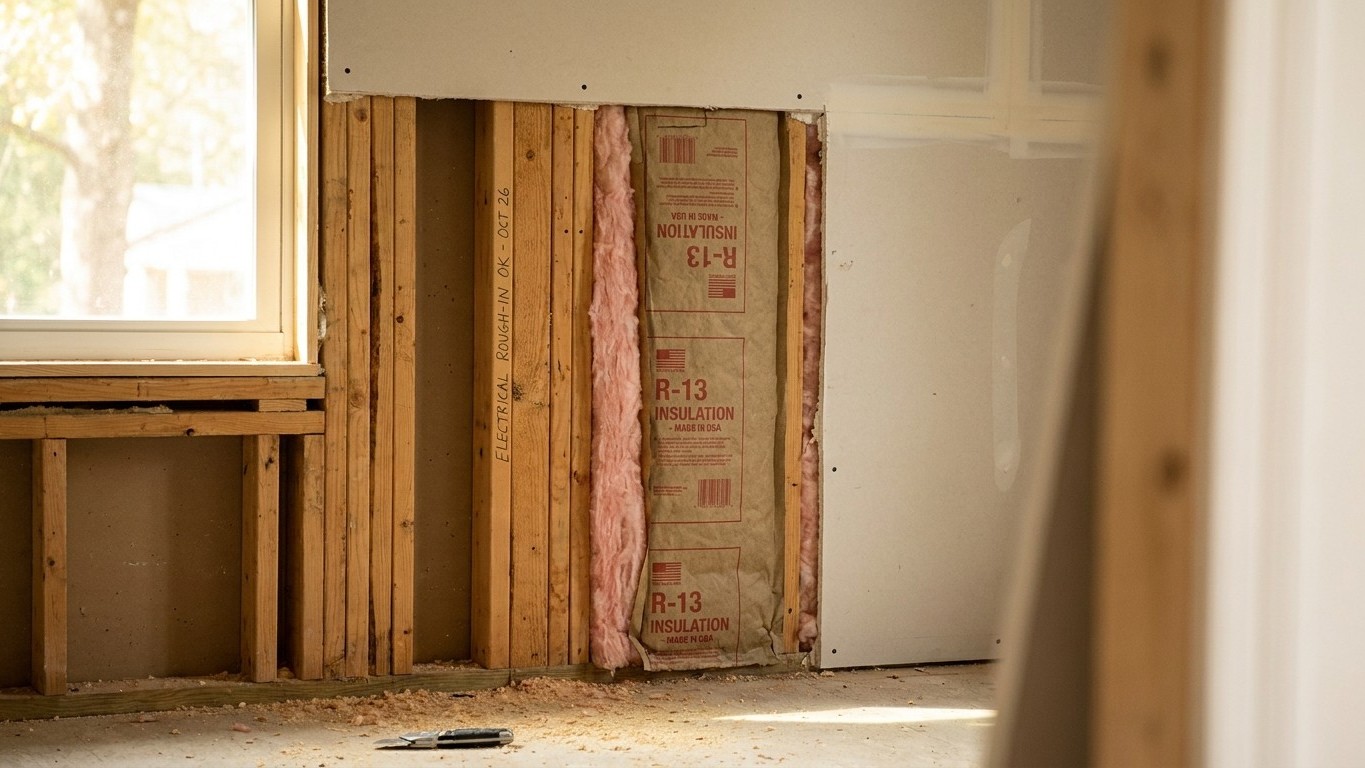
| Class II | Kraft-faced fiberglass batts, vapor retarder paint | Above 0.1 up to 1.0 perm |
| Class III | Latex or enamel paint | Above 1.0 up to 10.0 perm |
Polyethylene sheeting is a Class I product, one of the tightest options the code recognizes, and calling it simply “a vapor barrier” without noting the class skips the part of the debate that actually matters. The disagreement between a builder working in a cold state and one working in a warm, humid one was never about whether to control vapor. It’s about which class belongs on that particular wall.
Here’s a detail most homeowners miss entirely: ordinary latex or enamel wall paint qualifies as a Class III vapor retarder. Millions of walls across Ohio already carry one, coat after coat, without the owner ever thinking of paint as a code-recognized vapor control layer.
One more distinction worth keeping straight: a vapor retarder is not an air barrier. They solve different problems, vapor diffusion versus bulk air movement, and while a single product sometimes performs both jobs, the code treats them as separate requirements.
Where the rule stops
Section R702.7 lists specific situations where the vapor retarder requirement doesn’t apply at all:
- Basement walls
- The below-grade portion of any wall
- Construction where accumulation, condensation, or freezing of moisture won’t damage the materials
- Walls in Climate Zones 1, 2 and 3
That last exception is the one that doesn’t touch Ohio, as covered above. The basement exception is the one Ohio homeowners actually run into, because it governs a wall type found in a huge share of the state’s housing stock. A poured concrete or block foundation wall behaves nothing like a framed wall above grade. It sits in contact with soil that holds moisture year-round, and the concrete itself absorbs and releases water slowly, on a timescale of years rather than seasons. That assembly needs to be able to dry toward the interior. Seal it with an impermeable sheet on the inside, and the moisture already in the concrete has nowhere to go, which traps it against the framing and finish materials instead of letting it evaporate away. For the details specific to that wall type, this site’s basement wall guide covers the assembly considerations the framed-wall rule above doesn’t address.
The third exception, moisture that won’t damage the materials, is more of a judgment call written into the code for unusual assemblies rather than a bright-line rule, and it’s handled case by case by whoever is reviewing the plans.
Who actually decides, in Ohio
Everything above describes the model code and the state’s climate-zone assignment. Neither one is the final word for a specific address. Model codes get adopted state by state, sometimes with amendments, sometimes a code cycle or two behind the version referenced here, and the version actually enforceable on a given wall is whatever the local jurisdiction has formally adopted. That’s the office to call, not this page and not the IRC text itself.
It’s worth understanding why this question carries real weight in Ohio rather than being an academic footnote. At Columbus’s Port Columbus airport, the NOAA 1991-2020 climate normals put the annual heating degree day total at about 5,233, against roughly 1,068 cooling degree days. Heating degree days measure demand for heat, not a temperature reading, they accumulate for every day of the year based on how far the mean temperature falls below 65°F. A total north of 5,000 describes a long, genuinely cold heating season, one where interior moisture is pushing outward through the wall assembly for months at a stretch, not just on the occasional cold snap. That’s the physical reason the vapor-retarder question has teeth here, in a way it simply doesn’t for a Gulf Coast state.
None of that changes the basic advice: this page identifies the rule and explains what it depends on, but it doesn’t tell any individual reader what to install in their own wall. A wall built with the wrong vapor control doesn’t announce the mistake with a crack or a stain the week it’s finished. It rots quietly behind the drywall, and the owner typically finds out years later, when the damage is already extensive. The local building department, working from the code edition Ohio’s jurisdiction has actually adopted, is the only source that can answer for a specific house.