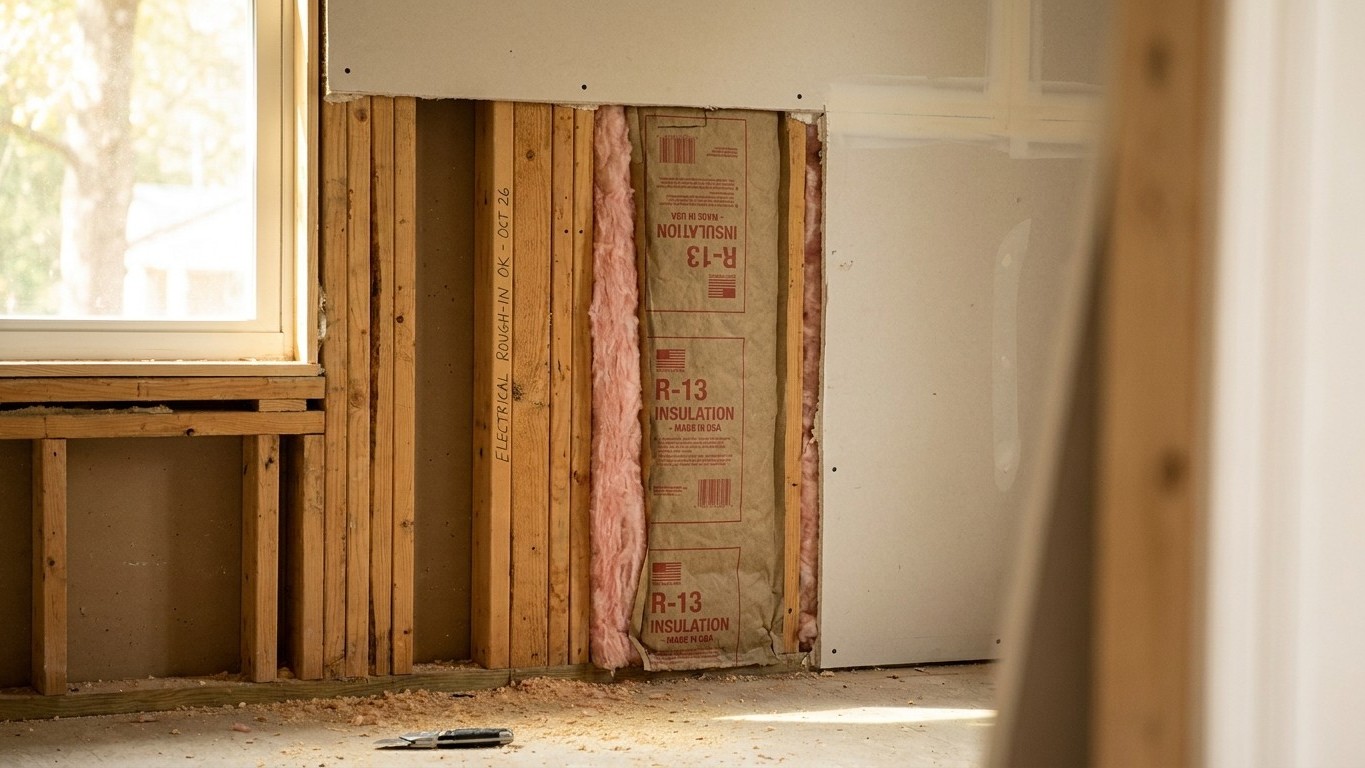

Most walls in South Carolina fall under a code exception that removes the requirement for an interior vapor retarder. But “most” isn’t “all”: the state’s building code splits it into two climate zones, and 2 of its 46 counties sit in a zone where the standard federal exception still applies the same way, just under a slightly different zone label. The short version, check with your local building department before you assume either way.
What the code asks for in South Carolina

The 2021 International Residential Code, Section R702.7, says a vapor retarder of a specific class “shall be provided on the interior side of frame walls” in most of the country. Then it lists four exceptions, and the one that matters here reads plainly: “A vapor retarder shall not be required in Climate Zones 1, 2 and 3.”
South Carolina’s 46 counties split across two of those zones. Forty-four counties sit in Zone 3A. Two counties sit in Zone 2A. That’s the whole picture, straight from the IECC’s own zone table, and it means there is no single answer that covers the entire state. Both of South Carolina’s zones fall inside the 1-2-3 range the code exempts, so the interior vapor retarder requirement doesn’t apply across the state’s 46 counties, full stop.
That’s worth sitting with for a second, because it’s easy to read “not required” and hear “forbidden.” It isn’t. The exception in R702.7 removes an obligation, nothing more. A builder in South Carolina can still choose to install a vapor retarder if the wall assembly calls for one; the code simply doesn’t force the issue the way it does in a northern state. What the code does forbid, implicitly, is assuming the rule from a cold-climate house applies here unchanged. It doesn’t, and building it that way creates its own risk, which the next section explains.
Why the county-level split still matters
A count of counties isn’t a share of population, and it isn’t a map of where you live. The fact that 44 counties land in one zone and 2 in another tells you the state isn’t uniform, not which zone your particular house sits in. IECC climate zones are assigned by county, not by a rule of thumb about distance from the coast or from Charlota. If you need to know which zone applies to your address, the county-by-county table in the IECC (or your local building department) is the source, not a guess based on this article.
This is also the point where a homeowner’s plan and a builder’s plan can diverge without either one being wrong. A wall built to Zone 3A specifications and a wall built to Zone 2A specifications can look identical on the outside and still follow different logic on vapor control, because the underlying moisture math changes county by county, not house by house.
Why the answer is the opposite in a warm climate
Here’s the mechanism that makes South Carolina’s rule make sense instead of feeling arbitrary. In a cold climate, the warm, moisture-laden air lives inside the house. A vapor retarder on the interior side of the wall stops that indoor humidity from migrating outward and condensing against a cold sheathing board in January. That’s the classic setup the code was written around, and it’s why northern building codes lean hard on interior vapor retarders.
Flip the climate, and the direction of the problem flips with it. In a warm, humid state, the moisture load comes from outside: hot, saturated air pressing against the wall from the exterior for much of the year. If that wall has an impermeable layer on the interior side, the U.S. Department of Energy’s Building America program lays out exactly what happens next: “If the wall contains a vapor retarder on the interior side of the Insulation, the water vapor will condense on this cool, impermeable surface.” The air conditioning keeps the interior surface cool, the humid outside air keeps pushing moisture toward it, and the vapor retarder becomes the exact condensing surface the wall didn’t need.
The result, per the same DOE guidance, is “ruined Insulation, mold, and structural rot of framing members.” Not a hypothetical. That’s the documented outcome of installing the wrong vapor control in the wrong climate, and it’s the reason Section R702.7 doesn’t apply the same rule everywhere. This isn’t the code being inconsistent or bureaucratic for its own sake. It’s the code tracking which way the water is actually traveling through the wall, season by season, and refusing to fight the wrong direction.
That’s the whole argument for South Carolina in one sentence: install a Class I vapor retarder here the way you would in Minnesota, and you haven’t added protection, you’ve added a condensing surface.
The three classes, and why the word matters
“Vapor barrier” gets used loosely, but the code doesn’t deal in one category, it deals in three, ranked by how much moisture they let pass. That distinction, called permeance and measured in perms, is the entire technical argument buried inside this page.
| Class | Example materials | Permeance range |
|---|---|---|
| Class I | Sheet polyethylene, nonperforated aluminum foil | 0.1 perm or less |
| Class II | Kraft-faced fiberglass batts, vapor retarder paint | Above 0.1, up to 1.0 perm |
| Class III | Latex or enamel paint | Above 1.0, up to 10.0 perm |
Notice what’s sitting in that Class III row. Ordinary latex paint, the kind most homeowners already have on their interior walls, qualifies as a vapor retarder under the code’s own definition. Most people painting a bedroom have zero idea they’re applying a Class III retarder while they roll it on. That’s not a loophole; it’s just how permeance works at the low end of the scale.
The disagreement between a builder working in a cold zone and one working in South Carolina was never about whether to use a vapor retarder at all. It’s about class. Sheet polyethylene should never be described as simply “a vapor barrier” without naming it as Class I, because Class I is the impermeable end of the spectrum, the one the DOE specifically flags as risky on the interior side of a warm-humid wall. Call something “Class I” and you’ve said something precise. Call it “a vapor barrier” and you’ve said almost nothing.
One more distinction worth a single sentence: a vapor retarder is not an air barrier. They do different jobs, stopping moisture diffusion versus stopping bulk air movement, and while some products handle both, the code treats them as separate requirements entirely.
Where the rule stops
Section R702.7 doesn’t just carve out Climate Zones 1, 2 and 3. It lists four situations where the interior vapor retarder requirement drops away entirely:
- Basement walls.
- The below-grade portion of any wall.
- Construction where accumulation, condensation or freezing of moisture will not damage the materials.
- Climate Zones 1, 2 and 3, the exception covering South Carolina’s 46 counties.
The basement exception is the one most homeowners actually run into, because it seems to contradict everything above ground. A concrete basement wall behaves nothing like a framed exterior wall. Concrete holds moisture and releases it slowly, over years, and that assembly needs to be able to dry toward the interior when conditions allow. Trap that wall behind an interior vapor retarder and you’ve sealed in exactly the moisture the assembly was counting on releasing. That’s why basement walls get their own exception rather than following whatever rule applies to the rest of the house, zone by zone. If you’re weighing vapor control for a basement specifically, that’s a different assembly with different logic, worth its own read on this site’s basement wall guide.
Who actually decides, in South Carolina
None of the above tells you what to install in your specific wall, and that’s deliberate. The IRC is a model code. States and local jurisdictions adopt it, sometimes with amendments, sometimes years behind the current edition, and the version actually enforced where you live is the one your local building department has on file, not necessarily the 2021 IRC referenced here.
That matters more in a state like this one than it would somewhere climatically uniform, precisely because South Carolina spans two zones with two different code postures on this one question. The heating demand backs up why the question carries real weight here rather than being academic: Charleston averages about 1,844 heating degree days a year against roughly 2,434 cooling degree days, a split that tells you this is a state where air conditioning does more annual work than the furnace, not less. Degree days measure demand, not temperature, and that lopsided ratio is a decent shorthand for why the DOE’s warm-humid warning applies to so much of the state rather than a narrow strip of it.
The stakes are also asymmetric in a way that’s easy to miss. A wall built with the wrong vapor control assembly doesn’t announce the mistake with a cracked ceiling or a musty smell the week the drywall goes up. It rots quietly, inside the cavity, and the framing damage or the mold problem tends to surface years later, often when a wall gets opened for an unrelated renovation. That lag is exactly why the local building department, not a national article, is the authority worth calling before framing starts. They know which code edition is in force in your county, whether local amendments have changed the zone-based exception, and what inspectors will actually be checking for on the walk-through.