
Yes, but the case for it in Minnesota rests more on winter than on July. With an average of just 10.6 days a year reaching 90°F at the Minneapolis reference station, the cooling season here is short. Insulation still cuts summer heat gain, but the bigger payoff comes from the seven or eight months of cold that bracket that brief stretch of heat.
The short answer for Minnesota

Ten and a half days above 90°F a year is not nothing, but it is not a long cooling season either. Compare that to a Gulf Coast city logging sixty or seventy such days, and the picture is clear: Minnesota’s climate asks Insulation to do winter work first and summer work second. That does not make the summer benefit fake. It makes it secondary.
The state’s climate zones back this up. Minnesota’s 87 counties split across three IECC zones: 61 counties sit in zone 6A, 23 in zone 7, and 3 in zone 5A. All three are cold-climate designations. There is no warm-humid county in the state, and no zone here treats cooling load as the dominant design driver the way a zone 2 or zone 1 designation would in the Deep South.
What that means for a homeowner is straightforward. The Insulation levels recommended for this state’s zones are already high, because they were sized against long, hard winters. That same thickness of material sitting in an attic or under a floor does not stop working in July. It resists heat flow in whichever direction the heat is trying to move, and for those ten-odd days a year when the attic bakes under a Minnesota sun, resistance runs the other way. The house that stays warm in January because of good insulation also stays a few degrees cooler on the handful of scorching afternoons in August.
So the honest framing is this: if the question is “does insulation matter for keeping this house cool,” the answer is yes, it measurably helps on hot days. If the question is “should a Minnesota homeowner insulate primarily for summer,” the answer is no. Size the investment around the winter, and treat the summer benefit as a bonus that comes along for the ride. A homeowner chasing cooling savings alone, in a climate with only 10.6 hot days a year, is solving the smaller half of the problem.
What happens above the ceiling
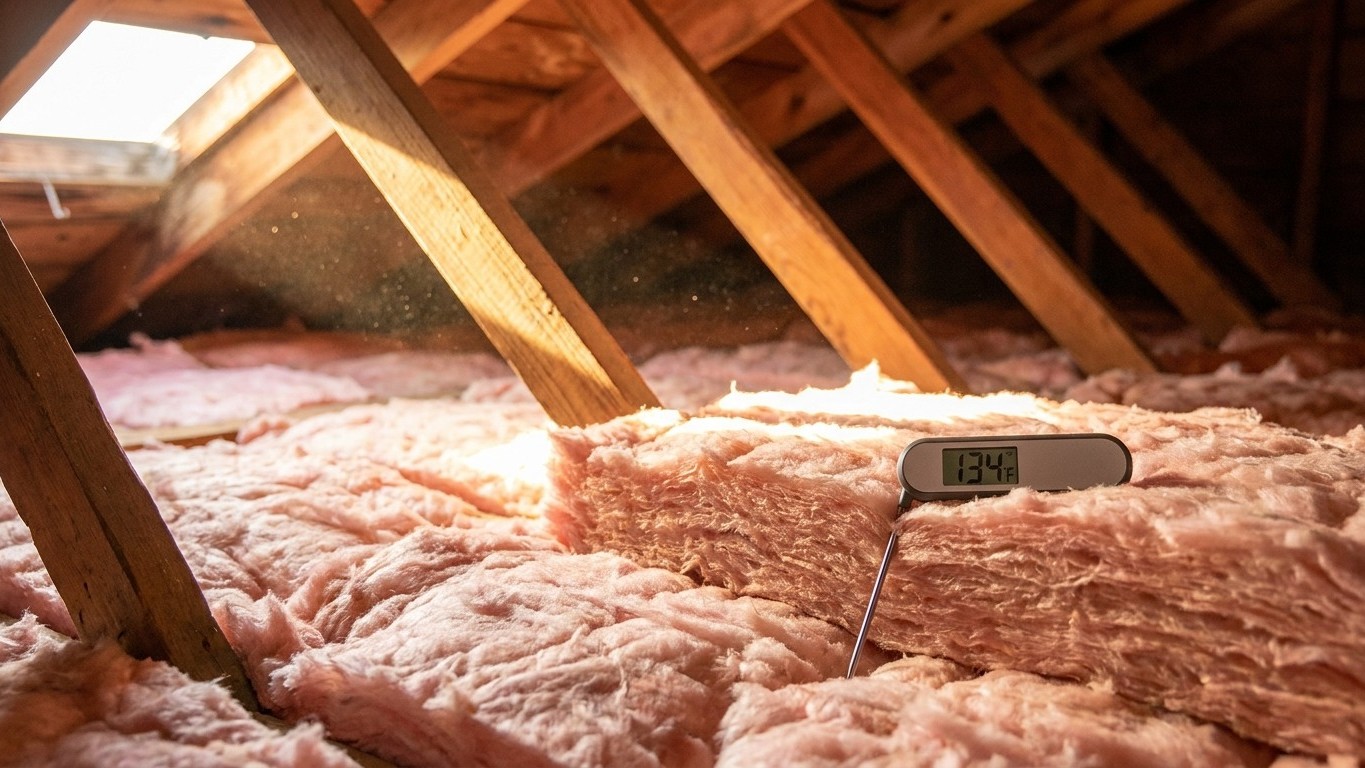
An attic under a sun-loaded roof deck does not sit at outdoor air temperature. It runs hotter, often much hotter, because a dark shingled roof absorbs solar radiation all afternoon and re-radiates it into the space below. Everything under that roof deck, the ceiling drywall, any ductwork routed through the attic, boxes of stored belongings, sits inside that superheated pocket of air. In a Minnesota summer, that pocket forms on fewer days than it would in Texas, but it still forms.
Attic insulation is the layer standing between that heat and the living space below. It is worth being clear about what that layer actually does: it is not a “winter product” that happens to have a side benefit in summer. It is a resistance to heat flow, full stop, and heat flow simply reverses direction with the seasons. In January the flow is upward, warm indoor air pushing toward the cold attic. In July the flow is downward, hot attic air pushing toward the cooled rooms below. The same fiberglass or cellulose does the same job in both directions.
ENERGY STAR publishes retrofit insulation levels for existing wood-framed homes, sorted by climate zone, and the table applies directly to Minnesota’s three zones. The source table has three figures per zone: attic insulation if the attic is currently uninsulated, attic insulation if the attic already has 3 to 4 inches in place, and a separate figure for the floor over unheated spaces.
| Zone | Attic if uninsulated | Attic if already 3-4 inches | Floor |
|---|---|---|---|
| Zones 6, 5 and 4C | R60 | R49 | R30 |
| Zones 7 and 8 | R60 | R49 | R38 |
The first row applies to zones 6 and 5, which covers Minnesota’s 61 zone 6A counties and 3 zone 5A counties. The second row applies to zone 7, covering the state’s 23 zone 7 counties. These are retrofit targets for existing homes, not new-construction code minimums, and ENERGY STAR does not publish a county-level list. A homeowner who wants to know which zone applies to a specific county should check the ENERGY STAR map rather than guess from a county count. What matters for this article’s purpose is simpler: whichever row applies, that same attic insulation is the one upgrade on the list that serves both the coldest night of the year and the hottest afternoon.
What homes in Minnesota cool with
Nationally, air-conditioning equipment of some kind shows up in 94% of U.S. homes surveyed, and 68% run a central air-conditioning system, according to the U.S. Energy Information Administration’s Residential Energy Consumption Survey. The remaining 29% rely on individual equipment: a ductless mini-split, a window or wall unit, or a portable unit. Ceiling fans turn up in 73% of homes. These figures are household survey shares, not counts of houses standing, and they describe the country as a whole rather than Minnesota specifically, since the state-level breakout in that same survey table is where a reader would look for a Minnesota figure.
The connection to insulation is worth making honestly rather than glossing over. In homes where the central air system routes ductwork through the attic, those ducts sit in the single hottest space in the building on a 90-degree day. Ceiling insulation, no matter how thick, does nothing to protect that ductwork once air is moving through it. Sealing and insulating the ducts themselves is a separate job with its own payoff, and it matters more in a hot attic than almost anywhere else in the house.
Where cooling comes from a window unit, a wall unit, or a mini-split instead, the calculation shifts. There is no attic run to worry about, but the room’s own envelope, its walls, its window, its exterior door if there is one, becomes the whole story for how hard that single unit has to work. A well-insulated room holds cool air longer between cycles; a poorly insulated one forces the unit to run near constantly on a hot afternoon.
For homes with ductwork in unconditioned space, this site’s duct insulation guides go into the sealing and insulating work in more detail. For homes cooling with window units or mini-splits, the room air conditioner guides cover what actually helps a single unit perform.
What the heat asks for that the cold does not
Two tools belong specifically to hot-climate homes, and neither one fits Minnesota’s short, mild cooling season particularly well.
A radiant barrier is not insulation. It carries no R-value, and instead of resisting conducted heat the way fiberglass or cellulose does, it reflects radiant heat before it ever reaches the attic floor. That makes it a genuine asset under a sun-loaded roof deck in a climate where the attic bakes for months on end. Minnesota, with 10.6 days a year above 90°F and insulation levels already set high for the cold, is not that climate. A radiant barrier is not the tool this state’s homes are asking for, and adding one here would be solving a problem the climate barely presents.
The second point concerns moisture, and it runs in the opposite direction of the radiant barrier point. In hot, humid climates, water vapor in summer moves from the humid outdoor air toward the cooled indoor air, which is why the model energy code does not require an interior vapor retarder in the country’s warmest zones; putting one on the inside wall would trap moisture in the wrong place. Minnesota’s zones are cold, not warm-humid, so that summer-reversal logic does not describe this state’s vapor situation the way it would describe a Gulf Coast home. Getting vapor barrier placement right in a cold climate like Minnesota’s is its own subject, with its own rules about which side of the wall assembly the retarder belongs on. That question deserves its own answer rather than a partial one folded into a page about summer heat, so it is worth checking this territory’s vapor barrier page directly rather than treating the hot-climate rule as if it applied here.
What the work is worth
ENERGY STAR’s published estimate is direct: “EPA estimates that homeowners can save an average of 15% on heating and cooling costs (or an average of 11% on total energy costs) by air sealing their homes and adding insulation in attics, floors over crawl spaces, and accessible basement rim joists.”
Both numbers matter, and so does keeping them attached to what they measure. The 15% figure is a share of combined heating and cooling costs together, not cooling costs alone. The 11% figure is a share of total household energy costs, a broader number that includes everything from water heating to appliances. Neither number is a cooling-only figure, and that is exactly the point for a state like Minnesota: the saving is not something that happens mostly in winter and merely carries over into summer as an afterthought. It is a combined-season figure from the start, which fits a climate where the work of insulating pays off across both a long cold season and a brief hot one.
This is an average drawn from energy modeling of a typical existing U.S. home, not a guarantee for any specific house. A century-old farmhouse with an unsealed attic hatch and no floor insulation over a crawl space will likely see more benefit from this work than a home built to a modern energy code already meeting most of these targets. The estimate also names precisely where this modeled work happened: attics, floors over crawl spaces, and accessible basement rim joists. It says nothing about walls, windows, or doors, and stretching the figure to cover those upgrades would be reading more into the number than ENERGY STAR published.
No price tag and no payback timeline come attached to that estimate, and none should be invented here. What the figure offers instead is a reason to think of attic and floor insulation as a single project addressing both ends of Minnesota’s weather, rather than two separate seasonal chores.