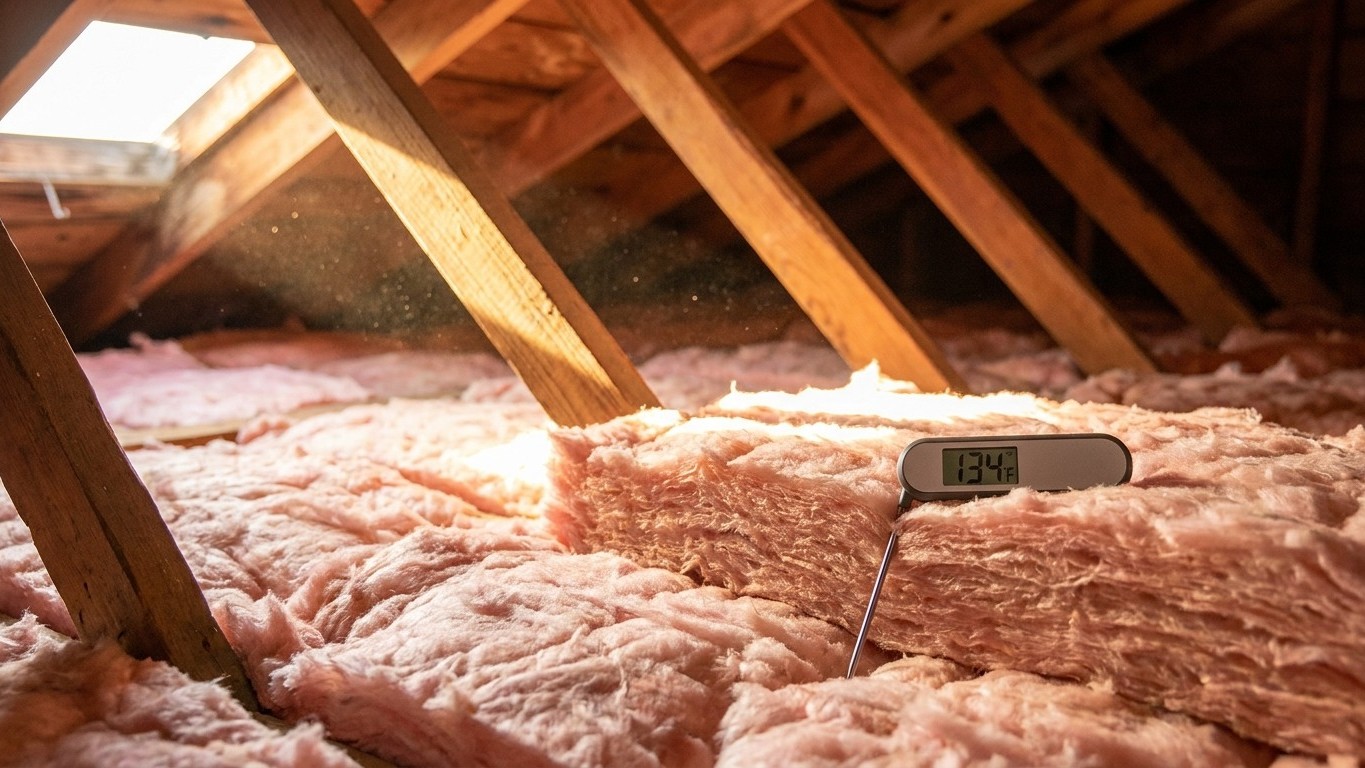

Yes, insulation resists summer heat in Nova Scotia the same way it resists winter cold, but the province’s climate barely tests that side of the ledger. Halifax Stanfield averages zero days a year above 90 F, and the region sits in a cold-dominated climate zone built around heating degree days. Insulation still matters here. It’s just not the season that decides whether the work pays off.
The short answer for Nova Scotia

Start with the number that actually describes a Nova Scotia summer: 0.0 days a year above 90 F at the Halifax Stanfield reference station, based on the 1981-2010 Canadian Climate Normals from Environment and Climate Change Canada. That is not a rounding artifact. It means the kind of extreme heat load that drives attic temperatures into the 150s and pushes air conditioners to their limit almost never shows up here in a typical year.
Halifax Stanfield also logs about 4,263 heating degree days below 18 C, which places it in Natural Resources Canada’s climate zone 6 out of the eight-zone national scale that runs from Zone 4 (under 3,000 HDD) up to Zone 8 (over 7,000 HDD). Zone 6 sits on the colder half of that scale. The whole system that Canada uses to size insulation is built around how much heat a house loses over a long winter, not how much it gains on a hot afternoon.
That framing matters because the honest answer to whether insulation keeps a Nova Scotia home cool is not the same enthusiastic yes you’d give a house in Phoenix or Charleston. Here, summer is short and mild enough that cooling rarely dominates a household’s energy bill. Insulation still slows heat gain in July the same way it slows heat loss in January. But the return on that work shows up mostly on the heating side of the year, because that’s where Nova Scotia spends most of its energy dollars fighting the outdoor temperature. A homeowner weighing an attic top-up should think of summer comfort as a welcome side effect, not the main reason to do the job.
None of that means insulation is irrelevant to summer comfort. A well-insulated ceiling still keeps upstairs bedrooms noticeably more livable during the handful of genuinely warm days the region does get, even without hitting the 90 F mark. It just means the case for insulation in Nova Scotia is built on the long cold season first, with modest summer benefits riding along.
What happens above the ceiling
Even in a climate with almost no 90-degree days, an attic under a dark asphalt shingle roof can still run 40 or 50 degrees hotter than the outdoor air on a sunny afternoon. That heat doesn’t stay in the attic. It radiates and conducts downward through the ceiling drywall, warms whatever is stored up there, and raises the surface temperature of any ductwork or wiring running through the space. On the handful of warm days Nova Scotia does get each summer, an under-insulated ceiling is the reason the upstairs feels ten degrees hotter than the living room below.
The useful point is that the insulation doing that job is not a separate summer product. It’s the same fiberglass, cellulose, or spray foam sitting between the joists all year, and it works by resisting heat flow in whichever direction that flow is moving. In January, the warm air is inside and trying to escape upward. In July, the sun-loaded roof deck reverses the flow, and the same material resists heat trying to push down into the house. One installation, two seasons of benefit.
Natural Resources Canada publishes recommended minimum insulation levels by climate zone in its Keeping the Heat In guide. For zone 6, the station that covers Halifax, those recommended minimums are:
| Building component | Recommended RSI | Recommended R-value |
|---|---|---|
| Walls | RSI 4.8 | R 27 |
| Basement walls | RSI 4.2 | R 24 |
| Roof or ceiling | RSI 10.6 | R 60 |
| Floor over unheated spaces | RSI 7.1 | R 40 |
Those figures are nominal insulating values and recommended minimums, not a code requirement. Provincial and municipal building codes can and do ask for more, so a homeowner should confirm current local requirements before buying material. It’s also worth remembering these numbers apply to the zone around the Halifax Stanfield station specifically. A property farther inland or at higher elevation elsewhere in the province could sit in a colder zone with its own, higher recommended values, so checking the degree-days for a specific municipality is worth the five minutes it takes.
What homes in Nova Scotia cool with
Air conditioning is far from universal here. Statistics Canada’s Canadian Social Survey found that 58.9% of households in the Atlantic region report having air conditioning, compared with 68.3% across Canada as a whole. That figure covers the whole Atlantic region as one block, not Nova Scotia specifically, and a share of households isn’t the same as a measure of need. A modest rate can reflect a naturally mild summer, an older housing stock, or both, and the survey doesn’t separate those explanations.
| Region | Households with air conditioning |
|---|---|
| Atlantic region | 58.9% |
| Canada (national) | 68.3% |
Where a home does have central air, the connection to attic insulation depends entirely on where the ductwork runs. In houses where the supply and return ducts travel through an unconditioned attic, those ducts sit inside the hottest space in the entire building envelope during a sunny afternoon, and ceiling insulation does nothing to protect them. Sealing and insulating the ducts themselves is a separate job, and it’s often the bigger source of cooling loss in a home like that. Readers dealing with attic ductwork should look at a dedicated duct insulation guide rather than assuming ceiling work covers it.
Where cooling comes from a window unit or a ductless mini-split instead, there’s no attic ductwork to worry about, and the room’s own walls, windows, and ceiling become the whole story. In that case, the insulation and air-sealing quality of that one room does most of the work of keeping the unit’s output where it belongs. A room air conditioner guide covers sizing and placement for that setup in more detail than fits here.
What the heat asks for that the cold does not
Two products belong specifically to hot-climate construction, and neither one fits a Nova Scotia house well.
A radiant barrier, typically a reflective foil layer installed under the roof deck, works by reflecting radiant heat rather than resisting conducted heat the way insulation does. It carries no R-value at all and isn’t insulation in any technical sense. Its entire case rests on a sun-loaded roof driving serious heat into the attic, the kind of load that shows up in climates with long runs of 90-plus-degree days. With zero such days a year at the Halifax reference station, that scenario essentially doesn’t arise here. A radiant barrier isn’t the tool for a Nova Scotia attic, whatever a supplier in a warmer market might suggest.
Vapour behavior is the second piece, and it runs backwards depending on climate. In a warm, humid climate, the outdoor air carries more moisture than the indoor air, so vapour tends to push from outside toward inside during the cooling season, which is one reason the model building code doesn’t require an interior vapour retarder in the warmest zones. Nova Scotia’s situation is the opposite of that warm-climate case: cold, heating-dominated winters push moisture from the warm interior toward the cold exterior for most of the year, which is the scenario an interior vapour barrier is built to handle. Getting the placement and materials right for this specific climate zone is enough of a separate topic that it deserves its own answer rather than a side note here. Check the vapour barrier guide for Nova Scotia before assuming either warm-climate rule applies.
What the work is worth
The U.S. Environmental Protection Agency’s ENERGY STAR program puts a number on the combined benefit of air sealing and insulation work: “EPA estimates that homeowners can save an average of 15% on heating and cooling costs (or an average of 11% on total energy costs) by air sealing their homes and adding insulation in attics, floors over crawl spaces, and accessible basement rim joists.”
The two percentages measure different things and shouldn’t be mixed. The 15% figure is a share of heating and cooling costs specifically, while the 11% figure is a share of total energy costs, the broader number that includes appliances, water heating, and everything else on the utility bill. Reading either figure without its denominator turns an accurate estimate into a misleading one.
That the estimate covers heating and cooling together, not heating alone, is exactly why this matters for a Nova Scotia homeowner. Even in a climate where cooling degree days are a rounding error next to heating degree days, the same air sealing and attic insulation work that cuts the winter heating bill is modeled as delivering part of that 15% figure on the cooling side too. It isn’t a separate summer program bolted onto a winter one. It’s one job that gets counted both ways in the same modelled average.
Two caveats keep that number honest. First, it’s an average drawn from energy modelling of a typical existing U.S. home, not a guarantee for any specific house, and a home in Nova Scotia’s climate and housing stock won’t necessarily land on that exact figure. Second, the estimate names precisely where the work was modelled: attics, floors over crawl spaces, and accessible basement rim joists. It doesn’t extend to wall insulation, window replacement, or door upgrades, and stretching the figure to cover those would misquote the source.