
British Columbia’s corn growers deal mainly with corn earworm, cutworms and armyworms, wireworms, flea beetles, aphids, spider mites, slugs, grasshoppers, western spotted cucumber beetle, and brown marmorated stink bug. Each shows up on a different stretch of the growing season, timed to the crop’s own clock rather than to a calendar month, and tied to a frost-free window that runs from a mean last frost around March 18 to a mean first frost around November 10.
Which pests attack corn in British Columbia

The documented list for this territory, drawn from University of Idaho Extension and WSU Extension, includes: Aphids, Brown marmorated stink bug, Cabbage maggot, Carrot rust fly, Colorado potato beetle, Corn earworm and earwigs, Cutworms, Cutworms and armyworms, Flea beetles, Grasshoppers, Imported cabbageworm, Imported cabbageworm and loopers, Onion maggot, Onion maggot and onion thrips, Pea leaf weevil, Slugs, Spider mites, Squash bug, Tomato hornworm, Western spotted cucumber beetle, and Wireworms.
That is a long list, but most of it has nothing to do with a corn patch. Cabbage maggot larvae feed on brassica roots, not grass-family stalks. Carrot rust fly targets carrots and other umbellifers. Colorado potato beetle chews potato and nightshade foliage. Imported cabbageworm and its cousin the cabbage looper skeletonize cabbage-family leaves. Onion maggot and onion thrips work onion bulbs and leaves. Pea leaf weevil notches pea and lentil seedlings. Squash bug and tomato hornworm belong to cucurbits and tomatoes, respectively. None of these seven or eight entries have a documented reason to touch a corn plant, and a reader who spots imported cabbageworm damage on corn leaves is very likely looking at something else.
What is left is the real corn list: aphids, brown marmorated stink bug, corn earworm and earwigs, cutworms, cutworms and armyworms, flea beetles, grasshoppers, slugs, spider mites, western spotted cucumber beetle, and wireworms. Wireworms and cutworms hit before a seedling has any chance to establish. Flea beetles and slugs work on tender young leaves. Corn earworm arrives once ears have formed silks. Aphids, spider mites, and brown marmorated stink bug tend to build through summer, and grasshoppers and cucumber beetles show up whenever conditions favor them locally. The decisive detail is timing, not the length of this list — a corn stand faces a different threat depending on whether it is two weeks out of the ground or three weeks past silking.
When each one shows up, and what it does first
Corn timing in British Columbia starts with soil, not air. Sweet corn needs soil above 60 F before seed goes in the ground, and that threshold is reached well after the mean last spring frost of March 18 at the Vancouver Int’l A station, not on that date itself. From there the crop needs 60 to 90 days to mature, and that stretch has to close out before the mean first fall frost of November 10 — a workable window in most of the province’s southern valleys, tighter anywhere colder or higher.
Wireworms and cutworms are the first threat, active before and right at planting, feeding underground or clipping stems at soil level so that a seedling that looked fine yesterday is lying flat today. Flea beetles follow within the first couple of weeks after emergence, leaving small, rounded shot-holes across young leaves. Slugs work the same early window, especially after wet spells, and leave ragged holes with a slime trail as the giveaway rather than a clean edge.
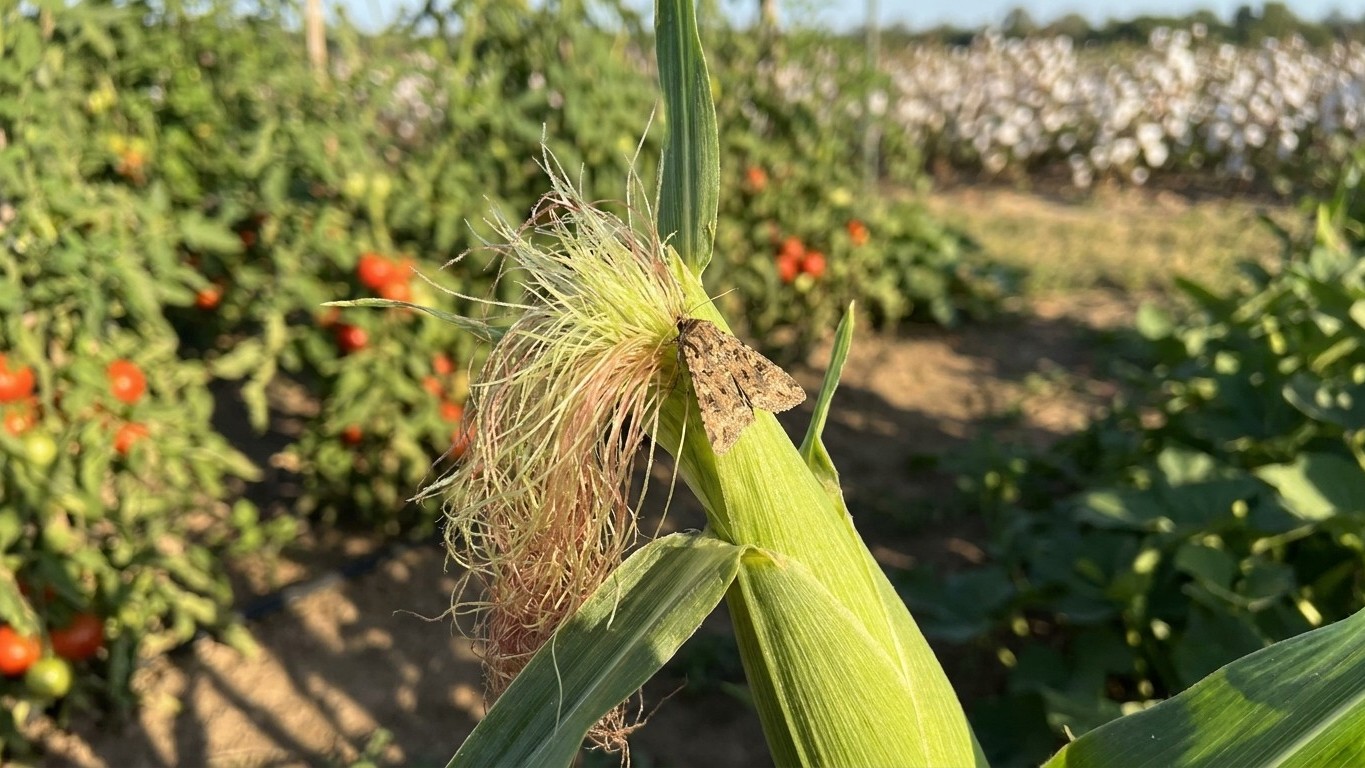
As plants get taller and put on more leaf, aphids cluster on the undersides of leaves and around developing tassels, and spider mites show up on the same tissue during warm, dry stretches, stippling leaves with fine pale dots. Grasshoppers and the western spotted cucumber beetle feed on foliage and silks through mid-season, more of a problem in years or spots with dry, weedy margins nearby. Brown marmorated stink bug punctures kernels and can show up any time ears are developing. Corn earworm is a late-season arrival, laying eggs on fresh silk and then tunneling down into the ear tip, which is the single most recognizable sign of this pest: chewed kernels at the tip, with frass and sometimes the caterpillar itself still inside.
Telling the damage apart from Everything else
Not every ragged leaf or stunted stalk is a pest. Corn is picky about water and nitrogen, and a garden that looks “attacked” is often just short on one or the other. The single most useful habit is checking the base of the plant and the soil line before assuming an insect is at work, because that is where mechanical damage and cutworm damage look almost identical from a distance.
| Symptom | Likely insect cause | Likely non-insect cause | What tells them apart |
|---|---|---|---|
| Seedling cut off at soil line | Cutworms | Hail, foot traffic, hoe damage | Cutworms leave a clean, angled cut and often curl nearby just under the soil |
| Small round holes in young leaves | Flea beetles | Wind-whipped leaf tearing | Flea beetle holes are numerous, round, and scattered; tearing follows leaf veins |
| Pale, stippled leaves | Spider mites | Nitrogen deficiency, drought stress | Mites leave fine webbing on the underside; deficiency yellows evenly along the leaf |
| Chewed ear tip with frass | Corn earworm | Poor pollination (blank kernels) | Poor pollination leaves gaps but no chewing or waste material |
| Ragged holes with slime trail | Slugs | Physical bruising from equipment | Slime trail, usually worse after rain or overnight watering |
A stalk that leans without a clean break, leaves that yellow from the tip inward, or ears that fill unevenly are more often about water, soil fertility, or an off week of pollination than about a bite mark. When the cause genuinely isn’t clear from these signs, that’s the moment to bring a sample, not a guess, to a local expert rather than treating for an insect that may not be there.
What actually works here, and what is a waste of time
On a season this short, timing beats treatment. Wireworms and cutworms are easiest to manage before planting, by turning soil early and removing sod or grassy residue where larvae overwinter, spraying after damage is already visible does nothing for the plants already cut down. Flea beetles and slugs are held off with a physical barrier such as row cover put down right at emergence and removed once plants have enough leaf to outgrow the pressure, since a barrier applied a week late does very little compared to one in place from day one.
For corn earworm, the practical move is watching silks daily once they appear and acting the moment eggs or damage show up, because once the caterpillar has tunneled into the ear tip nothing reaches it. Isolating sweet corn plantings so that su, se, and sh2 types don’t tassel at the same time protects flavor, not pest pressure, but it’s worth doing in the same window: keep plantings in blocks of three or more rows for good pollination, and stagger sweet types by timing rather than distance, since no isolation distance is published for this.
What doesn’t work is spraying on a fixed schedule regardless of what’s actually present, since it burns time and money on pests that were never there while doing nothing for the ones that are. Broad, repeated treatments against aphids or mites also tend to knock back the predators that would otherwise keep both in check, which can make a mild problem worse by mid-season. Any decision about which product, if any, is appropriate and legal to use belongs with the local extension service, not with a general guide.
Where to check this for your own county
British Columbia doesn’t run a single provincial extension office the way a US state does. The pest documentation behind this page comes from University of Idaho Extension and WSU Extension, whose growing conditions in the interior valleys and Pacific Northwest lowlands are close enough to southern BC to be a useful reference, not a substitute for local confirmation.
What’s documented at that scale doesn’t say what’s in one particular garden. Pest pressure shifts from the Okanagan to the Fraser Valley to Vancouver Island, and even within a single regional district it can differ from one side of a valley to the other depending on wind, soil, and what’s growing nearby. The one number worth remembering before planting is the 60 to 90 day maturity window, since it decides whether a late variety even has time to finish before the mean November 10 frost in a given spot.
The next move is a local one: contact the provincial Ministry of Agriculture and Food’s regional office, or a nearby university extension agent if closer to the border, and describe the symptom along with when it appeared relative to planting. Bringing a photo or a sample of the actual damage gets a far more useful answer than a pest name pulled from a general list.
Common questions
What is the most common early-season corn pest in British Columbia?
Wireworms and cutworms cause the most damage right at and after planting, since they attack seed and seedlings underground or at the soil line before a plant has any chance to establish.
When does corn earworm show up on BC corn?
It arrives once ears have formed fresh silk, laying eggs there before the larvae tunnel down into the ear tip, which is a late-season problem rather than an early one.
Do I need to worry about tomato hornworm or squash bug in my corn?
No. Neither is documented as a corn pest for this territory; tomato hornworm feeds on tomato and related nightshade foliage, and squash bug works cucurbit vines, so damage that looks similar on corn has another cause.
Why does soil temperature matter more than the frost date for planting?
Sweet corn seed needs soil above 60 F to germinate reliably, and that point is reached well after the mean last frost of March 18, so using the frost date alone as a planting cue risks seed rotting in cold, wet soil.