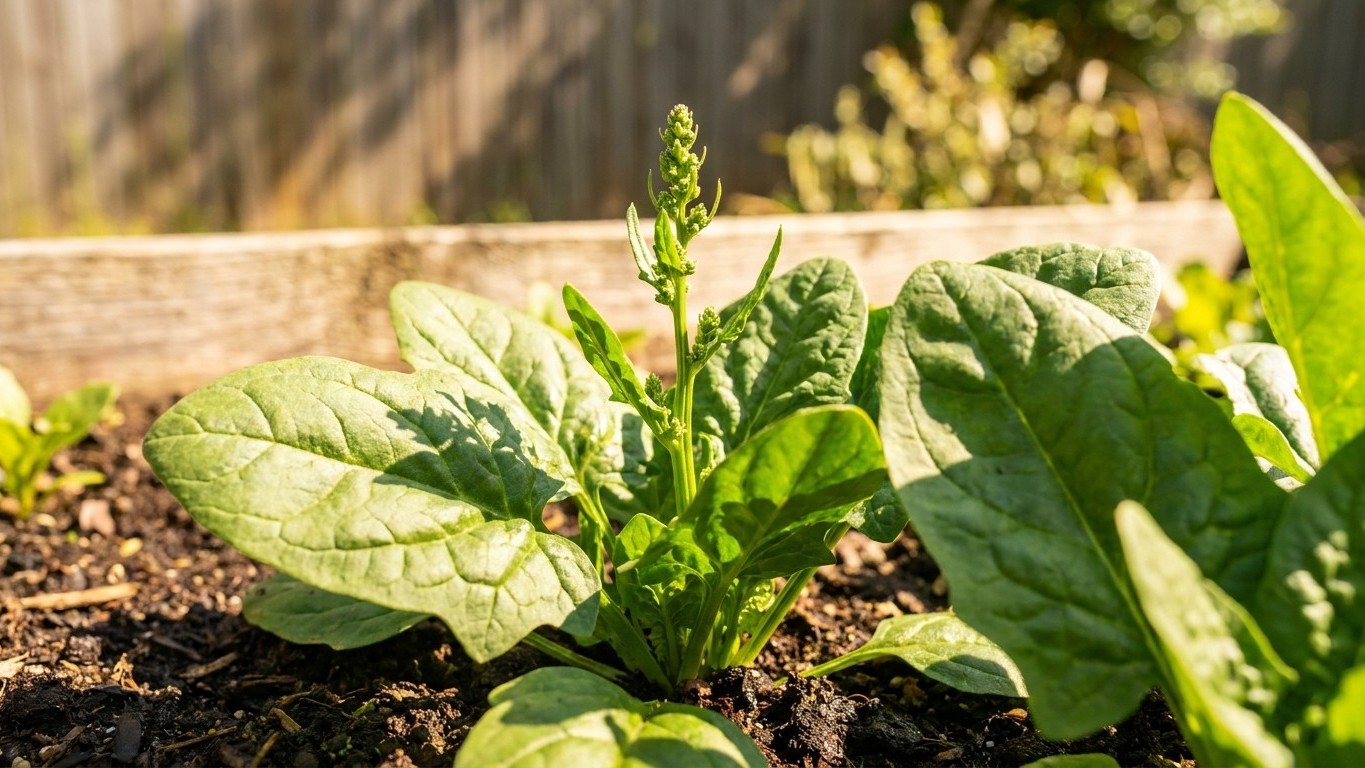

Spinach in British Columbia mostly answers to six pests: aphids, cutworms and armyworms, flea beetles, slugs, spider mites, and grasshoppers. None of them are unique to spinach, and none show up on a fixed date. What actually decides the timing is the region’s frost-free window and the point where long summer days push the crop toward bolting rather than growth.
Which pests attack spinach in British Columbia

University of Idaho Extension and WSU Extension document a long list of vegetable-garden pests across this Pacific Northwest climate zone, the closest formal reference available for the growing conditions found in coastal British Columbia. The full list includes aphids, brown marmorated stink bug, cabbage maggot, carrot rust fly, Colorado potato beetle, corn earworm and earwigs, cutworms, cutworms and armyworms, flea beetles, grasshoppers, imported cabbageworm, imported cabbageworm and loopers, onion maggot, onion maggot and onion thrips, pea leaf weevil, slugs, spider mites, squash bug, tomato hornworm, western spotted cucumber beetle, and wireworms. That is a garden-wide inventory, not a spinach-specific one, and most of those names have no business on a spinach bed.
Cabbage maggot targets the roots of cabbage-family crops, not spinach. Carrot rust fly is a carrot-family specialist. Colorado potato beetle feeds on potato foliage almost exclusively. Corn earworm damages corn ears, and earwigs travel with it in the same documentation without being spinach feeders. Imported cabbageworm and loopers chew cabbage-family leaves. Onion maggot and onion thrips stay with the onion family. Pea leaf weevil is a legume pest. Squash bug and western spotted cucumber beetle both work cucurbits. Tomato hornworm is a tomato-family caterpillar. Wireworms feed on roots and tubers underground, mostly in potato and root-vegetable plots, not on leafy greens above ground. Brown marmorated stink bug favors fruiting crops and orchard fruit over leaf crops.
What’s left after that sorting is a short list, and it stays short because a leaf crop with no fruit and no bulb simply offers less to most of the specialists on the extension inventory. Aphids, cutworms and armyworms, flea beetles, slugs, spider mites, and grasshoppers are the ones with a real reason to visit a spinach row: they either chew soft leaf tissue, sever seedlings at the base, or feed on plant sap, and spinach offers plenty of all three early in its short life. The University of Idaho Extension and WSU Extension documentation does not go further than this for a Pacific Northwest garden, and there is no reason to pad the list with anything beyond what those two services actually record.
When each one shows up, and what it does first
Coastal British Columbia’s frost-free window runs, on average, from March 18 to November 10, based on the 1981-2010 normals from the Vancouver Int’l A station. That is a mean, not a guarantee: in half the years on record, frost has arrived later than either of those dates, so treat the window as a midpoint rather than a safe boundary. Spinach usually goes into the ground close to that spring date, since it tolerates cool soil far better than heat, and this is exactly the stretch when the earliest pest pressure builds.
Slugs are typically the first sign of trouble, showing up within days of germination while the soil is still cool and wet from the spring rains. The damage looks like ragged, irregular holes in the youngest leaves, often with a silvery slime trail nearby, worse after rain or overnight watering. Cutworms follow close behind, working at night to sever whole seedlings right at the soil line before the plant has a real root system to recover from it; a bed that looked fine the evening before and shows missing seedlings by morning points here first.
Flea beetles arrive as the soil starts to warm, leaving small round shot-holes across the leaf surface, and they’re most active during dry, sunny stretches. Aphids build up a bit later, clustering on the undersides of leaves and along stems as the season warms toward spinach’s own upper comfort range, causing curled or distorted new growth. Spider mites tend to appear during the driest, warmest spells the coast sees, leaving fine stippling and sometimes faint webbing on stressed plants. Grasshoppers are the latest arrivals of the group, showing up as populations build through summer and chewing ragged notches along leaf edges rather than the fine holes typical of the earlier pests.
Telling the damage apart from Everything else
Spinach runs into trouble that has nothing to do with insects far more often than gardeners expect, and mixing the two up leads to spraying a plant that was never being eaten. The single most common false alarm on this crop is bolting, which happens because spinach flowers under long days and warm temperatures together, and grows best only where temperatures stay below 75°F. A bolting plant sends up a tall central stem, its leaves narrow and turn pale or bitter, and there is no hole, no chewed edge, and no slime trail anywhere on it. That is a response to day length and heat, not to feeding, and no barrier or spray changes it.
Nutrient deficiency is the second common mix-up, usually showing as a uniform yellowing that spreads evenly across older leaves rather than the patchy, torn look that feeding leaves behind. Drought stress produces wilting even when the surface soil looks moist, since spinach roots sit shallow and dry out fast in a warm spell. Mechanical damage, from wind, hail, or a foot in the wrong place, tends to follow the pattern of exposure across the bed rather than concentrating on the youngest, most tender leaves the way slugs and aphids do.
| Symptom | Likely cause | What sets it apart |
|---|---|---|
| Ragged holes, slime trail | Slugs | Trail visible, worse after rain or overnight watering |
| Seedling severed at soil line | Cutworms and armyworms | Curled larva often found in soil near the cut plant |
| Tiny round shot-holes | Flea beetles | Beetles jump when the plant is disturbed |
| Curled leaves, sticky residue | Aphids | Clusters visible on leaf undersides |
| Fine stippling, faint webbing | Spider mites | Confirmed with a hand lens in dry, warm weather |
| Tall stem, pale narrow leaves | Bolting | No holes or chew marks anywhere on the plant |
| Even yellowing, older leaves first | Nutrient deficiency | No feeding marks, spreads uniformly |
None of this replaces a look from someone trained to identify it. If a symptom doesn’t clearly match one row of that table, that’s a job for the local extension office, not a guess made from a photo online.
What actually works here, and what is a waste of time
A physical barrier put down at seeding, before any pest has found the bed, does more than any treatment applied after the damage shows. Floating row cover laid over the row right after sowing keeps flea beetles and early aphid flights off the crop through its most vulnerable weeks, and it costs nothing in pest identification since it works whether the culprit turns out to be a beetle or a mite. For slugs and cutworms, keeping the bed clear of the damp mulch and plant debris they hide under during the day removes shelter faster than almost anything else, and handpicking cutworms out of the soil near a freshly clipped seedling is still one of the most reliable controls there is for that particular pest.
Waiting until damage is visible before doing anything is the most common mistake, because by the time holes or missing seedlings show up, the generation responsible has often already finished feeding for that cycle. Spraying broadly without confirming which pest is actually present wastes effort and risks killing off the aphid predators that would otherwise keep populations down on their own. And no treatment, physical or otherwise, will stop bolting once long days and heat set it off, since that isn’t a pest response at all.
For a fall planting, germination drops once soil temperature passes 80°F, so the window opens as the soil cools rather than on a fixed date, and the crop should go in roughly 50 to 75 days before the target harvest. University of Idaho Extension and WSU Extension name four spinach varieties commonly grown in this region, Bloomsdale, Melody, Teton, and Olympia, but neither service publishes days-to-maturity or performance data for any of them, so there’s no verified figure to lean on beyond the planting window itself. Choosing which one to grow comes down to what’s locally available, not a published comparison.
Where to check this for your own county
Pest presence documented at the state or provincial level never guarantees what’s actually in a specific garden. University of Idaho Extension and WSU Extension remain the closest formally documented sources for this shared Pacific Northwest growing region, even though a British Columbia garden sits across the border from both. A slug problem two properties over says nothing about a bed with better drainage, and a flea beetle outbreak recorded at a research station miles away doesn’t mean every yard nearby carries the same pressure.
The county extension office attached to either service is the right next call when a symptom doesn’t match anything in a table like the one above, or when a treatment tried in good faith hasn’t worked. They can confirm an identification from a sample or a clear photo, and they know which control options are actually registered for use in a home garden, which this article deliberately does not list. That’s not a gap in the information here, it’s a deliberate line: pesticide registration changes by jurisdiction and by year, and only the office covering a specific county or region has the current answer.
The next useful step for a gardener facing a damaged spinach bed right now is not another search, it’s a sample bagged and taken to that office before the next watering washes away the evidence.
Common questions
Does row cover need to come off once spinach starts growing?
It can stay on for most of the crop’s life since spinach doesn’t need pollinators, and leaving it on continues to block aphids and flea beetles through the whole harvest window.
Can slug damage happen even in a raised bed?
Yes. Slugs travel readily into raised beds, especially when the surrounding soil stays damp from spring rain, and height alone doesn’t stop them the way it can with some crawling insects.
Is bolted spinach still safe to eat?
It’s not unsafe, but the leaves usually turn bitter and tougher once the plant bolts, since that shift is tied to the same heat and day-length trigger that causes flowering.
Why do extension sources from Idaho and Washington apply to a British Columbia garden?
Because no closer province-specific documentation exists for this exact list, and the growing conditions along this stretch of the Pacific coast are close enough that the same pests and the same general timing apply.