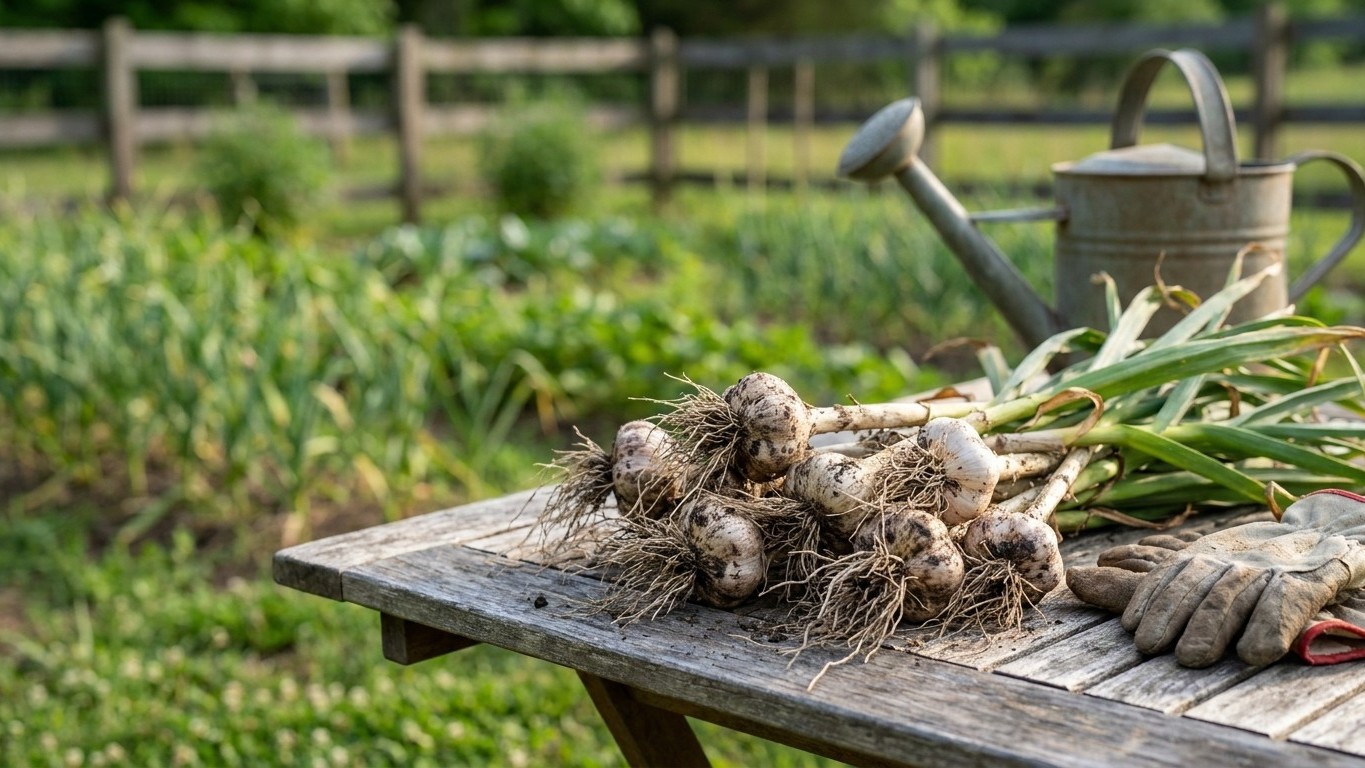

Garlic planted the previous autumn is ready to lift once the lower third to half of its leaves have turned brown and dried, typically in late June to early July in Kentucky, though the exact week shifts with the season. Waiting for the whole plant to collapse risks split bulbs and loose wrappers, which cuts storage life short. The plant tells you when it’s ready. The state’s climate mostly shapes how that timeline got set up the previous fall.
When garlic is ready to lift in Kentucky
The leaf-count signal
Each leaf on a garlic plant corresponds to a wrapper layer around the bulb below. When roughly half the leaves have browned from the bottom up and the rest are still upright and green, the bulb has usually filled out its cloves and started sealing them under dry protective skins. Pull one test bulb from the row, slice it in half, and look at how distinct the cloves are and how intact the wrappers look. If the cloves are still fused and undersized, give it another week. If the wrappers are already splitting on the bulb in the ground, you’ve waited too long.
Why the fall planting date still matters
Garlic in Kentucky goes into the ground the previous autumn, and how that planting date lined up with the season’s first hard freeze affects how much root and shoot growth the clove managed before winter dormancy. NOAA NCEI’s 1991-2020 Climate Normals put the first fall freeze in the state somewhere between November 2 and November 12, based on 32-degree freeze probabilities. That’s a midpoint, not a safe date. In roughly half of all years, the freeze arrives later than that window, and NWS Louisville has noted that the urban station behind those normals tends to run later in fall than the surrounding rural county, so gardeners outside the city should treat the window as tighter still. A clove planted well ahead of that freeze window has more time to root before cold sets in, which generally translates into a slightly earlier, more even bulb maturity the following summer. A late planting, rushed in right before or after the freeze, can push harvest a week or two later and produce a less uniform crop across the row.
Weather in spring plays a role too. A cool, wet spring slows bulb sizing and can delay the leaf-browning signal by a couple of weeks compared to a warm, dry one. That’s another reason to watch the plant instead of circling a date on the calendar.
Curing it, and where to hang it here
Beating Kentucky’s humidity
Once bulbs are out of the ground, shake off loose soil but don’t wash them and don’t trim the roots or stalks yet. Move them somewhere dark, dry, and out of direct sun, since sunlight after harvest can scald the bulbs right through the outer skins. This is the step where Kentucky’s humid summers cause the most trouble. In a drier climate, garlic can cure hanging loosely in almost any shaded spot. Here, stagnant humid air inside a closed garage, shed, or covered porch invites mold on the outer wrappers before the neck has had a chance to dry down. Space bundles apart rather than piling them, and run a box fan or leave a window cracked for airflow. A ceiling fan on low in a covered porch works well for a lot of growers in the state during the sticky stretch of July.
Knowing when curing is finished
Curing is done when the neck above the bulb is fully dry and no longer squishy, the outer wrappers rustle like paper instead of feeling rubbery, and the roots have gone brittle. That’s the point to trim the roots close to the bulb and cut the stalk down to an inch or two, or braid the stalks together if you’re working with a softneck variety. Bulbs cured indoors in a humid summer sometimes need longer stretches of airflow to reach that point than the same variety would in a drier region, so judge by feel and appearance rather than by a fixed number of days.
Storing it through a Kentucky winter
Where in the house it actually holds
Cured garlic keeps best somewhere cool, dark, dry, and ventilated, in mesh bags, open baskets, or braided bundles rather than sealed plastic. A refrigerator isn’t the right spot for whole bulbs meant for eating over the winter, since the cold and moisture in there tend to trigger early sprouting. Kentucky basements can be a mixed bag for this purpose. Many run cooler than the rest of the house, which is a plus, but they also pick up humidity from summer storms and can stay damp well into fall, which invites mold on stored bulbs before winter even sets in properly. A spare closet, an unheated back room, or a pantry shelf away from the stove and dishwasher often works better than a basement corner unless that basement is unusually dry.
Hardneck versus softneck differences
Hardneck varieties, more common among home growers in the state because they tolerate cold winters well, tend to hold up for a shorter stretch in storage than softneck types. Softnecks generally store longer before cloves start softening or sprouting. Either way, set aside your largest, healthiest bulbs at harvest to replant that following fall rather than digging into your seed stock partway through winter when the kitchen supply runs low.
Check stored bulbs every few weeks through winter. One soft or moldy bulb left in a basket can spread trouble to its neighbors faster than you’d expect, so pull anything questionable as soon as you spot it.
What goes wrong here
The most common misstep is timing at both ends: pulling bulbs too early leaves loose, immature wrappers that won’t protect the cloves in storage, while leaving them too long lets bulbs split open underground, exposing cloves to soil moisture and rot organisms before curing ever starts. Second most common is curing in a closed, humid space, which in Kentucky’s summer climate can turn a healthy harvest moldy within a couple of weeks if there’s no airflow.
On the insect side, University of Kentucky Extension Entomology documents pressure in the state from Japanese beetle, squash bug, squash vine borer, striped cucumber beetle, spotted cucumber beetle, brown marmorated stink bug, bagworm, eastern tent caterpillar (Malacosoma americanum), fall webworm, and azalea lace bug. None of those target bulbing garlic directly, which means the plant’s real risks in this state are almost entirely about harvest timing, humidity during curing, and storage conditions rather than insect damage. If a county-specific pest or disease shows up on garlic that isn’t on that list, it’s worth checking with University of Kentucky Cooperative Extension rather than assuming it’s something documented statewide.
Common questions
Can I harvest garlic before the leaves start browning?
Pulling bulbs while most leaves are still fully green usually means the cloves haven’t finished sizing and the wrappers are too thin to protect them in storage. It’s better to wait for the lower leaves to brown before lifting.
What happens if I miss the harvest window?
Bulbs left in the ground after most of the leaves have died back tend to split their wrappers open, and the individual cloves can separate and start rooting again on their own, which makes them poor keepers even if they still look edible.
Do I need to cure garlic if I’m eating it right away?
Not really. Garlic eaten within a week or two of harvest can be used fresh with just the soil brushed off. Curing only matters if you plan to store bulbs for weeks or months.
How long will Kentucky-grown garlic keep before it starts sprouting?
That depends heavily on variety and storage conditions rather than any fixed number, since softneck types generally outlast hardnecks and a cool dry space always beats a warm humid one. Checking bulbs regularly through winter is a more reliable approach than counting on a set shelf life.