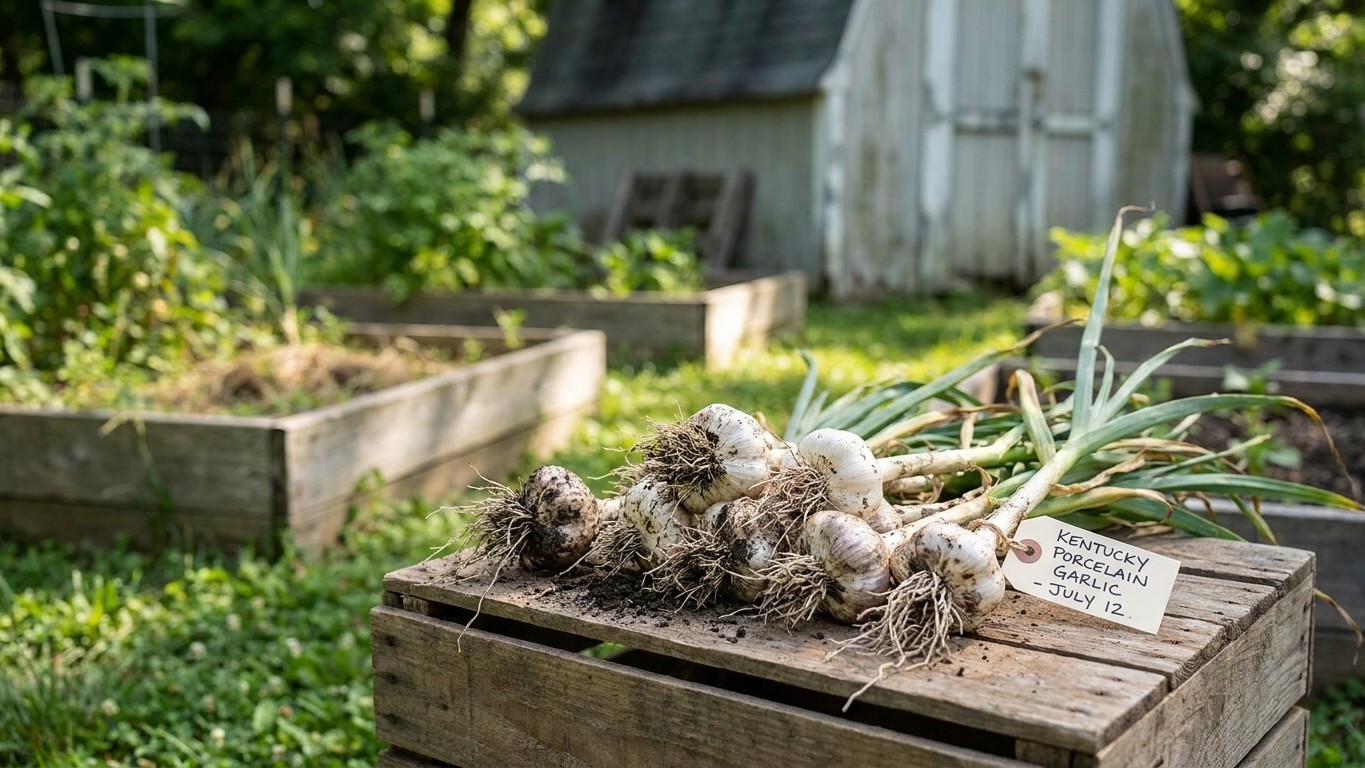

A round, undivided bulb the following July is what tells you the cold didn’t do its job — not too little garlic, just garlic that never split into cloves. Kentucky growers rarely need to worry about that outcome. Fall-planted cloves here sit through November freezes and then months more of sub-40°F soil, well past the six-to-eight-week threshold that triggers division. Most winters clear the bar easily. The exceptions are short, mild ones, or a garden pocket sheltered enough to dodge the cold that the rest of the state gets.
Will garlic get the cold it needs in Kentucky

Garlic planted in fall needs a real run of cold to trigger the clove inside the bulb to split apart. Skip that cold and you lift a single round bulb the next summer instead of a head of cloves. University of Georgia Extension, in publication C854, puts the requirement at six to eight weeks of soil temperatures below 40°F before the plant divides properly.
Kentucky clears that bar without much drama. NOAA’s 1991-2020 climate normals put the first fall freeze near Louisville between November 2 and November 12, and cold weather doesn’t let up after that first freeze. Air temperatures keep sliding through November, December, January and into February most winters, so a clove planted in October has months of sub-40°F weather ahead of it, far more than the six-to-eight-week minimum, which is why timing matters and why checking When to Plant Garlic in Kentucky before you start can save a crop. Kentucky’s winters are cold enough, and long enough, for garlic to split into full cloves in nearly every part of the state.
That holds across the state’s usual range of winters, but not every winter behaves the same way. A short, mild winter, or a garden tucked into an unusually sheltered pocket, can come in under the mark. Compare that to a state like Louisiana, where a real cold snap is the exception rather than the rule and growers there have to plan around its absence (see Growing Garlic in Louisiana: Planting Dates, Varieties and Winter Cold). Kentucky gardeners rarely face that problem, but it helps to know the fallback exists.
The fallback options
If a warm winter does happen, or you’re growing in a protected microclimate that never gets properly cold, you have two real options. Refrigerate the cloves for four to eight weeks before planting, breaking the bulb apart and storing individual cloves in a paper bag in the crisper drawer, which substitutes for the missing field cold. Or plant a softneck type instead of a hardneck. Softneck garlic evolved in milder climates and divides reliably even with a shorter, gentler cold spell, which is why it’s the fallback crop of choice in places that never get a hard freeze at all. Choosing the right cultivar for your conditions matters here, and a look at Garlic Varieties That Suit Kentucky Winters can help narrow down which softneck or hardneck type suits your microclimate best.
When to put the cloves in
Plant garlic by counting backward from the first fall frost, not from a date on a calendar. Cloves need three to four weeks of workable soil to grow roots before winter shuts growth down, but not so much time that the shoot pushes above ground and gets caught by a hard freeze. NOAA’s 1991-2020 climate normals put that first frost near Louisville at a range of roughly November 2 to November 12, and that window is the anchor for the whole state’s schedule, even though the actual date will run earlier or later depending on where you garden.
Working back from that frost window, the planting window for Kentucky falls in mid to late October, which is why every variety listed below carries that same set-out date. Get cloves into the ground too early and you risk green top growth before the first freeze, which wastes stored energy and leaves the plant more exposed to winter injury. Plant too late and the roots don’t have time to establish before the ground goes cold, and a poorly rooted clove is far more likely to heave out of loose soil over winter.
What shifts the date
The Louisville frost figure is a reference point, not a rule for the whole state. NWS Louisville itself notes that the station behind that normal sits in an urban heat pocket and runs later in fall than the surrounding rural county, so a garden outside the city should expect frost, and the safe planting window, to arrive earlier than the Louisville figure suggests. Elevation matters too. Higher ground in the eastern part of the state cools faster in autumn than the river valleys and low ground farther west, so a garden at elevation may need to plant on the earlier edge of the window while a sheltered valley garden can wait toward the later edge. A large body of water can buffer nearby ground from an early freeze as well, though most Kentucky gardens sit far enough from open water that the effect is minor.
Because that frost date is a range and not a single day, treat your own planting date as a range too. Watch the extended forecast through October rather than locking in one Tuesday on the calendar months in advance.
Which types suit Kentucky
Garlic splits into two basic types, and the split matters more in a place with real winters than almost any other growing decision you’ll make. Hardneck garlic sends up a flowering stalk called a scape and performs best with a proper cold season behind it. Softneck garlic skips the scape, tolerates a milder winter, and stores for months longer than hardneck under typical kitchen conditions.
Kentucky’s winters favor hardneck garlic, and it’s the type most local growers settle on. The cold that reliably arrives by the NOAA frost window and continues through the winter gives hardneck varieties everything they need to size up into large, easy-to-peel cloves. Good options include German Red, German White, Chesnok Red, Duganski, Bavarian Purple, Blue Music, Georgian Crystal, and Georgian Fire, along with Fall Festival and Ivan. All of them go into the ground mid to late October, per the arithmetic above.
Softneck’s place in Kentucky
Softneck garlic still has a place in a Kentucky garden, especially if long storage matters more to you than a scape harvest. Inchelium Red, Italian Late, Early Red Italian, and Lorz Italian all tolerate Kentucky’s winter without trouble and will keep in a pantry well past the point most hardneck bulbs have started to soften or sprout.
| Trait | Hardneck | Softneck |
|---|---|---|
| Cold requirement | Needs a real winter to perform well | Tolerates a milder winter |
| Scape | Sends up a scape, usually cut in early summer | No scape |
| Clove count | Fewer, larger cloves per bulb | More, smaller cloves per bulb |
| Storage life | Several months | Six months or more under good conditions |
Soil and bed preparation
Garlic spends eight or nine months in the same patch of ground, through a wet winter and into a humid summer, so the bed has to drain well before anything else matters. Standing water over winter rots cloves faster than any disease will, so choose the highest, best-drained spot in the garden, or build a raised bed four to six inches above grade if the native soil runs to heavy clay.
Work compost or well-rotted manure into the bed a few weeks before planting rather than right at planting time, so the material has started to break down and won’t sit in direct contact with a freshly cut clove. Loosen the soil a full spade depth, since garlic roots downward more than it spreads sideways, and break up any compacted layer that would trap water at the root zone over winter.
Weeds and mulch prep
Clear the bed of perennial weeds before planting. Garlic can’t compete with an established weed the way a fast-growing summer vegetable can, and once mulch goes down for winter you lose the chance to hoe. If you plan to mulch heavily, as most Kentucky gardeners should, stage the straw or shredded leaves near the bed in October so it’s ready to spread the same week you plant, rather than leaving bare soil exposed for weeks before the first freeze.
What the climate here favours, and what it does not
UC IPM’s Pest Management Guidelines for Onion and Garlic, UC ANR Publication 3453, publish the temperature ranges where four soilborne garlic diseases are active. Matching Kentucky’s monthly air temperatures against those published ranges shows which diseases have a wider window here and which barely open at all. The published thresholds are soil temperatures, and the figures used here are air temperatures, so a month whose air average falls inside a disease’s range describes a tendency, not proof that infection is happening in that soil.
Where the window opens
Fusarium basal rot, caused by the fungus Fusarium oxysporum f. sp. cepae, has the widest opening of the four. Its published range of 59°F to 90°F overlaps Kentucky’s growing-season air temperatures in five months: September, October, May, June and July, with one of those months landing right at the pathogen’s published optimum. That’s the longest run of any disease on this list, which makes basal rot worth watching hardest, especially in bulbs held at warm room temperature after harvest rather than in the field itself.
White rot, caused by Sclerotium cepivorum, has a published range of 50°F to 75°F and overlaps Kentucky’s air temperatures in four months: September, October, April and May, the shoulder seasons rather than the depths of summer or winter. Pink root, caused by Setophoma terrestris, has a narrower optimum of 75°F to 85°F, and Kentucky’s air temperatures sit inside that optimum for two months, June and July, both at the pathogen’s peak activity range.
Where it stays shut
Southern blight is the one disease on this list that Kentucky’s climate mostly keeps in check. Caused by Sclerotium rolfsii, it has a published optimum of 86°F to 95°F, and no month of Kentucky’s growing season reaches a mean air temperature inside that band. That does not mean southern blight is impossible here. Outside its optimum the fungus is simply less active, and infected planting stock or a run of unusually hot weeks can still bring it on. None of these four counts is a forecast for any single garden. They describe a tendency built from one reference station’s monthly averages, and a real infection depends on what pathogen is already present in the soil or on the seed cloves you plant, not on the thermometer alone.
Getting it through the winter
Mulch is what turns Kentucky’s cold from a risk into an asset. Once the ground has started to cool but before it freezes solid, lay a loose layer of straw or shredded leaves over the bed, several inches deep, enough to insulate the soil without smothering it. The mulch isn’t there to keep the ground warm. It’s there to keep soil temperature steady, so repeated freeze-thaw cycles don’t heave a shallow-planted clove up out of the ground over the course of the winter.
Avoiding heave
Heaving is the real winter risk in Kentucky, more than the cold itself. A clove planted too shallow, or one where the soil hasn’t settled firmly around it, can work its way to the surface as the ground freezes and thaws through December, January and February, exposing the roots to drying wind and cold air. Planting at the right depth to begin with and mulching promptly after planting are the two best defenses against it.
Pull the mulch back gradually in spring once the weather has turned reliably mild and you see the first green shoots pushing up. Leaving it too thick too long can trap moisture against the emerging shoot and encourage rot, but pulling it off too early exposes new growth to a late cold snap. Kentucky’s winter is a real one, closer to the deep cold a New England garden deals with than to a mild southern winter. In a colder state like Rhode Island, growers leave mulch on longer into spring and pile it on thicker to begin with (see Growing Garlic in Rhode Island: Planting Dates, Varieties and Winter Cold), and a Kentucky bed sits somewhere between that deep-cold approach and the light winter protection a milder region gets away with.
Harvest and curing here
Lift garlic by watching the plant, not the calendar. When the lower third to half of the leaves have browned and dried while the upper leaves are still green, the bulbs are ready. Pull a test bulb or two and check that the cloves have filled out and the wrapper still holds together. Waiting too long past that point causes the wrappers to split underground, which shortens storage life even if the bulb still looks fine at harvest.
Kentucky’s early summer humidity makes curing the trickiest part of the whole crop, and it’s the stage where a good harvest is most often lost. Curing needs steady airflow and shade, not heat, and a humid stretch of weather slows the process down and invites mold on the outer wrappers before the bulb has finished drying. Hang bulbs in loose bunches or lay them in a single layer on a screen, somewhere shaded, dry, and out of direct sun, with a fan running if the air is still.
Judging when curing is done
Curing is finished when the outer wrappers are papery and dry all the way through and the neck is tight, not soft, usually after three to four weeks in good airflow, longer if the weather has stayed humid. Check a few bulbs by cutting the neck. A cross-section that’s still moist inside means more curing time is needed, even if the outside looks finished. Trim roots and cut stalks only once curing is complete, and store cured bulbs somewhere cool, dry, and dark rather than in the refrigerator, which encourages early sprouting.
Local help
County-level frost dates, soil test results, and planting advice tuned to your exact location go well beyond what any statewide article can offer. The University of Kentucky Cooperative Extension Service runs an office in every county, and a soil test through your local office will tell you what this bed actually needs before you plant, rather than what a generic guide assumes. Call before your planting window closes, since some offices need a few weeks to turn a soil sample around.
Common questions
Can I Plant Garlic in the spring instead of fall in Kentucky?
Not with good results. Garlic depends on that stretch of fall-into-winter cold to split into cloves, and a spring-planted clove skips most of that cold exposure, so it usually grows into a small, undivided bulb rather than a proper head. Plant in the fall window and be patient through the winter instead.
What happens if I miss the October planting window?
Get cloves in the ground as soon as you can in November while the soil is still workable, and expect a smaller harvest. A late-planted clove has less time to root before the ground cools hard, and thinner roots going into winter usually mean a smaller bulb the following summer, not a failed one.
Do I need to cut the scapes off my hardneck garlic?
Cut the scape once it curls, typically before the bulb finishes sizing up. Leaving the scape in place lets the plant put energy into a flower stalk instead of the bulb, and cutting it redirects that energy underground, which is also why hardneck growers get a second, smaller harvest of the tender scapes themselves.
Can I plant garlic bulbs from the grocery store?
You can, but it’s a gamble. Grocery garlic is often treated to slow sprouting, which can also slow or block root growth after planting, and it frequently comes from warmer climates that were never bred for a Kentucky winter. It can also carry basal rot or other soilborne disease into a bed that was previously clean. Buying named seed stock from a garlic grower avoids both problems.
Why did my garlic come up as one big clove instead of splitting into a head?
That’s almost always a sign of insufficient cold exposure or a planting date that ran too late for the roots to establish before winter. It can also happen if the bulb was harvested too early the year it was grown as seed stock, before the cloves had fully differentiated inside the wrapper.