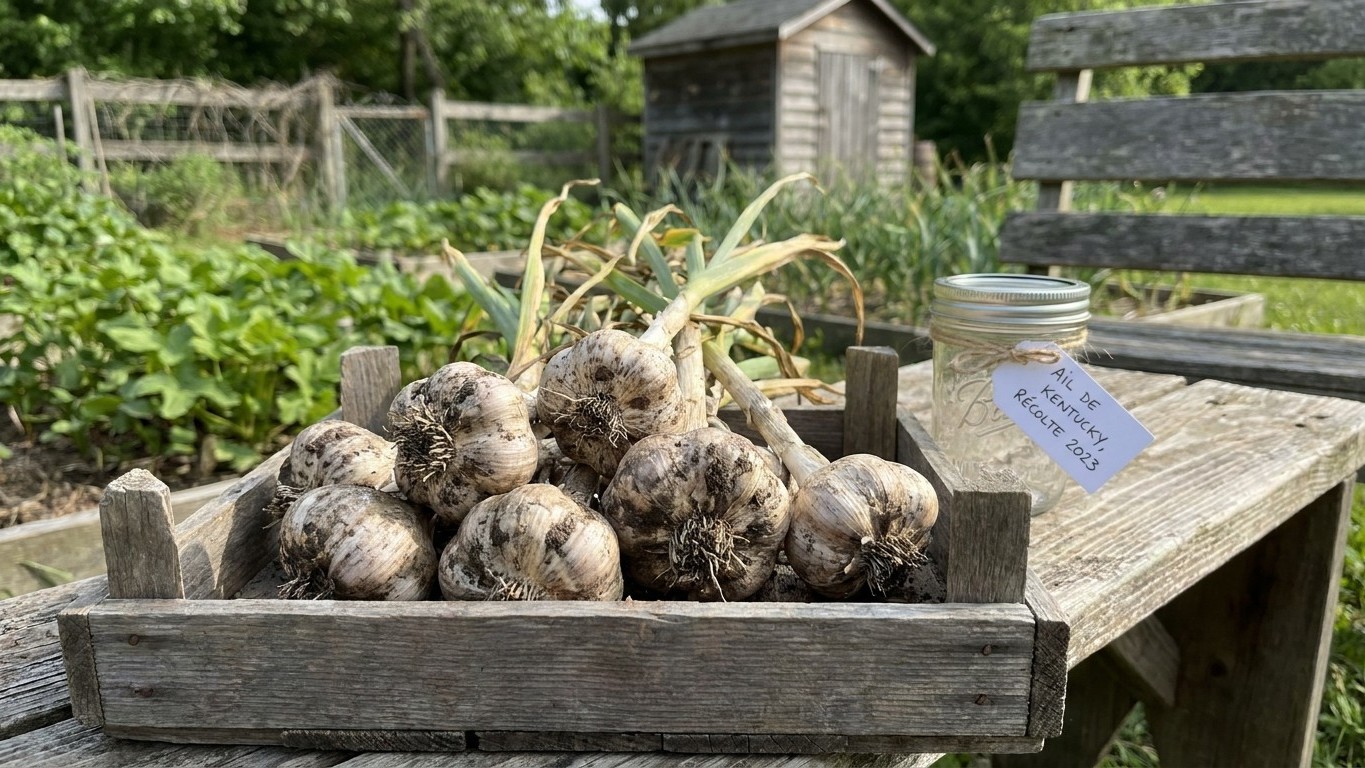

Mid-October to late October is when garlic goes into the ground near Louisville, and that’s true whether you’re planting softneck or hardneck. The date isn’t picked at random — it’s set two to three weeks ahead of the first fall freeze, which typically lands between November 2 and November 12. That gap gives cloves enough time to root before the ground locks up, without pushing green growth into weather that would damage it. Every variety follows this same window.
The short answer for Kentucky

For gardeners near Louisville, mid-October to late October is the planting window that matches the region’s climate data most closely. NOAA’s National Centers for Environmental Information (NCEI) put the first fall freeze at Louisville’s reference station between November 2 and November 12 in its 1991-2020 Climate Normals. Garlic needs several weeks of root growth before the ground freezes hard, so a set-out date roughly two to three weeks ahead of that frost window gives cloves time to establish roots without pushing tender green growth a hard freeze would damage.
That November 2-12 figure is a midpoint, not a safe date to plant against. In roughly half the years in the record, the first 32°F freeze at this station arrives after November 12. In the other half, it arrives before November 2. Treat the range as the center of a spread of outcomes, not a guarantee.
Same window, every cultivar
Every cultivar in Kentucky’s garlic catalog, softneck or hardneck, is set out in the same mid-October to late-October window. That’s not a coincidence tied to any one variety’s days-to-maturity figure. Garlic is planted by the calendar in fall and lifted by the calendar the following summer, so the fall set-out date depends on frost timing rather than a packet’s day-count.
| Variety | Type | Set-out window |
|---|---|---|
| Inchelium Red | Softneck | Mid to late October |
| Chesnok Red | Hardneck | Mid to late October |
| German White | Hardneck | Mid to late October |
| Lorz Italian | Softneck | Mid to late October |
Working it out for your own garden
If you haven’t picked a bed or worked the soil yet, Growing Garlic in Kentucky covers site selection and soil prep before you get to timing. The Louisville figure above is not shared by the whole state, and adapting it means redoing the same arithmetic NOAA’s data gives you, starting from a frost window closer to your own garden.
Start with your county’s frost window
Louisville’s Nov 2-12 window comes from an urban, airport-adjacent weather station, and the National Weather Service office in Louisville explicitly warns that this site runs later into fall than the surrounding rural county. If you garden outside the city, your actual first frost is likely to land earlier than November 2, and a frost figure from the closest full-service station to your own address will give you a tighter, more accurate window than borrowing Louisville’s number directly.
Once you know your local frost window, count back two to three weeks to land on a set-out range. If your area’s typical first frost sits earlier than Louisville’s Nov 2-12, planting in late September or early October, rather than waiting for mid-to-late October, keeps you inside the same two-to-three-week buffer these cultivars are built around.
Elevation moves the date more than anything else
Elevation is the biggest swing factor across the state. Ground that sits several hundred feet above a nearby valley cools faster on clear autumn nights, because cold air is denser than warm air and drains downhill into low ground overnight. A ridge-top garden can see its first freeze arrive noticeably earlier than a garden in a river bottom a few miles away, even inside the same county. Kentucky has no ocean coastline and no Great Lake shoreline to moderate temperatures the way those features do elsewhere, so local topography, not proximity to open water, does most of the work in shifting frost dates around the state.
- Your county’s average first frost date from NOAA or the closest full-service weather station
- Whether your bed sits on a ridge, a slope, or a low spot that collects cold air overnight
- How exposed the planting site is to wind, which speeds up how fast the ground freezes
What changes across Kentucky
Kentucky runs about 400 miles east to west and spans real elevation range, from lowland near the Mississippi River in the far west to well over 4,000 feet in the eastern mountains. That spread means the Nov 2-12 window measured at Louisville does not describe the whole state, which is exactly why NOAA maintains a full network of stations rather than one reading for every county.
Eastern Kentucky highlands
The Appalachian Plateau counties in eastern Kentucky sit at higher elevation than the Louisville reference station and, following the general pattern that higher ground cools faster, typically see their first fall freeze arrive earlier in the season. Gardeners in that part of the state should plan on tightening the planting window toward its earlier edge, or earlier still, and confirm the local pattern with their own county’s extension office rather than relying on the Louisville figure.
Western Kentucky and the Jackson Purchase
The Jackson Purchase region near the Mississippi River sits at lower elevation and often lags behind the rest of the state into fall, which tends to push the first freeze later than at Louisville. A planting date matched to Louisville’s window may go into the ground earlier than a Purchase-region garden strictly needs.
The Ohio River valley
Low-lying bottomland along the Ohio River collects cold air on still nights and can frost before higher ground nearby, even while the pavement and buildings of Louisville itself hold heat that delays the reading at the reference station behind the NOAA normals above. That’s the same effect the National Weather Service flags when it warns the urban site runs later in fall than the surrounding county. A garden a few miles outside the city, on open ground, should expect its own first frost ahead of the Nov 2-12 range.
The mistakes this climate punishes
Planting into soil that’s still warm
Cloves planted while the soil still holds summer heat sit inside the range where soilborne pathogens are most able to establish. UC IPM’s Pest Management Guidelines for Onion and Garlic (UC ANR Publication 3453) list Fusarium basal rot, caused by Fusarium oxysporum f. sp. cepae, as active across a 59-90°F range, and white rot, caused by Sclerotium cepivorum, across a 50-75°F range. September’s mean air temperature in Kentucky typically falls inside both ranges. That’s an air reading, not a soil reading, and soil lags air by weeks and swings less than air does day to day, so it isn’t a direct measure of what’s happening around a buried clove. Even so, it’s one more reason to hold off until the mid-to-late October window these cultivars are built around, once the soil has had more time to cool. None of this means either disease is absent outside these months. Infected seed stock carries both pathogens into a garden at any planting date, which is why starting with clean, disease-free seed garlic matters more than timing alone.
Planting too late, or too shallow
The opposite mistake shows up in years when a gardener waits for the calendar to feel safe and misses the window entirely. Because Louisville’s Nov 2-12 figure is a midpoint, roughly half of all years bring a freeze before November 2. A clove planted in the first days of November, expecting three more weeks of mild weather, can get caught by a hard freeze before it has rooted in. Shallow planting compounds the problem: a clove sitting just under the surface has less soil mass buffering it from a sudden cold snap, and freeze-thaw cycling through winter can heave an under-planted clove right back out of the ground. A thick straw mulch laid down at planting time, not added later as an afterthought, protects a late-planted bed more than almost anything else you can do.
Checking this against your county
Louisville’s frost data is the most complete public figure available for a page like this one, but it describes a single station in one part of the state. The University of Kentucky’s Cooperative Extension Service, reachable through its county office directory at extension.ca.uky.edu, keeps county-level guidance that accounts for local elevation and microclimate in a way a statewide article can’t. Before you commit to a date, especially if you garden in the eastern highlands or the Jackson Purchase, call your county office and ask for their fall garlic recommendation. Once your date is set, Garlic Varieties That Suit Kentucky Winters breaks down the softneck and hardneck options by how they handle the local climate.
Common questions
Can I Plant Garlic in Kentucky in November?
You can, but you’re pushing past the window these cultivars are built around and gambling on a late frost. NOAA’s 1991-2020 normals put Louisville’s first freeze between November 2 and November 12, and that’s a midpoint, not the earliest a freeze can arrive. Cloves planted in November may not root deeply enough before winter, which tends to show up as smaller bulbs the following summer.
What if I already missed the October planting window?
Get cloves in the ground as soon as you can rather than waiting for spring. Garlic needs several weeks of root growth before the ground freezes hard, and a late-planted bed with a heavy straw mulch generally still produces a harvest, just a smaller one than a bed planted on time.
Does it matter if I plant hardneck or softneck garlic in Kentucky?
Both types share the same October planting window, so timing isn’t the deciding factor between them. The real difference is in the bulb: hardnecks send up a firm central stalk and tend to have larger, easier-to-peel cloves, while softnecks store longer and skip that stalk entirely. Choose based on storage life and clove size rather than worrying that one type needs a different planting date.
How deep should garlic cloves go before winter?
Set cloves pointy end up, deep enough that a couple of inches of soil sit above the tip, then add a straw mulch on top of that. In a fall that turns cold quickly, that extra depth and the mulch layer are what keep a clove from heaving out of the ground during winter freeze-thaw cycles.
Some gardeners also time this by the Moon: when to plant garlic by the moon, as almanac tradition rather than fact.