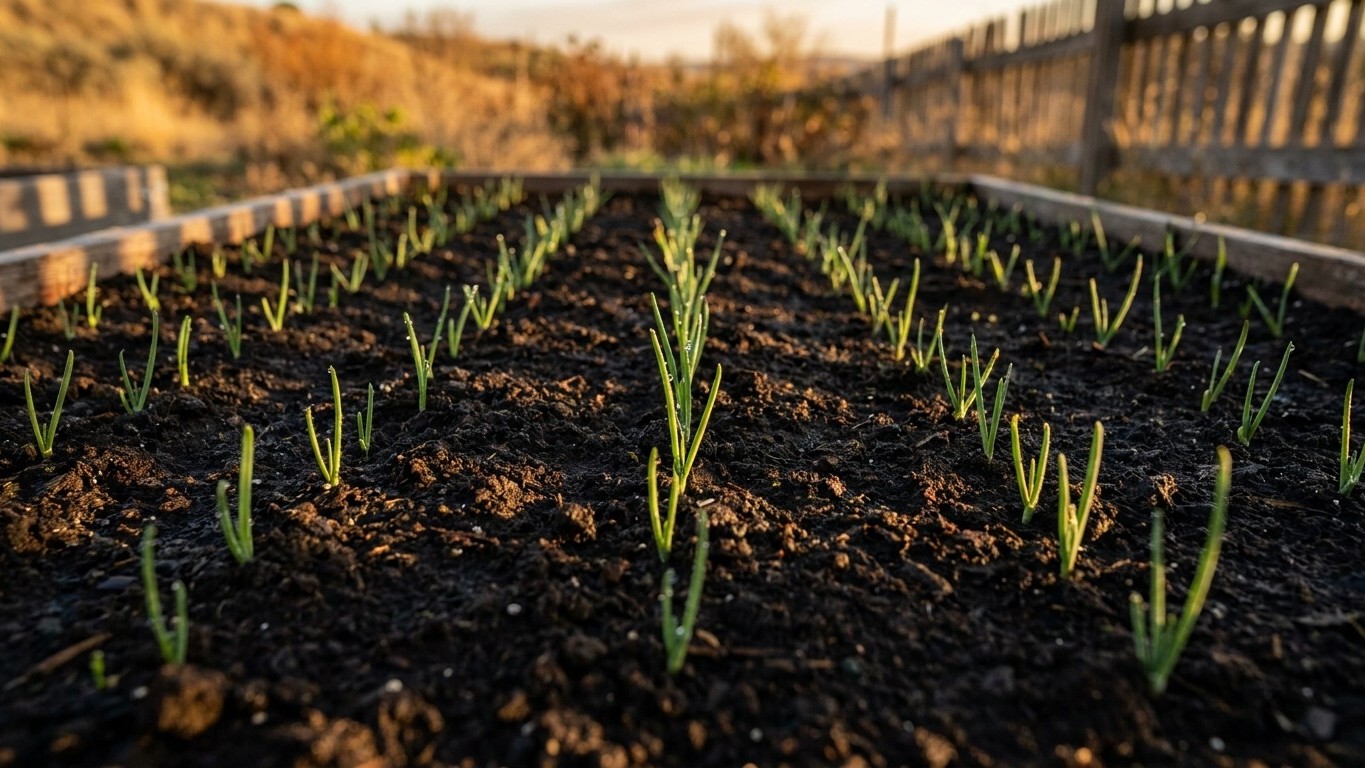

Garlic in Kentucky gets eaten on a schedule. Voles and wireworms work the bed from planting through winter. Thrips and mites take over once spring warms. Bulb nematodes arrive hidden in the seed cloves and show up at harvest. Knowing which pest is active in which month tells you what to protect, and when.
The short answer for Kentucky
The calendar starts with the first fall freeze, which falls between November 2 and November 12 according to the NOAA NCEI 1991-2020 Climate Normals for Louisville (the 30 to 70 percent probability band for a 32°F freeze). Garlic is planted in autumn around that date and lifted the following summer, so every pest on this list is measured from it.
That date is a midpoint, not a safe date. In one year out of two, the first freeze lands later than the range suggests, and in the other half it lands earlier. A mild stretch in late November leaves the soil warm and the bed open to anything that feeds on fresh cloves. An early hard freeze shortens the time garlic has to root before the ground locks up.
The Louisville station also comes with a caution. The National Weather Service office there warns that this urban station runs later in spring and earlier in fall than the rural parts of Jefferson County around it. A garden out past the suburbs should expect a tighter window, meaning an earlier freeze than the figure above.
Pests follow the same logic as the frost. After planting, the main threats are underground and mammalian: wireworms and other soil insects chewing at cloves, and voles tunneling under mulch where the cover keeps them warm. As soil temperatures drop, insect activity fades and the rodents become the bigger worry. In spring, thrips and aphids move onto the new leaves. By early summer the problem is inside the bulb itself: mites, or stem and bulb nematodes, which usually come in on the cloves you planted months earlier. This page does not publish dates for when each pest peaks in a given county, because no sourced figure for that is on hand. The county extension office can fill that gap (details are at the bottom).
Working it out for your own garden
A state is not one climate, so the Louisville number is a starting point rather than an answer. The arithmetic is short enough to redo for any Kentucky address.
Step one: find your frost date and move it
Start with November 2 to November 12. Then adjust for where you actually garden. Elevation, a large lake and the surrounding terrain can each shift these dates by roughly two weeks either way. A garden on a ridge in the east will usually see freezing weather before one in a sheltered river valley. A garden right next to a big body of water may get a slightly later freeze. Treat the Louisville range as the middle of the distribution and your own site as the thing that pushes you toward one end.
For the planting date itself, the walk-through in When to Plant Garlic in Kentucky: Counting Back From the First Frost covers the counting-back method in detail. What matters for pests is how that date lines up with the next stages.
Step two: lay the pest calendar over it
Plant too early, in warm soil, and cloves sit in the ground at full insect activity. Wireworms and other soil feeders are still working, and shoots may push up before winter, giving rodents and deer something to find. Plant on time, and the cloves root as the soil cools, so insect feeding has largely stopped by the time the ground freezes.
Winter belongs to voles. A thick mulch layer protects garlic from heaving, but it is also shelter for rodents. Many growers apply mulch after the ground starts to cool rather than the day cloves go in, and some lay hardware cloth over the bed, though the right approach depends on your site.
Spring starts when shoots grow and leaves expand, and the first soft-bodied insects appear. Thrips scrape the leaves and leave silvery streaks. Heavy feeding can cost bulb size, so look at the leaves when the weather warms. The following summer, once the lower leaves begin browning, you lift the crop and see whatever the season left behind: mite damage, soft cloves or the swollen, distorted base that points to nematodes.
Step three is the one most gardeners skip. Count backward from harvest to your seed source. Garlic grown from your own saved bulbs carries any nematodes or mites forward into the next season. Buying clean seed stock matters more than any spray.
What changes across Kentucky
Kentucky stretches from the Mississippi River bluffs in the west to the Appalachian ridges in the east, and the freeze arrives at very different times along that line. The Louisville range sits in the middle.
The Cumberland Plateau and the mountains of southeastern Kentucky, around Harlan and Letcher counties, are higher and usually colder. Garden sites there freeze earlier in fall, so planting moves earlier and the rooting window shrinks. That has a pest consequence: a late-planted clove that never roots well is easier prey for soil feeders and heaves out of the ground more readily, which also exposes it to rodents.
The Jackson Purchase and the Pennyrile in the west and southwest are lower and warmer, and the first freeze comes later. Soil stays warm longer there, which means soil insects stay active longer and planting too early carries more risk. The big reservoirs in that corner, Kentucky Lake and Lake Barkley, can soften the edge of cold nights along their shores. How much they shift a given garden depends on distance and slope, so treat it as a possibility rather than a rule.
The Bluegrass around Lexington and the Ohio River counties of northern Kentucky fall closer to the Louisville numbers, though the urban-versus-rural split applies there as well. A garden in a city neighborhood gets the benefit of paved-over warmth, while a farm field a few miles out will freeze first.
Variety choice also depends on location. Garlic Varieties That Suit Kentucky Winters covers which types handle the cold here. Hardneck types do well in the colder eastern highlands, where winter chill is dependable. For a broader look at the crop in the state, see Growing Garlic in Kentucky.
The mistakes this climate punishes
Kentucky winters are cold enough to demand hardneck-friendly timing but unpredictable enough to surprise you. Compare that with the Gulf coast, where the problem is mild winters; in When to Plant Garlic in Louisiana: Counting Back From the First Frost and Garlic Varieties That Suit Louisiana Winters, the concern is whether garlic gets enough cold at all. In Kentucky the cold is a given. The errors that cost a crop here are different.
Planting too early. A warm October tempts people to get cloves in the ground. But if the shoots come up before winter, they are exposed to hard freezes, to deer browsing and to soil pests that are still active. Waiting for the soil to cool, in step with the frost range, is the better bet.
Planting too late to root. This is the mirror image. If the ground freezes before the cloves have grown roots, they are more likely to heave out during freeze-thaw cycles, and a heaved clove sitting on the surface is an easy meal for rodents. Because the first freeze is a midpoint and comes early in about half of all years, building in a cushion matters more than hitting a specific day.
Planting too shallow. Shallow cloves are the first to heave and the easiest for voles and birds to dig up. Setting them deep enough that soil and mulch protect them through repeated freezing and thawing is one of the cheapest forms of pest control.
Mulching the day you plant, and never checking. A thick straw blanket laid on warm soil gives voles a ready-made home. Check the bed in midwinter. Runways and chewed cloves show up early if you look.
Replanting your own seed without inspecting it. Bulbs with soft spots, discolored basal plates or swollen, distorted tissue should not go back in the ground. Nematodes and mites persist in the soil and in stored cloves, so a bad batch can become a bad bed for years.
Checking this against your county
The Louisville normals are one station and one set of numbers. For county-level frost dates, local pest reports and advice on what is active near you, contact your University of Kentucky Cooperative Extension county office. Agents can identify a pest from a sample, tell you what is circulating in your area and point you toward clean seed sources.
Common questions
When do garlic pests become active in Kentucky?
Soil insects are active until the ground cools after planting, which is anchored to a first fall freeze between November 2 and November 12 (NOAA NCEI 1991-2020 Climate Normals, Louisville). Rodents are the main winter concern. Thrips and aphids appear on the new leaves in spring. Mite and nematode damage becomes visible at harvest the following summer.
Is the November 2 to November 12 range a guarantee?
No. It is a midpoint. In one year out of two, the first freeze falls later than the range, and in the other half it falls earlier. Rural gardens around Louisville should expect an earlier freeze than the urban station records.
Can I use garlic from the grocery store as seed?
It is a gamble. Store bulbs may not suit Kentucky winters, and you cannot know whether they carry nematodes or mites. Buying certified seed garlic from a reputable supplier lowers that risk.
Where can I get exact pest timing for my county?
The University of Kentucky Cooperative Extension county office is the right source. This page does not publish county-specific peak dates for individual pests, so ask the agent for local figures.